The first thing most lists bury: the HARO you remember is gone. Cision shut it down on December 9, 2024, and in April 2025 Featured.com revived only the brand — as a free, ad-supported email newsletter of journalist requests. So in 2026, "HARO" is a free newsletter run by Featured.
But even at its peak, HARO's open queue was drowning in spam — mostly SEO link-grabs and AI-generated filler, plus a big-outlet bias from its domain-authority gates. So the real choice isn't *which queue is less spammy* — it's waiting in a public queue at all vs. proactively pitching the journalists you choose. Below: every real free and paid source-request service, plus the proactive tool ranked #1.
Free: let an agent watch journalist requests alongside HARO.
Connect one authenticated MCP feed to Claude, ChatGPT, or another compatible agent. It checks six included request channels every hour, uses zero Medialyst credits, and keeps every response behind human review.
A disclosure up front: we make Medialyst and ranked it #1, but it is not a HARO response marketplace. Its read-only MCP feed lets agents screen six approved request sources, and its proactive research workflow finds and verifies journalists; it does not submit a response into HARO. We cover the real free and paid response networks because a list that pretends one tool wins every job is useless. We evaluated cost, usable free access, request or contact quality, spam, reactive versus proactive workflows, and geographic and topical fit. Facts and prices are drawn from the cited public sources as of June 2026.
Tool
Best for
Standout
Starting price
Free option
1Medialyst
PR teams, founders, and experts who want one agent workflow for read-only request screening and proactive journalist research.
AI reads each journalist's recent coverage and scores fit for your story
From $97/mo (annual) · $149/mo monthly
Free first list · no credit card
2Featured
Experts chasing citations in major outlets (Forbes, Inc., Fortune) who want a curated, low-spam version of the HARO model and will pay for volume.
Operates the revived HARO; curated, low-spam queries from elite outlets
Free → ~$19–$99/mo
Free: 3 answers/mo + HARO newsletter
3Source of Sources (SOS)
Anyone who wants the classic free HARO experience — a simple email digest of journalist queries — from the person who invented the format.
Built by Peter Shankman, who founded HARO in 2008
Free
Free, no card
4Qwoted
PR pros and experts who want the best outlets and the least spam, and can justify a paid plan — strongest for finance, business, and tech.
Highest share of DR 80+ requests; aggressive anti-spam vetting
$99/mo (annual)
Free tier: 2 pitches/mo, 2-hr delay
5Connectively
Mostly here so you don't waste time: the original Connectively is dead. Featured revived the name in 2026 as a separate paid platform — verify before paying.
Discontinued Dec 2024 — do not sign up for the old one
Discontinued; revived as paid
n/a (original discontinued)
6MentionMatch
B2B experts in SaaS, marketing, tech, finance, and manufacturing who want high-quality citations with far less spam than open HARO-style feeds.
B2B-only and ruthlessly anti-spam — the cleanest free feed
Free
Free, no card
7SourceBottle
Experts and small businesses outside the US — especially Australia, New Zealand, and the UK — who want free journalist callouts in their region.
Best free option for AU/NZ/UK coverage
Free (premium ~$65/mo)
Free tier (10 keyword alerts)
8JustReachOut
Solo founders and small teams who want one paid tool that combines a curated query feed, a journalist database, and AI-drafted outreach from their own inbox.
Aggregates 20+ query sources + database + pitching in one app
$147/mo
7-day trial (card required)
Reactive vs. proactive is still the key split. Medialyst spans the boundary with a read-only, agent-readable request feed plus proactive journalist research, but response marketplaces remain the place where you actually submit an answer. Free options trade volume and control; paid networks cut spam or add workflow features. Pricing reflects public pages and reviews as of June 2026.
The ranked list
The 8 best HARO alternatives.
1
MedialystOur pick5.0/5 on G2
Proactive journalist discovery — the opposite of waiting in a query queue
Best for: PR teams, founders, and experts who want one agent workflow for read-only request screening and proactive journalist research.
Pricing: From $97/mo (annual) · $149/mo monthly
Free option: Free first list · no credit card
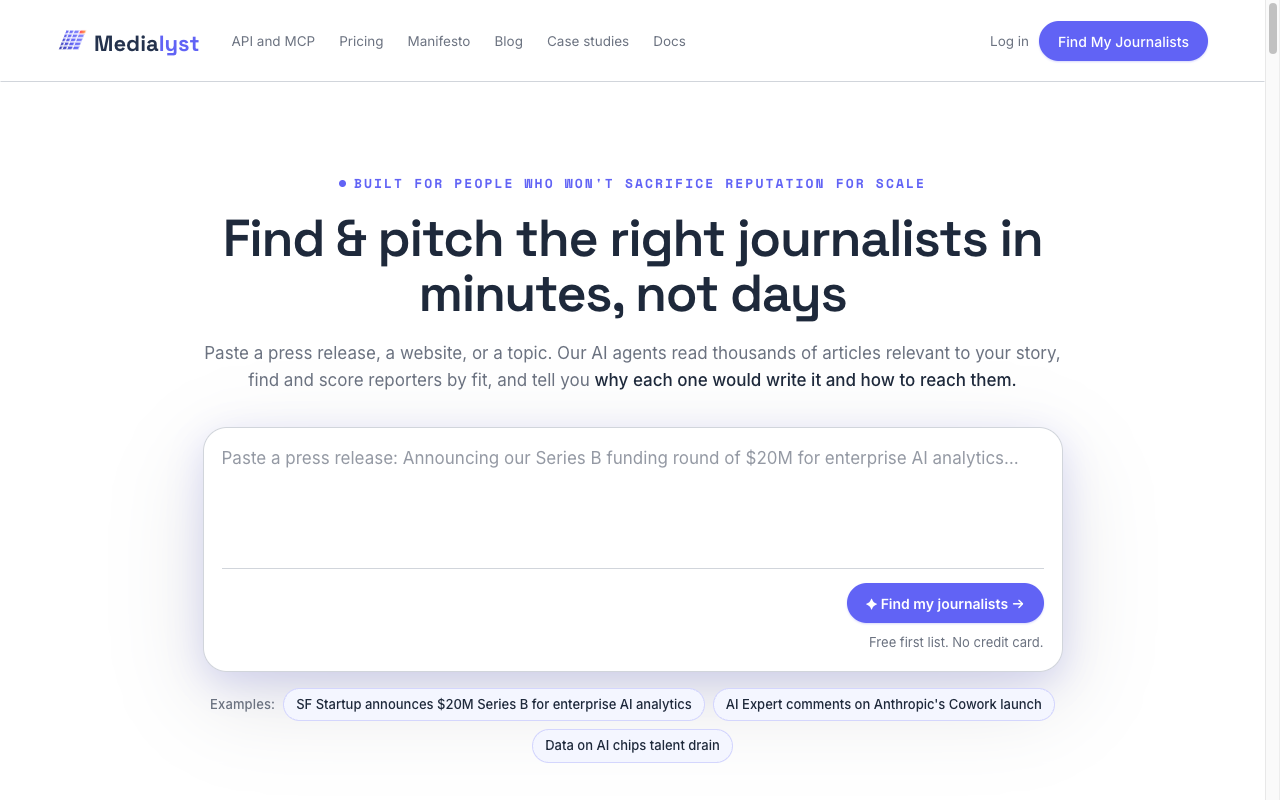
Medialyst covers two complementary jobs. Its authenticated MCP feed lets an agent screen normalized requests from Connectively, HARO, Twitter/X, LinkedIn, MentionMatch, and Substack for free across all six platforms. It is read-only: it does not submit a response into HARO or promise a complete archive. For proactive outreach, describe your announcement or story and Medialyst reads recent coverage to find journalists who cover it, scores fit, and verifies contact details before you pitch. The hosted MCP works in Claude, ChatGPT, and other compatible agents; every request still needs human review.
Best for: Experts chasing citations in major outlets (Forbes, Inc., Fortune) who want a curated, low-spam version of the HARO model and will pay for volume.
Pricing: Free → ~$19–$99/mo
Free option: Free: 3 answers/mo + HARO newsletter
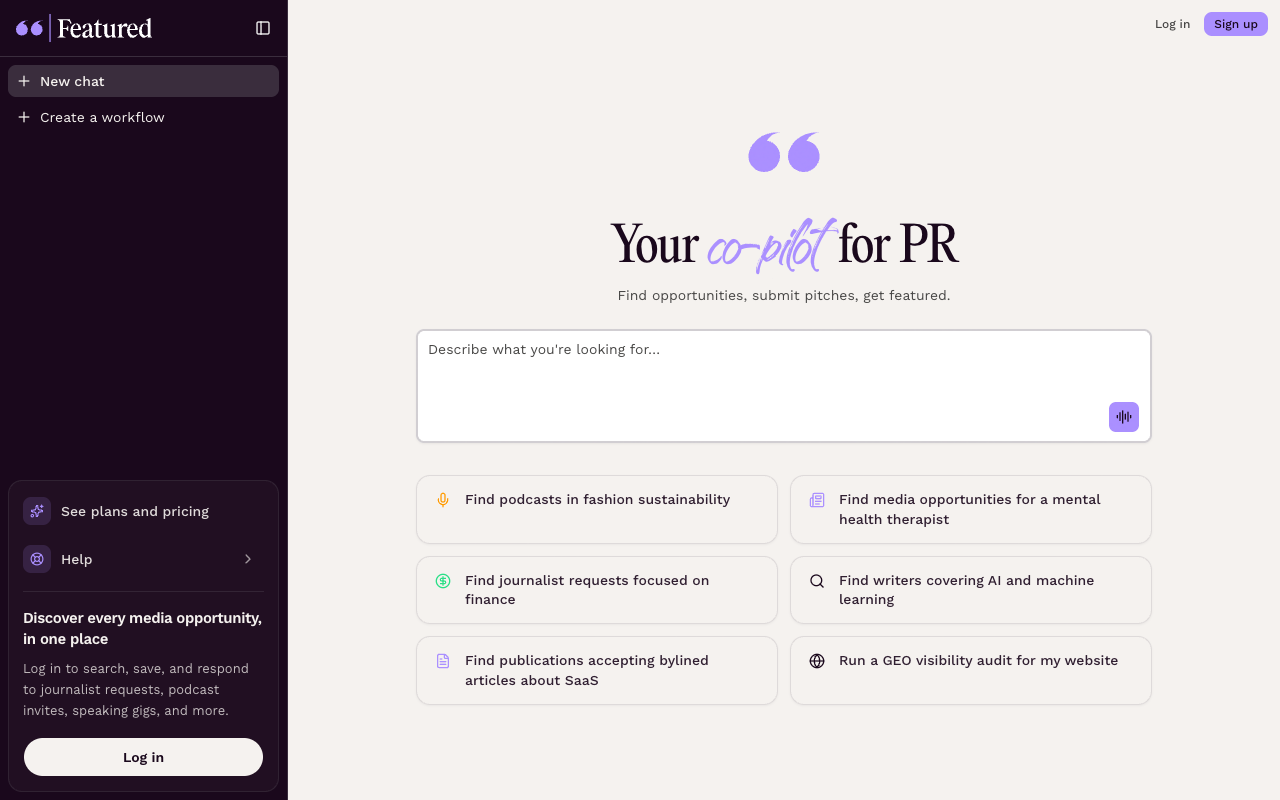
Featured.com is the most important name here because it now owns and operates the revived HARO. As a product, Featured is a curated Q&A marketplace: journalists and publishers post questions, you submit answers, and the best get used — with a much cleaner, more vetted feed than HARO ever had, and access to Forbes, Inc., Fortune, and Fast Company. If you want the HARO model done better, this is the most direct upgrade. The honest catches are real: the free tier is genuinely limited (about 3 answers a month), it's effectively a pay-to-play SEO/citation tool that filters out lower-DA outlets, you never get the journalist's direct contact, and paid tiers (roughly $19–$99/mo) are where it becomes usable. It's reactive by design — you answer questions, you don't reach out.
Pros
Runs the revived HARO and offers a far less spammy, curated feed
Real access to Fortune-tier outlets (Forbes, Inc., Fast Company)
Genuine free tier to start, plus published, affordable paid plans
Cons
Free tier capped at ~3 answers/mo — usability needs a paid plan
Pay-to-play citation/SEO tool; DA filters exclude smaller outlets
Reactive only, and you never get a journalist's direct contact
HARO's original founder rebuilding the original HARO
Best for: Anyone who wants the classic free HARO experience — a simple email digest of journalist queries — from the person who invented the format.
Pricing: Free
Free option: Free, no card
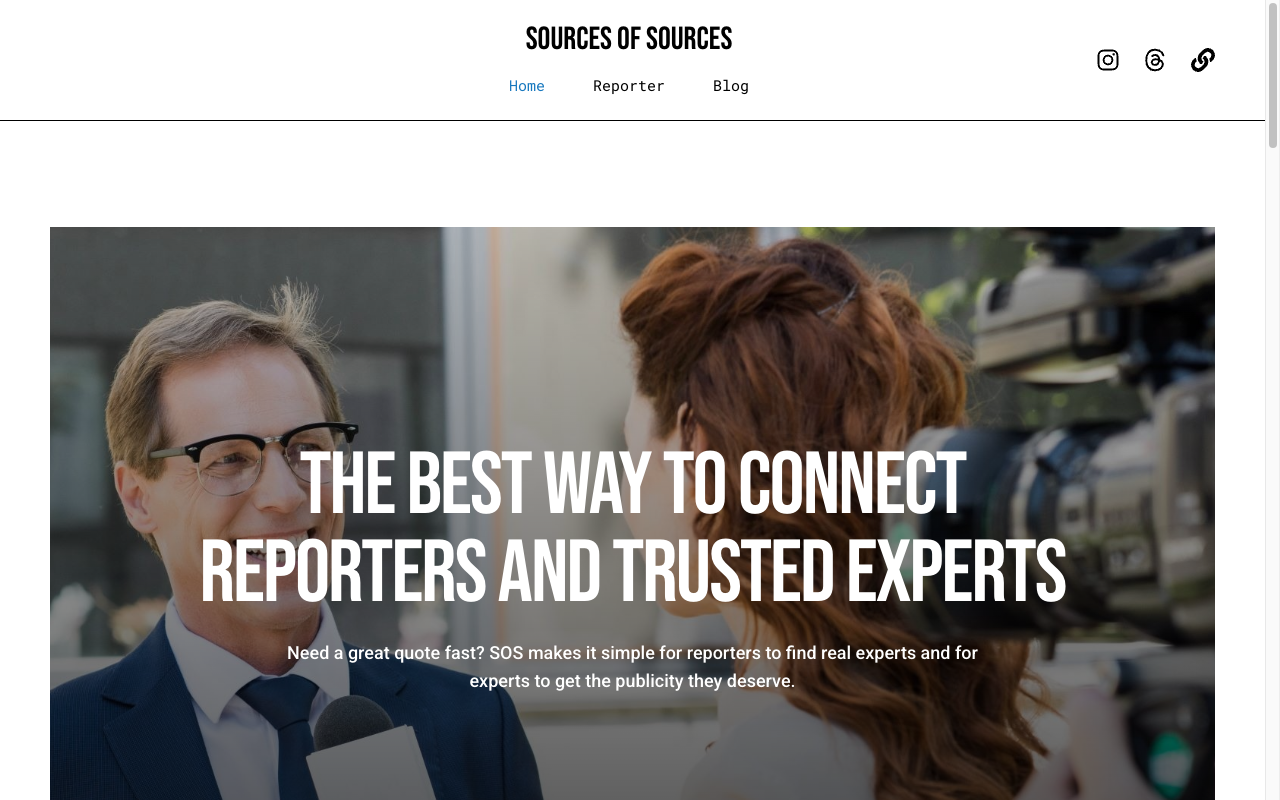
When Cision killed HARO, Peter Shankman — the man who created HARO in 2008 — launched Source of Sources (sourceofsources.com) as a free, email-based revival of exactly what HARO used to be: keyword-filtered journalist queries delivered to your inbox a few times a day, no platform to learn, no paywall. For HARO loyalists this is the most spiritually faithful replacement, and Shankman's name still opens doors with journalists. The honest catch is that it's a newer, smaller operation than the HARO at its peak: query volume is lower, there's no search interface, no DA/metrics on opportunities, and it's still rebuilding its journalist base. It's a genuinely free top-of-funnel, not a scaled outreach engine.
Pros
Completely free, with the simplest possible email-digest model
Built by HARO's original founder — the most faithful HARO clone
Legitimate, opted-in journalist queries with low overhead
Cons
Lower query volume than HARO at its peak — still rebuilding
No search interface, no DA/quality metrics on opportunities
Reactive only: you wait for a relevant query to appear
The highest-quality, most-vetted source-request marketplace
Best for: PR pros and experts who want the best outlets and the least spam, and can justify a paid plan — strongest for finance, business, and tech.
Pricing: $99/mo (annual)
Free option: Free tier: 2 pitches/mo, 2-hr delay
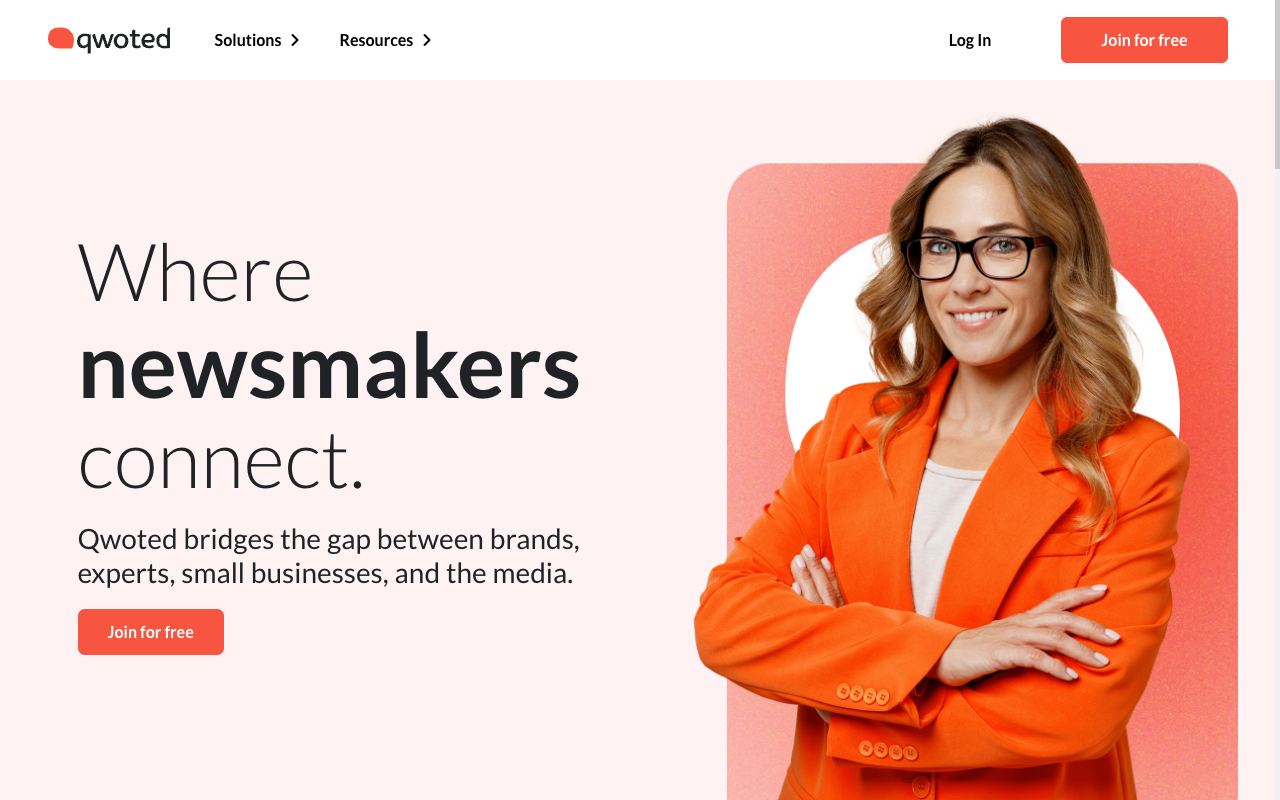
Qwoted is the quality leader among source-request marketplaces. It processes roughly 200 journalist queries a day, holds the highest share of high-authority (DR 80+) publication requests of any platform in independent studies, verifies contributors, and aggressively bans AI-spam and SEO-grab accounts — so the noise that broke HARO is far lower here. For finance, business, and tech experts especially, the inbound demand is genuinely warm. The honest catches: the free tier is nearly unusable (2 pitches a month with a 2-hour delay behind paying users), Pro is $99/mo billed annually or $149/mo monthly, and there's now a sharp jump from Pro to custom pricing. It's also strictly reactive and has had reports of abrupt account suspensions, including over AI-content accusations.
Pros
Best outlet quality (highest DR 80+ share) of the source-request tools
Strong anti-spam vetting — far less noise than open HARO feeds
Adds podcast, speaking, and awards requests, plus real-world networking
Cons
Free tier is barely usable (2 pitches/mo, 2-hour delay)
Pricey: $99–$149/mo Pro, then a big jump to custom plans
Reactive only; reports of abrupt account suspensions
Best for: Mostly here so you don't waste time: the original Connectively is dead. Featured revived the name in 2026 as a separate paid platform — verify before paying.
Pricing: Discontinued; revived as paid
Free option: n/a (original discontinued)
Important so you don't waste a step: "Connectively" was the name Cision gave HARO when it rebranded in March 2024, and that platform was shut down completely on December 9, 2024. If you find an old "sign up for Connectively" link from that era, it's dead — don't bother. In a twist, Featured.com revived the Connectively brand on June 2, 2026 as a separate paid platform (a journalist-request feed with an AI co-pilot), distinct from the free HARO newsletter it also runs. Pricing for this relaunch is still unsettled — sources cite figures from $49 to $149/mo and the page has redirected during the rollout — so we can't recommend it on terms that aren't verifiable yet. We list it only to clear up the confusion: the original is gone, the new one is unproven, and HARO (free) and Featured (paid) are the live products from that lineage.
Pros
Brand has real lineage (it was HARO under Cision)
The 2026 Featured relaunch adds an AI co-pilot and a live request feed
Cons
The original Cision Connectively was discontinued Dec 9, 2024 — don't sign up for it
The 2026 revival's pricing/tiers are unsettled and unverified
Still a reactive query feed underneath the AI co-pilot
Best for: B2B experts in SaaS, marketing, tech, finance, and manufacturing who want high-quality citations with far less spam than open HARO-style feeds.
Pricing: Free
Free option: Free, no card
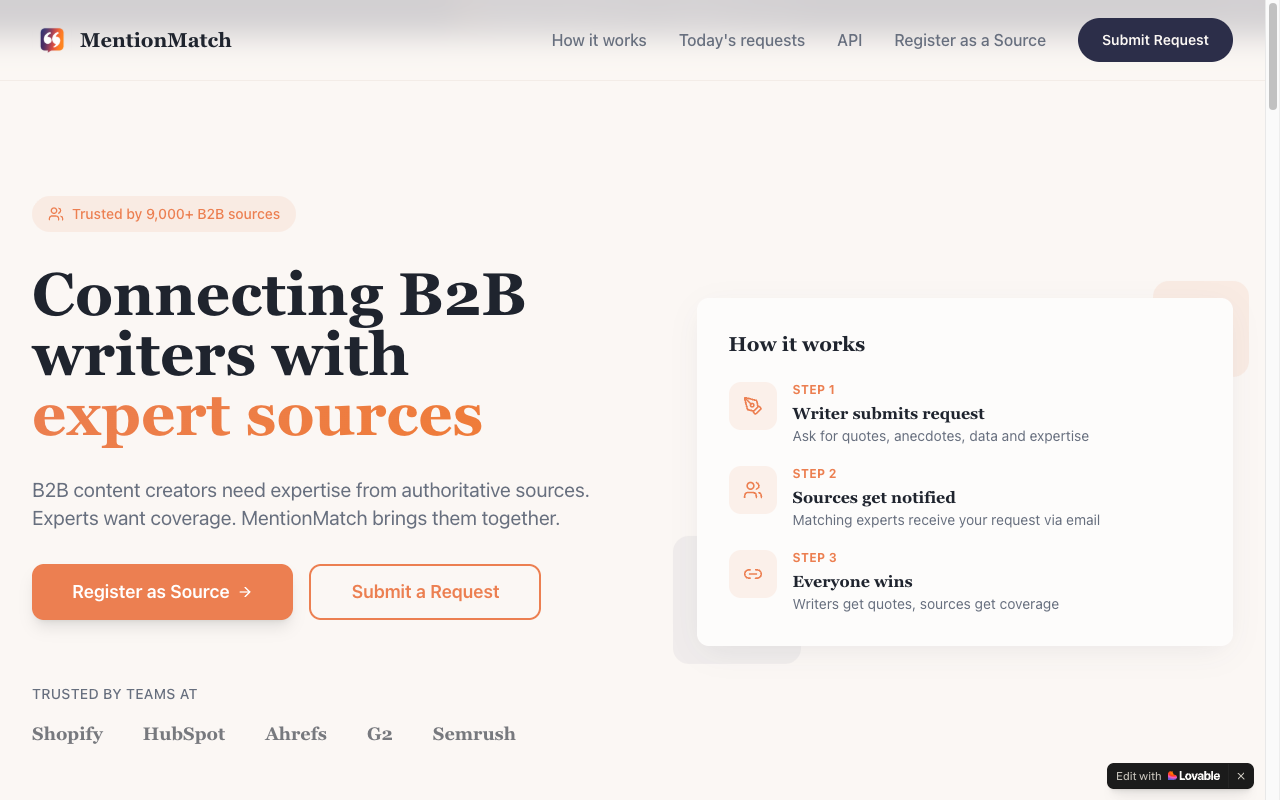
MentionMatch (formerly Help a B2B Writer, acquired by the Superpath content-marketing community in 2023) is a free, niche source-request service built exclusively for B2B topics — AI, SaaS, marketing, sales, fintech, manufacturing. Because it's narrow and manually moderated, the noise is dramatically lower than open feeds: queries come from real B2B writers at outlets like HubSpot and Semrush, and the platform is aggressive about killing spam and AI-generated pitches. If your expertise is B2B, this is arguably a better signal-to-noise ratio than HARO itself. The trade-off is exactly that narrowness: if you're a consumer brand, a local business, or anything outside B2B, there simply won't be queries for you, and total volume is lower than the big feeds.
Pros
Free, with a much cleaner feed than open HARO-style services
Aggressive spam and AI-pitch filtering keeps query quality high
Genuinely effective for B2B/SaaS citations (HubSpot, Semrush, etc.)
Cons
B2B-only — useless for consumer, local, or lifestyle topics
Lower overall query volume than HARO or Featured
Reactive only, and strict AI-detection can flag false positives
Best for: Experts and small businesses outside the US — especially Australia, New Zealand, and the UK — who want free journalist callouts in their region.
Pricing: Free (premium ~$65/mo)
Free option: Free tier (10 keyword alerts)
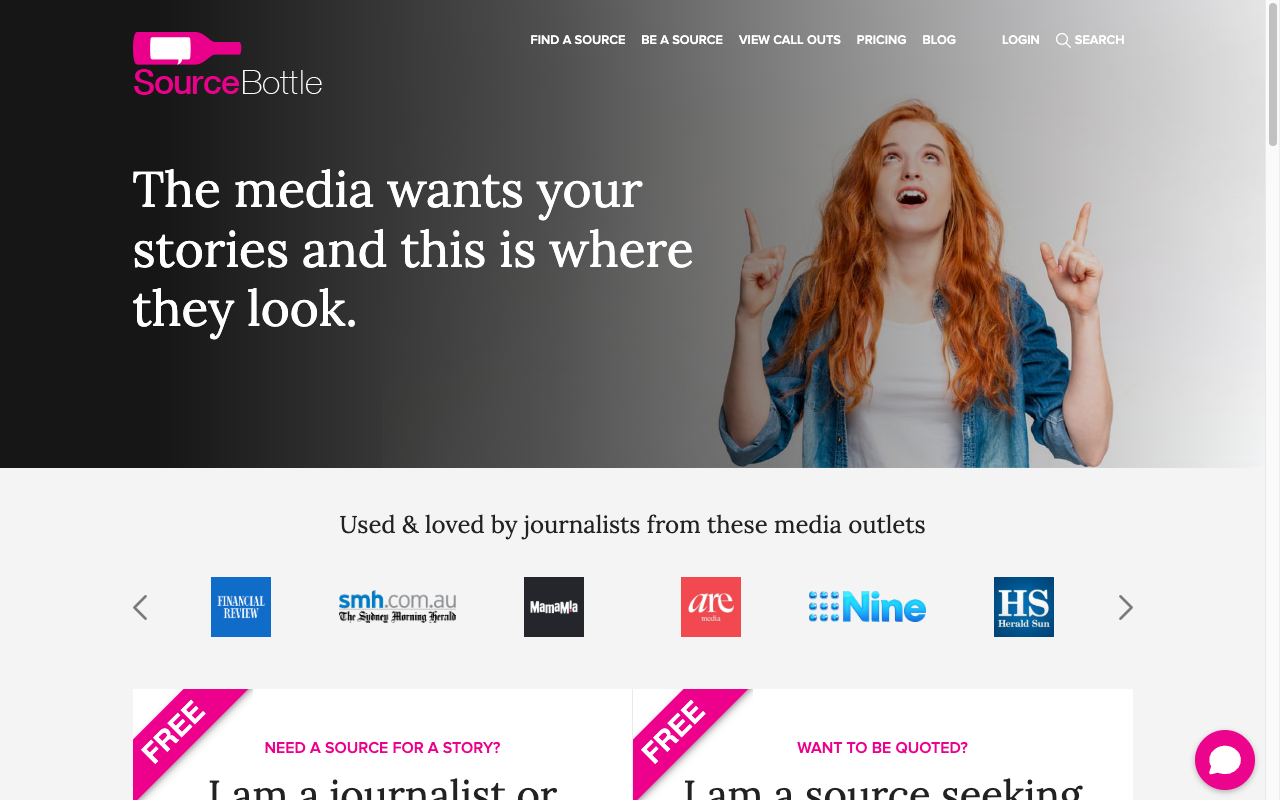
SourceBottle is one of the oldest HARO-style services still running — a free daily email matching experts to journalist "callouts," with up to 10 keyword subscriptions on the free plan and optional paid profile-visibility upgrades (around $65/mo). Its real differentiator is geography: it has the strongest reach of any free option in Australia, New Zealand, and the UK, which is exactly where US-centric tools like Featured and JustReachOut are thin. The honest catch is that US volume is smaller and the average outlet authority skews lower than the elite-publication feeds — it's best treated as a free, regionally-strong supplement rather than your only channel.
Pros
Free, with keyword-filtered daily callouts and a long track record
Strongest free coverage for Australia, New Zealand, and the UK
Adds PR-adjacent opportunities like product giveaways and case studies
Cons
Smaller US volume; outlets skew lower-authority than elite feeds
Meaningful visibility often needs a paid upgrade (~$65/mo)
Source requests plus a database and AI pitching, for SMBs
Best for: Solo founders and small teams who want one paid tool that combines a curated query feed, a journalist database, and AI-drafted outreach from their own inbox.
Pricing: $147/mo
Free option: 7-day trial (card required)
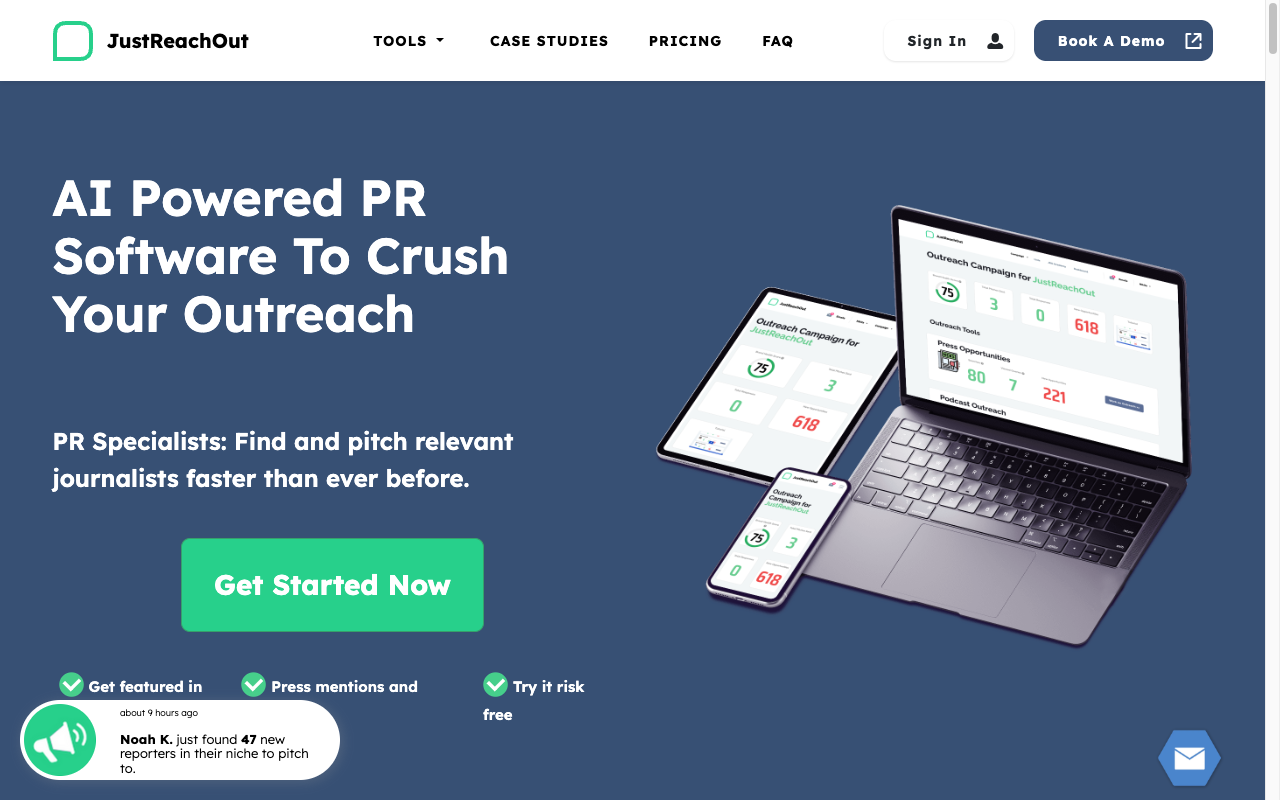
JustReachOut is the SMB all-rounder. Post-HARO, its curated press-opportunity finder aggregates journalist requests from 20+ sources and refreshes through the day, and it pairs that with a 700K-journalist database, AI pitch drafting, and sending from your own Gmail or Outlook — a genuinely useful combination if you want one tool instead of stitching together a free feed and a database. It's also honest that PR results take three to six months. The honest catches are price and scope: plans run $147 / $247 / $497 a month (the trial requires a card), search is recency-biased so older niche coverage gets missed, non-US coverage is thin, and there's no API or agent surface. It's a solid reactive-plus-database tool, not a free option.
Pros
Combines a curated query feed, a database, and AI pitching in one app
Aggregates 20+ source-request feeds, refreshed throughout the day
Strong PR education for DIY founders; sends from your own inbox
Cons
Paid only ($147–$497/mo); 7-day trial requires a card
Paste a story. Get your journalist list in minutes.
Drop in a press release, your website URL, or a one-line description of your news. Medialyst reads what's relevant, finds reporters who actually cover it, scores them by fit, and verifies every email — your first list is free, no credit card.
First list free · No credit card
FAQ
HARO alternatives — common questions.
Is HARO still around — what happened to it?
HARO (Help A Reporter Out) was acquired by Cision, rebranded to "Connectively" in March 2024, and shut down completely on December 9, 2024. Featured.com then bought the HARO brand back from Cision in April 2025 and revived it as a free, ad-supported email newsletter of journalist requests sent a few times a day. So HARO exists in 2026 — but as a free newsletter run by Featured, a different product under a different owner than the platform most people remember.
Is HARO free in 2026?
Yes. The revived HARO under Featured.com is free — it's an ad-supported email newsletter, with no paid tier for sources. Featured's separate Q&A platform and the relaunched Connectively are the paid products. So if you just want HARO-style journalist requests in your inbox at no cost, the revived HARO and Source of Sources are both genuinely free.
What is the best free HARO alternative?
For a like-for-like free replacement, Source of Sources (sourceofsources.com) is the closest — it's built by Peter Shankman, HARO's original founder, as a free email digest of journalist queries. The revived HARO itself is free again too. If your expertise is B2B, MentionMatch is free and has a much cleaner, less-spammy feed. SourceBottle is free and strongest for Australia, New Zealand, and the UK. All of these are reactive: you wait for a relevant query to appear.
Why is Medialyst ranked #1 if it is not a response marketplace?
Because it gives an agent both a normalized, read-only feed for screening six approved request sources and a proactive path when no useful query appears. It does not submit into HARO, guarantee every network request, or replace the network's response workflow. If all you need is a free inbox newsletter, HARO or Source of Sources is simpler; if you want agent-based triage plus proactive research, Medialyst covers more of the workflow.
Why did people leave HARO even before it shut down?
Quality. By most working journalists' accounts, the large majority of HARO responses were SEO-driven link-grabs rather than genuine expertise, and more recently the queue filled with AI-generated filler — "every other pitch seemed like nothing more than lazy AI-generated nonsense." HARO's owners responded by bolting on AI-detection (which produces false positives) and a minimum-domain-authority gate that biases toward big outlets. The combination — high competition, low signal, big-outlet bias — is why even loyal users went looking for less crowded alternatives.
What's the difference between HARO, Connectively, and Featured now?
All three trace to the same lineage but are different things in 2026. HARO is the free email newsletter run by Featured. Featured is the paid curated Q&A platform (also run by Featured.com) that gives access to outlets like Forbes and Inc. Connectively was the name Cision used for HARO before killing it in December 2024; Featured revived the Connectively brand in June 2026 as a separate paid request platform with an AI co-pilot, though its pricing is still unsettled. Short version: HARO = free newsletter, Featured = paid Q&A, Connectively = paid relaunch (verify before buying).
Should I use a free or paid HARO alternative?
Start free, then pay only if volume or quality forces it. Free options (Source of Sources, the revived HARO, MentionMatch, SourceBottle) cost nothing and are fine for occasional, opportunistic placements — the trade-off is more spam to wade through and less control. Paid options earn their fee by cutting noise and adding features: Featured (~$19–$99/mo) for curated elite-outlet access, Qwoted ($99–$149/mo) for the highest-quality vetted requests, JustReachOut ($147+/mo) for a query feed plus database and pitching. And if your goal is proactive outreach rather than answering queries, Medialyst's first list is free so you can compare that motion before paying.
Product names and logos are trademarks of their respective owners and are used here only for purposes of comparison. Medialyst is not affiliated with, endorsed by, or sponsored by any of the tools listed. Pricing and feature claims are based on public documentation and customer reviews as of June 2026; please verify with each vendor.