Last updated September 2026 · independently researched
Let's be fair up front: among the legacy databases, Muck Rack has the strongest reputation we've seen for journalist-data quality. It's built journalist-first, profiles are tied to real bylines, and it says it staffs "a team of over 100 people all over the world" to review and update listings — more human curation than most of this category funds.
What sends people looking elsewhere is the commercial model, not the data. Muck Rack publishes no prices: its pricing page lists Starter, Standard and Premier tiers with a "Contact us" button on each, explaining that "pricing depends on a few factors specific to your team including the number of users" (retrieved 11 September 2026). The only public numbers are third-party ones — Vendr's marketplace reports a median Muck Rack buyer paying $13,000/yr across 80 tracked purchases, from $8,000 to $20,860. There's no published free trial of the platform and no published monthly option, which is a hard sell for a founder or small agency that just wants to start pitching this week. So the real question is a curated directory you filter and verify yourself vs. an AI that researches a fresh, scored, pre-verified list for you. Here are the 7 best alternatives — what each nails, what it really costs, and where we couldn't confirm a number.
A quick disclosure: we make Medialyst, so we've ranked it first — but we've tried to be a fair broker, because a list that pretends one tool wins every category is useless to you. Where a competitor is genuinely better than us at something, we say so, and we say so about Muck Rack's data curation below. We evaluated each tool on what actually decides a PR workflow: how relevant and current its journalist data is, how fast you get from a story to a send-ready list, pricing transparency and contract terms, and whether it has a real AI/agent surface or just AI marketing. Every claim below is sourced to the vendor's own public pages and press releases, or attributed inline to a named third party (G2, Capterra, Vendr, Trustpilot) — and where a vendor doesn't publish something, we say it isn't published rather than assuming it doesn't exist. Pricing and feature claims were re-verified on 11 September 2026; quote-only vendors are flagged. Rankings and characterisations are our opinion; the facts are cited so you can check them.
Tool
Best for
Standout
Starting price
Free option
1Medialyst
PR teams, founders, and agencies who want a story-specific, verified journalist list in minutes — not a static database to vet by hand.
AI reads each journalist's recent coverage and scores fit for your story
From $97/mo (annual) · $149/mo monthly
Free first list · no credit card
2Cision
Large enterprise comms teams that need global scale, broadcast monitoring, and PR Newswire distribution — with the budget to match.
Cision says its database holds 850,000+ contacts, plus PR Newswire wire distribution
Not published · Vendr reports ~$12,625/yr median
No free trial published (demo only)
3Meltwater
Teams whose primary need is broad media monitoring and social listening, with journalist outreach as a secondary use.
First-class media monitoring and social listening across 270K+ sources
Not published · Vendr reports ~$25,000/yr median
No free trial published (demo only)
4Propel
Small-to-mid teams that live in Gmail/Outlook and want database + pitching + analytics in one lighter-weight platform.
A PR CRM that works natively inside the inbox you already use
Not published as of Sept 2026 (demo only)
No free tier published as of Sept 2026
5Prowly
Teams that want a press portal, newsroom, and database under one login — and can live with roadmap uncertainty.
Genuine all-in-one workflow with branded online newsrooms
Now sold as the Semrush AI PR Toolkit · no standalone price published
Trial via Semrush signup
6Prezly
Comms teams that want a branded online newsroom and a relationship CRM, and are happy to bring their own contacts.
Beautiful branded newsrooms + the clearest published pricing in the category
From €100/mo (Essential, billed annually)
14-day trial, no card
7Qwoted
Teams and experts who want journalists to come to them via source requests, rather than building outbound lists.
Verified inbound source requests with less spam than HARO-style feeds
$99/mo (Pro, billed annually) or $149/mo monthly
Free tier — 2 pitches/mo, delayed access
Pricing reflects each vendor's own published pages, or an inline attributed third-party report, as re-verified on 11 September 2026. Muck Rack, Cision, Meltwater and (as of September 2026) Propel and Prowly publish no prices; figures shown for them are reported estimates from named third parties such as Vendr, not vendor price lists — verify with each vendor. Muck Rack's pricing page lists Starter, Standard and Premier tiers routed to "Contact us", and does not publish contract length, refund terms, or a free trial of the platform.
The ranked list
The 7 best Muck Rack alternatives.
1
MedialystOur pick5.0/5 on G2
AI-native journalist discovery — story-in, verified list out
Best for: PR teams, founders, and agencies who want a story-specific, verified journalist list in minutes — not a static database to vet by hand.
Pricing: From $97/mo (annual) · $149/mo monthly
Free option: Free first list · no credit card
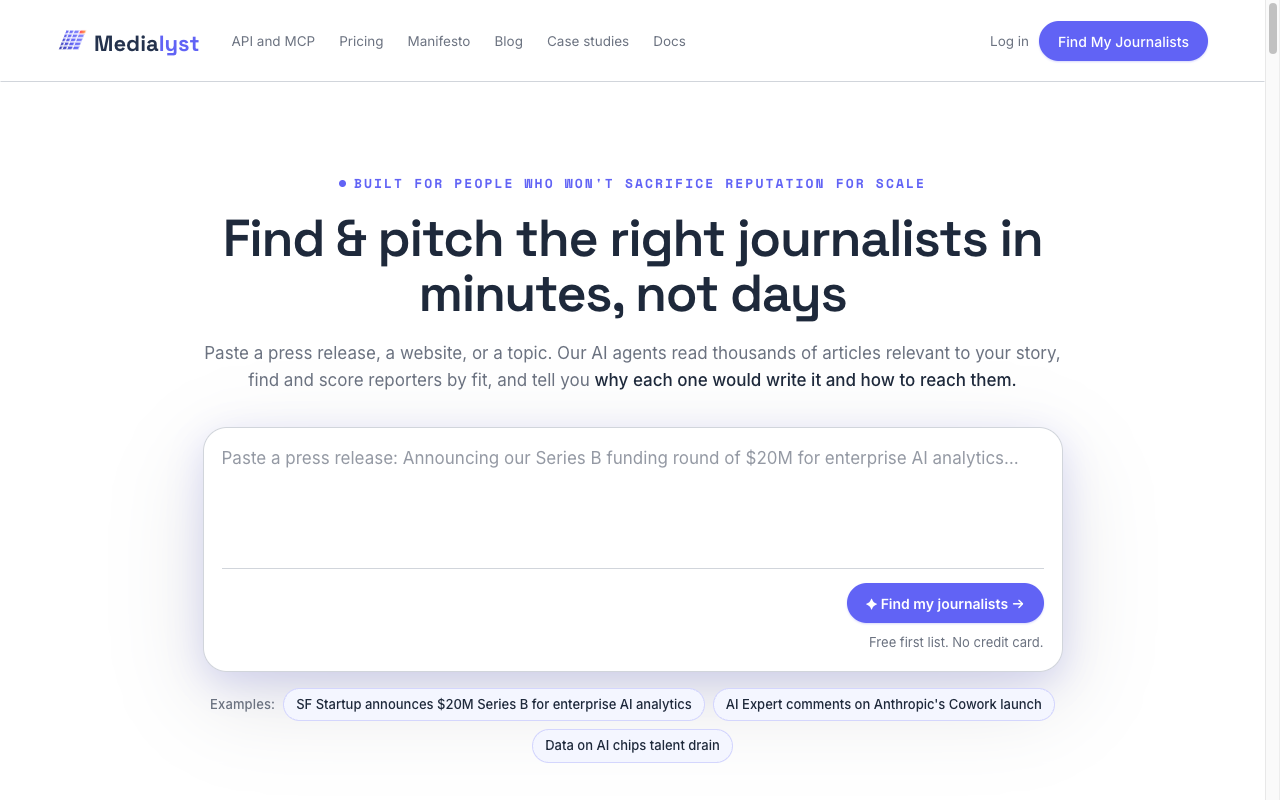
Medialyst is the AI-native media list builder. Instead of handing you a giant static database to filter and verify yourself, it reads hundreds of articles relevant to your specific announcement, surfaces the journalists who actually cover it, scores them 0–100 by fit with reasoning grounded in their recent work, and verifies every email in real time before it reaches you. It runs from a chat box — paste a release, a URL, or a one-line description — and from inside Claude, ChatGPT, or Cursor via a public REST API and a hosted remote MCP server. Pricing is public, monthly, and contract-free; your first list is free with no credit card.
Pros
Story-specific relevance scoring grounded in journalists' actual recent articles, not keyword filters
Every email verified in real time before delivery — built to kill the bounce-rate problem of static databases
Public, monthly, contract-free pricing with a free first list
Agent-native: public REST API + hosted remote MCP, usable inside Claude, ChatGPT, and Cursor
Upload any competitor CSV and the agent re-verifies and re-scores every contact
Cons
Newer than the legacy incumbents — not the choice if a recognizable enterprise brand name is itself the requirement
Focused on discovery, pitching, and verification rather than broad social-listening or share-of-voice dashboards
Best for: Large enterprise comms teams that need global scale, broadcast monitoring, and PR Newswire distribution — with the budget to match.
Pricing: Not published · Vendr reports ~$12,625/yr median
Free option: No free trial published (demo only)
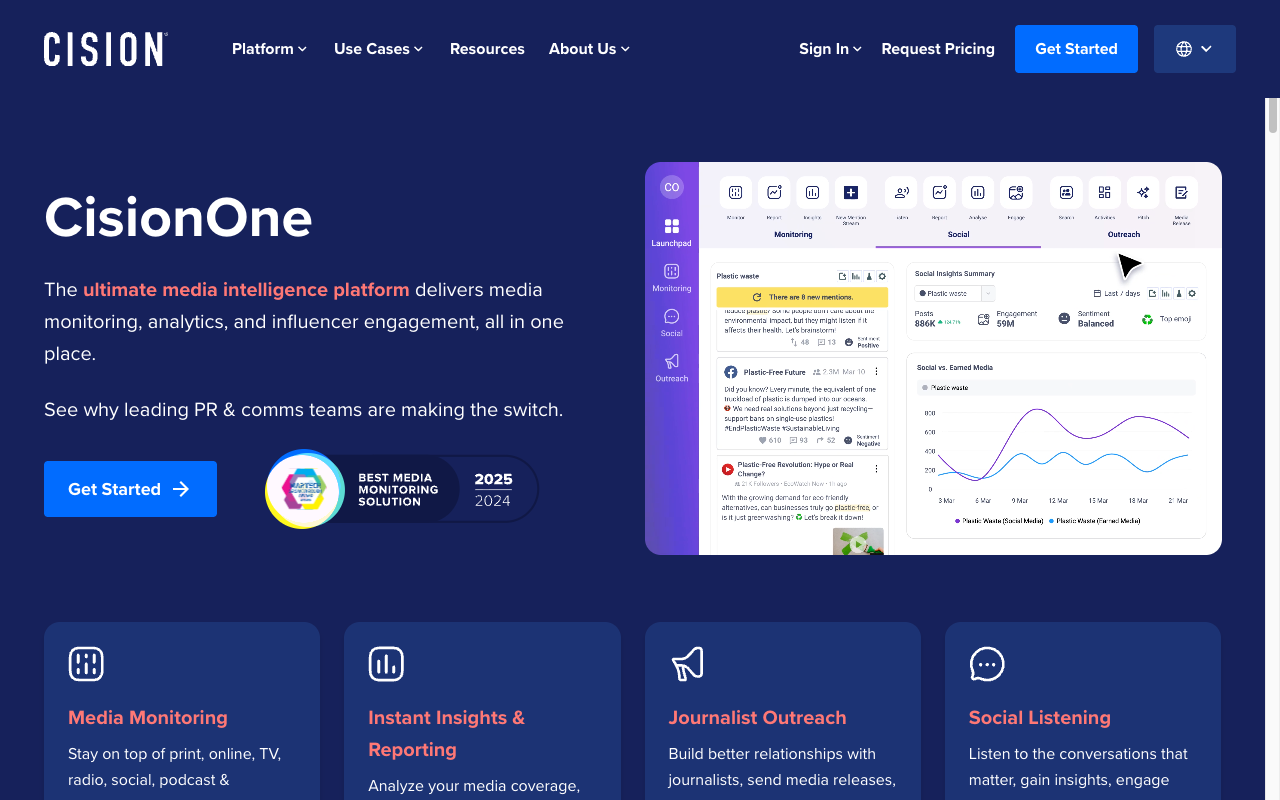
Cision is the 800-pound gorilla, and for a true enterprise it has things Muck Rack doesn't: Cision says its database holds more than 850,000 media contacts across 200+ countries, and it owns PR Newswire — one of two dominant global wire services — for paid distribution. If your strategy depends on the wire, that integrated distribution is genuinely hard to replicate, and Cision says 84% of the Fortune 500 are customers. The case against it is the same one that sends people away from Muck Rack, only more so: Cision publishes no pricing, and Vendr's marketplace reports a median buyer around $12,625/yr with tracked deals ranging from $3,150 to $30,553. Reviewers on G2 and Capterra flag stale contacts and bounced pitches, a platform built from a decade of acquisitions, and auto-renewal terms requiring months of advance notice to exit. In our view it's a heavier, pricier commitment than Muck Rack, and its data reputation is the weaker half of the trade.
Pros
Cision says 850,000+ contacts across 200+ countries, plus PR Newswire distribution
Full-service broadcast, print, and online monitoring at global scale
Enterprise brand recognition — Cision says 84% of the Fortune 500 are customers
Cons
No published pricing; Vendr reports a ~$12,625/yr median, $3,150–$30,553 range
Stale contacts and bounce rates are a recurring theme in its G2 and Capterra reviews
Clunky platform and steep learning curve; reviewers report long auto-renewal notice periods
Best for: Teams whose primary need is broad media monitoring and social listening, with journalist outreach as a secondary use.
Pricing: Not published · Vendr reports ~$25,000/yr median
Free option: No free trial published (demo only)
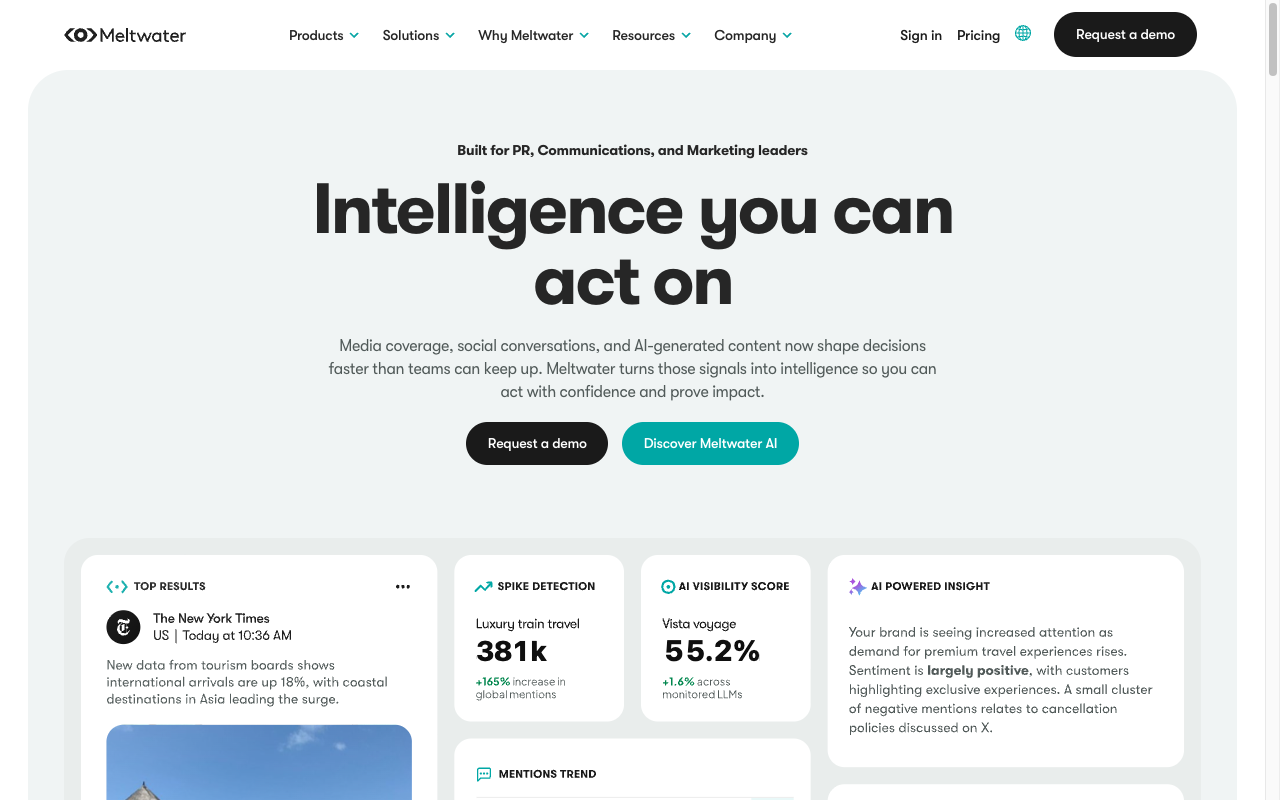
Meltwater leads with monitoring and social listening rather than outreach, and that's where it's strong — it says it processes roughly a billion pieces of content a day across 270,000+ sources, with a serious AI analytics suite in GenAI Lens, which tracks how brands appear inside ChatGPT, Claude and Gemini. It won PRWeek Global's Best PR Software or AI Platform on 20 May 2026, and in our view that's earned. But if your job is finding and pitching reporters, you're funding a monitoring platform to use one slice of it. Meltwater publishes no pricing; Vendr's marketplace reports a median buyer near $25,000/yr, and Meltwater's standard terms are sold on a 12-month basis with no published trial. Outreach is the part of the suite we'd scrutinise hardest on a trial: it's a monitoring product first, and its own marketing says so.
Pros
Best-in-class media monitoring and social listening (270K+ sources)
Best for: Small-to-mid teams that live in Gmail/Outlook and want database + pitching + analytics in one lighter-weight platform.
Pricing: Not published as of Sept 2026 (demo only)
Free option: No free tier published as of Sept 2026
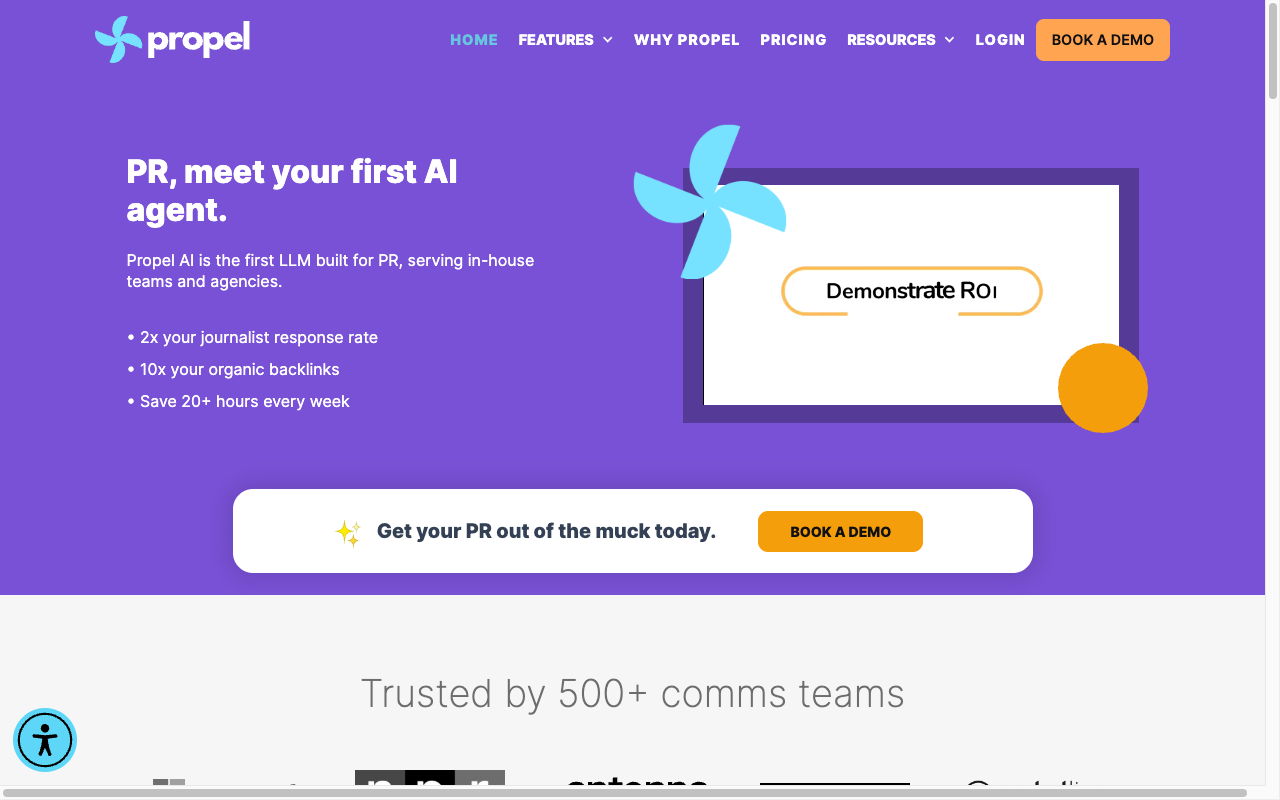
Propel's pitch is workflow: native Gmail, Outlook and Slack plugins so you pitch and track from the inbox you already work in, with included Signal AI media monitoring, and it holds the highest G2 rating of the legacy-adjacent tools here at 4.7/5. Reviewers consistently like the inbox-native flow. One important correction since our last update: Propel used to be the transparency story in this category, and it isn't anymore. propelmypr.com now redirects to propel-ai.com, and as of 11 September 2026 its pricing page lists Essentials, Pro and Premium tiers with a "Book a demo" button on each and no prices, no published free tier, and seat caps of 1, 4 and 7 users. The $0 tier and ~$99/mo Premium plan we previously cited are no longer published, and the page we cited for them now returns a 404. The honest catch on data: Propel's journalist records come from a maintained static database rather than per-story live research.
Pros
Native Gmail/Outlook/Slack plugins for inbox-based pitching
Highest G2 rating of the established tools here (4.7/5)
Included Signal AI media monitoring in a lighter-weight platform
Cons
Pricing is no longer published — all tiers now route to "Book a demo" (Sept 2026)
The $0 free tier it previously published is no longer listed
Journalist data is a maintained static database, not per-story live research
Best for: Teams that want a press portal, newsroom, and database under one login — and can live with roadmap uncertainty.
Pricing: Now sold as the Semrush AI PR Toolkit · no standalone price published
Free option: Trial via Semrush signup
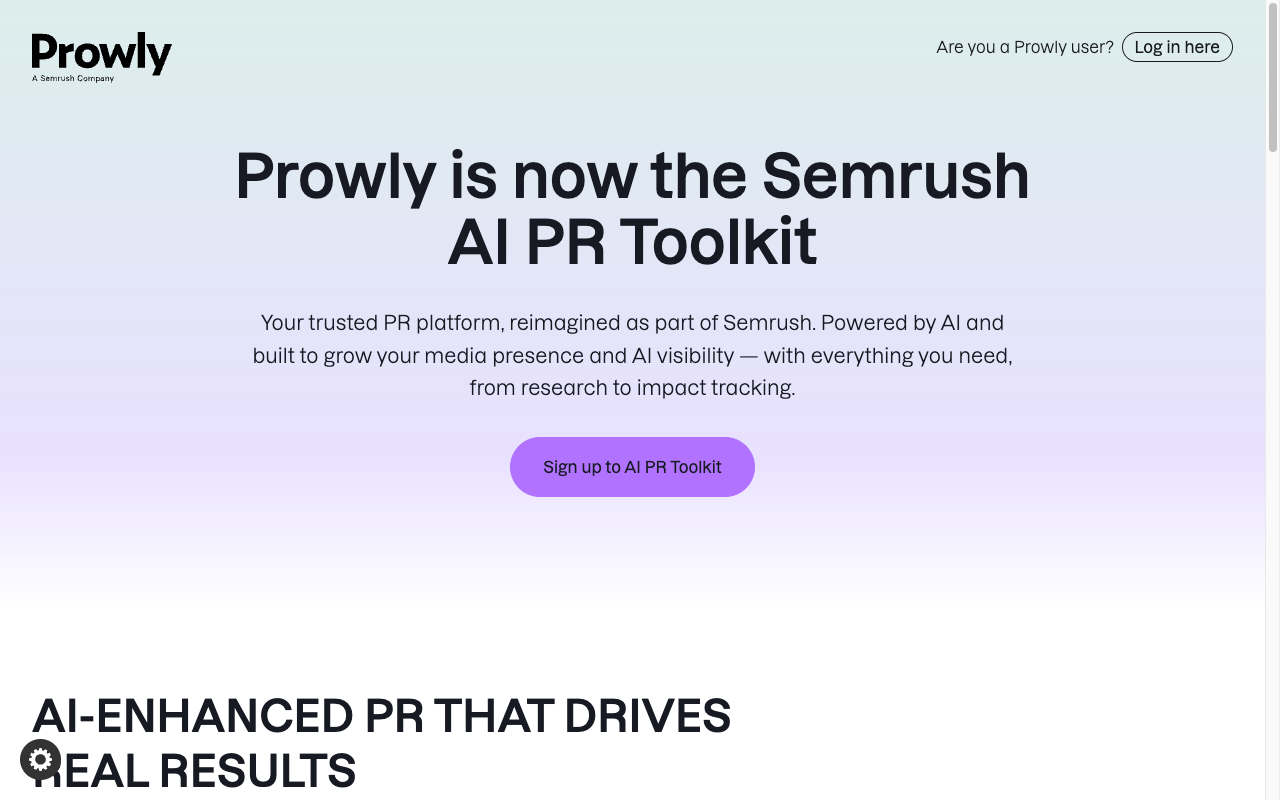
Prowly was the affordable all-in-one — media discovery, pitching, monitoring, and genuinely beautiful branded newsrooms in one tidy platform at a published monthly price. The catch is no longer the product; it's the corporate stack above it. Prowly's own site now reads "Prowly is now the Semrush AI PR Toolkit" and "Your trusted PR platform, reimagined as part of Semrush," with signup routed to Semrush — and Adobe completed its ~$1.9B acquisition of Semrush in April 2026, with no public product commitment for the PR line. As of 11 September 2026 we could not find a published standalone price for the AI PR Toolkit on either prowly.com or Semrush's pricing page, so the clear monthly pricing that used to be Prowly's advantage is, for now, gone. On data it draws the familiar legacy complaints: a large static contact database with stale-contact and bounce reports in its G2 and Capterra reviews, and no real-time verification. One 1-star Capterra reviewer (Mathieu L., Financial Services, Dec 2024) wrote that the licence renewed "without any warning, not prior agreement." If you want the newsroom and can tolerate the roadmap question, it's still capable — but the uncertainty is real.
Pros
Genuine all-in-one: discovery, pitching, monitoring, and branded newsrooms
Best-in-class online newsrooms and press-release presentation
Access to the Semrush data ecosystem for AI-visibility work
Cons
Standalone pricing no longer published; now sold as the Semrush AI PR Toolkit
Roadmap sits two levels up, inside Adobe, after the Semrush deal closed in April 2026
Large static database with stale-contact and bounce complaints in G2/Capterra reviews
Best for: Comms teams that want a branded online newsroom and a relationship CRM, and are happy to bring their own contacts.
Pricing: From €100/mo (Essential, billed annually)
Free option: 14-day trial, no card
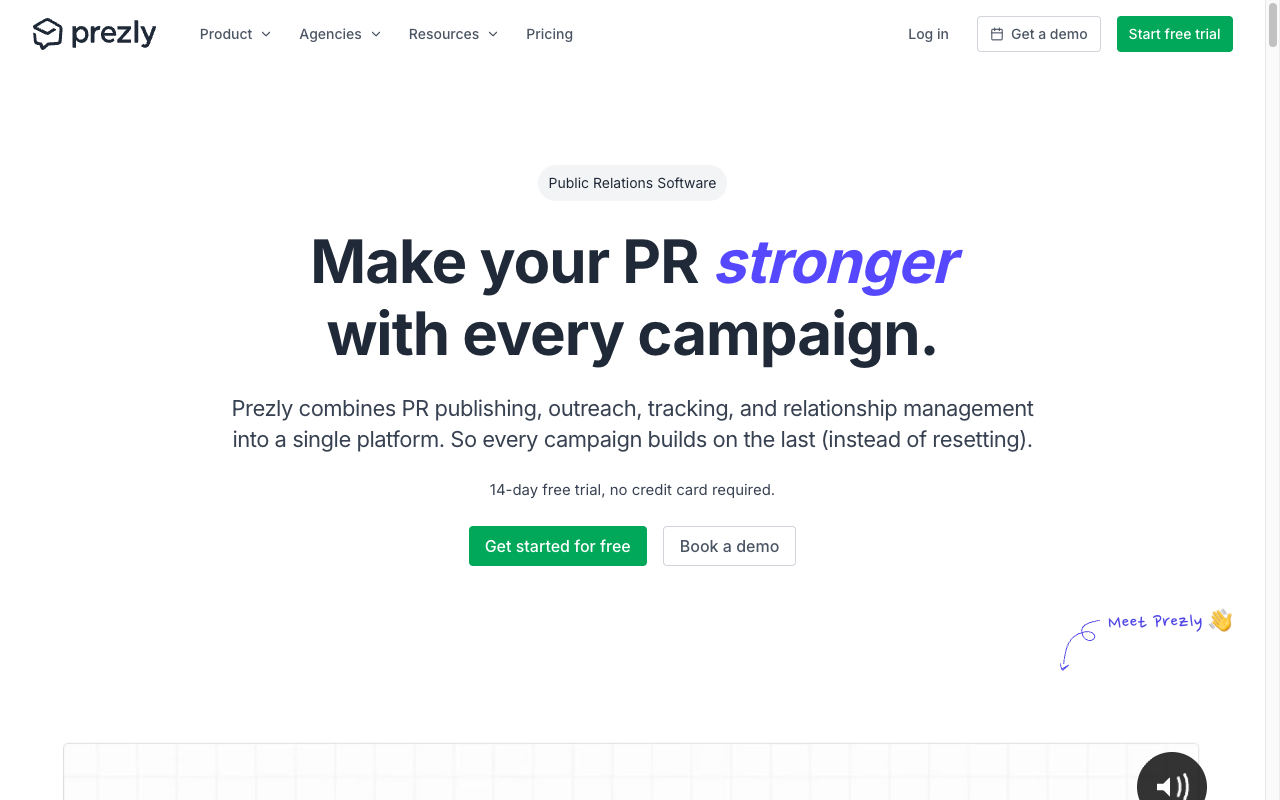
Prezly is the opposite of Muck Rack on the thing buyers complain about most: its prices are on the page. Essential is listed at €100/mo and Standard at €250/mo, both billed annually, and the site offers "Try Prezly 14 days free. No credit card required." Its branded online newsrooms, press-release editor, and relationship CRM are, in our view, best-in-class, and support is its clearest moat. The honest catch is scope, and Prezly is refreshingly blunt about it: it deliberately doesn't sell a media database, arguing publicly that bought databases are "ineffective and unethical" and that "20–50% of pitches sent to bought contacts never even make it to journalists' inboxes." So journalist discovery means bringing your own contacts or pairing Prezly with a discovery tool. If Muck Rack's data was never your reason for staying and you mostly want a press portal and a relationship hub, it's the strongest swap here.
Pros
Published pricing on the page — Essential €100/mo, Standard €250/mo, billed annually
14-day trial with no credit card required
Best-in-class branded newsrooms and a relationship CRM that rejects spray-and-pray
Cons
No built-in media database — you bring your own contacts, by stated design
No media monitoring or social listening
Entry plan is billed annually, and reporting depth is thinner than the legacy suites
Qwoted is a different model from Muck Rack entirely — a source-request marketplace where journalists post what they need and you respond, rather than a database you pitch out of. Its strength is signal quality: requests are vetted, the outlets skew elite, and Qwoted publicly polices AI-generated pitch spam, so the noise is lower than HARO-style services. Its pricing is published, which we'll credit: a free tier, Pro at $99/mo billed annually or $149/mo month-to-month, then custom-quoted Team and Managed plans. It's a complement rather than a like-for-like Muck Rack replacement, and we'd treat the free tier as a demo rather than a working plan — it's capped at 2 pitches a month with delayed access to new requests. The structural limit is the model itself: you're reacting to whatever journalists happen to ask for, not driving outreach for the story you need placed this week.
Pros
Vetted inbound source requests, with outlets skewing to major titles
Publicly polices AI-generated pitch spam, keeping signal higher than HARO-style feeds
Published pricing, including a free tier — a good complement to proactive outreach
Cons
Inbound marketplace — it can't target a specific story on your timeline
Free tier is capped at 2 pitches/mo with delayed access to requests
Pro at $99–$149/mo is priced above several outbound tools here
Paste a story. Get your journalist list in minutes.
Drop in a press release, your website URL, or a one-line description of your news. Medialyst reads what's relevant, finds reporters who actually cover it, scores them by fit, and verifies every email — your first list is free, no credit card.
First list free · No credit card
FAQ
Muck Rack alternatives — common questions.
What is the best Muck Rack alternative in 2026?
It depends on what pushed you to look. If you want story-specific journalist discovery without a sales call or a quote-only price, Medialyst is the closest like-for-like alternative: it finds and scores journalists by fit for your specific story, verifies emails in real time, and starts at $149/mo on a monthly plan, with a free first list and no credit card. If you specifically need enterprise scale and PR Newswire wire distribution, Cision is the heavyweight; if you mainly need monitoring and social listening, Meltwater is stronger; and if you want published prices and a branded newsroom, Prezly lists Essential at €100/mo with a 14-day no-card trial.
How much does Muck Rack cost in 2026?
Muck Rack doesn't publish prices. Its pricing page lists Starter, Standard and Premier tiers for brands and agencies, puts a "Contact us" button on each, and says "pricing depends on a few factors specific to your team including the number of users, so we'd love to prepare a customized proposal for you" (retrieved 11 September 2026). For third-party figures, Vendr's marketplace reports a median Muck Rack buyer paying $13,000 per year across 80 tracked purchases, with a low of $8,000 and a high of $20,860 — those are Vendr's numbers for deals it brokered, not a Muck Rack price list, and your quote may differ. Muck Rack doesn't publish contract length, refund terms, or a free trial of the platform, and needing a sales conversation to learn the price is the most common reason buyers tell us they started looking.
Is Muck Rack's journalist data actually accurate?
It has the strongest reputation for data quality we've seen among the legacy databases, and we'll say so plainly: it's built journalist-first, profiles are tied to real bylines, and Muck Rack says it staffs "a team of over 100 people all over the world working tirelessly to review and update outlet and journalist listings." The useful nuance is cadence, in Muck Rack's own words: it "aims to review every listing annually" and makes "hundreds of thousands of updates every year." That's a review cycle rather than a check at the moment of use — which matters because journalists change beats and outlets between cycles. It's also worth knowing that Muck Rack's green verified badge certifies that "a profile page meets Muck Rack's criteria to be defined as a full-time journalist" — it marks the person as a working journalist, not the address as deliverable. AI-native tools like Medialyst take the other approach: enrich each journalist and verify the email at the moment you build the list.
Is there a cheaper alternative to Muck Rack?
Almost certainly, though Muck Rack's price depends on the quote you're given. Medialyst's Starter plan is $149/mo billed monthly with no contract and no per-seat fees, and the first list is free with 100 credits and no credit card — set against the $13,000/yr median Vendr's marketplace reports for Muck Rack buyers. Prezly publishes Essential at €100/mo (billed annually) with a 14-day no-card trial. Qwoted publishes a free tier and Pro at $99/mo billed annually, though it's an inbound request marketplace rather than a database. Note that two tools we previously listed here as cheap and transparent, Propel and Prowly, no longer publish prices as of September 2026.
Can I move my Muck Rack contacts to a new tool?
Yes. Export your Muck Rack media lists as a CSV. With Medialyst you can upload that CSV and the agent re-verifies and re-scores every contact against your story, then enriches each with recent coverage — so you can compare results on your own data before your renewal window closes.
What's the difference between a media database and an AI-native tool like Medialyst?
A traditional media database (Muck Rack, Cision, Meltwater, Prowly) gives you a large curated list to filter with keywords and then verify yourself, maintained on a review cycle — Muck Rack, for instance, says it "aims to review every listing annually." An AI-native tool reads articles relevant to your announcement, surfaces journalists who actually cover that topic, scores them by fit, and verifies their emails in real time — so the unit of truth is a freshly researched contact for your story rather than a row awaiting its next refresh. Both models have real trade-offs: a curated directory is better for browsing and for breadth of monitoring, while live research is better for a specific pitch on a deadline.
Product names and logos are trademarks of their respective owners and are used here only for purposes of comparison. Medialyst is not affiliated with, endorsed by, or sponsored by any of the tools listed. Pricing and feature claims are based on public documentation and customer reviews as of September 2026; please verify with each vendor.