FOR JOURNALISTS
A note to journalists: our AI says "don't send this" more than anything else.
You have every reason not to trust an AI PR tool. This is why Medialyst is built on your side of the inbox, with receipts.

Start with what you already know
You get 200+ pitches a day. Most of them miss your beat. AI made it worse - because every AI tool in PR you've heard of was built to send more pitches, faster.
A journalist put it to me bluntly last week: use a service like this and I'll reject every pitch. Our work is deeply human. It deserves a conversation, not a prompt.
He's half right.
He's right about the tools he's seen. Automated pitch bots are bombarding UK media with AI-generated content. Legacy databases sell 10,000-contact spreadsheets and call it targeting. If that's AI in PR, rejecting it is the correct response.
But he's wrong that AI is the enemy of the craft. WIRED just profiled tech reporters using AI to help write and edit their stories - Alex Heath dictates his scoops into a mic and lets Claude write the first draft. And journalists are already screening their own inboxes the same way: one editor's AI pitch-filtering prompt is making the rounds right now. AI is on both sides of the inbox. The real question is what the sending side optimizes for: more pitches, or better ones?
1. Our AI rejects most of the pitches it reads
At the start of 2026 I built IsMyPitchShit.com - a free tool where PR people paste their pitch and an AI editor tears it apart before any journalist ever sees it.
As of July 2026 it has roasted 1,477 pitches and flagged 71% of them as garbage.
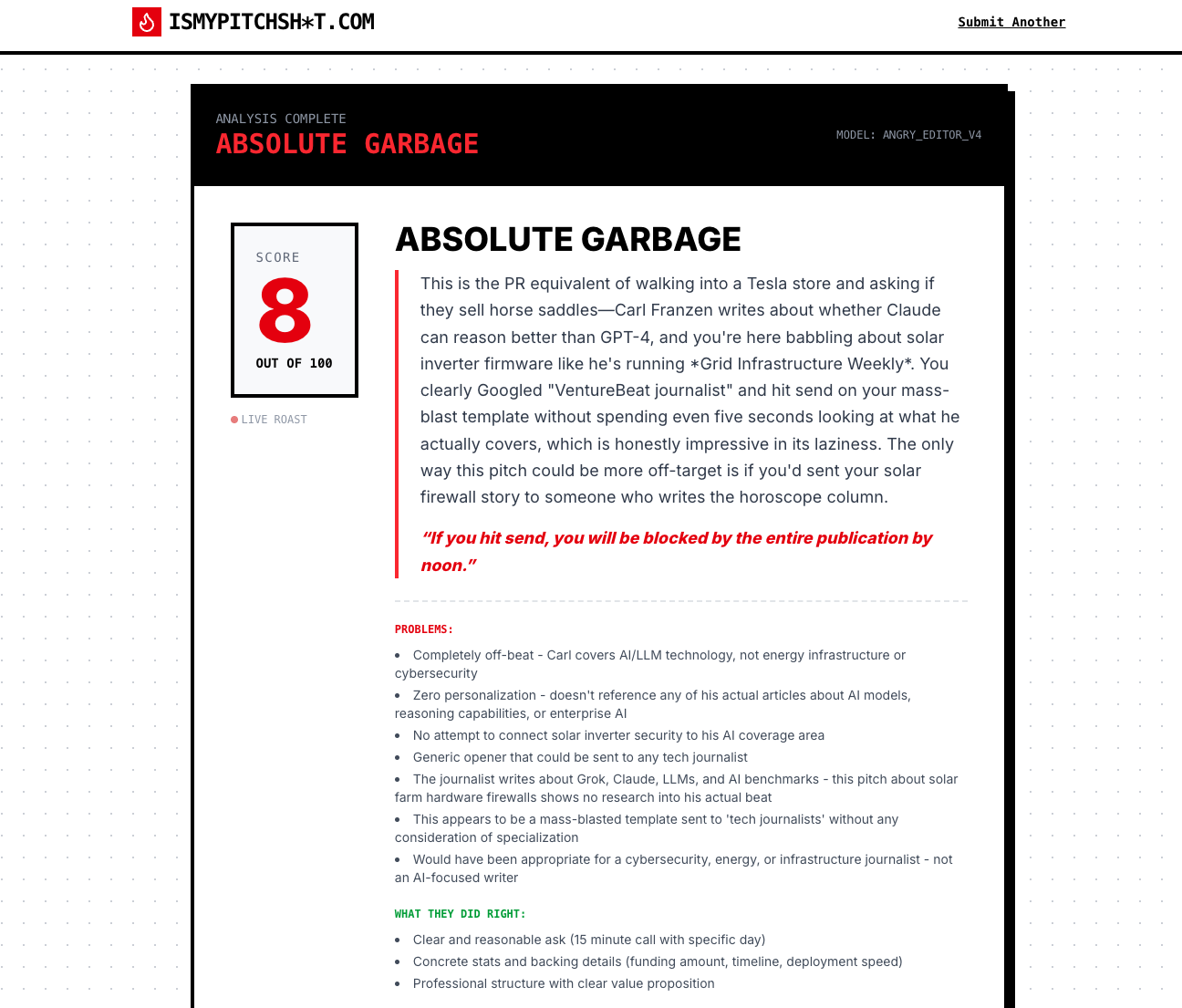
The senders agree with it. After every roast we ask one question - "was this accurate?" The average pitch scores 32 out of 100, and when the AI does score a pitch 80+, user agreement is 100%. The full experiment is in the manifesto.
That same judgment engine is what powers Medialyst. Every pitch a Medialyst user sends survived an editor that rejects most of what it reads.
If every PR team ran this check before hitting send, you'd receive roughly 70% fewer garbage pitches. That's the standard we're trying to make normal.
Before writing a line of product code, we still tested whether AI could predict which journalist would actually cover a story, using 5,000+ real campaigns from 2024-2025 with the AI blinded to the coverage it was predicting. The benchmark matters to us; I do not expect the technical detail to resonate with you. The outcome should: 93% precision, tuned deliberately toward fewer names, not more sends. We'd rather hand a user 10 journalists who'd genuinely care than 15 with 5 duds, because a Medialyst list gets smaller as it gets better. Your inbox is not an ad channel, and volume is failure - it's written into our doctrine, not just this page.
2. Thirty minutes reading your work, or one?
Here's the question that actually decides what your inbox looks like: how long do you want a PR person to spend reading your work before they pitch you?
Right now you're getting the worst version of that math. A PR person with thirty names to hit and a deadline spends one minute reading your work - and twenty-nine minutes reading the twenty-nine other people who were never a match for the story.
Nobody wins that trade. You get a pitch from someone who skimmed one headline. The other twenty-nine get a pitch that was never for them.
So if you want better pitches, the answer isn't less AI. It's letting AI eat the twenty-nine wrong names - the beat-checking, the filtering, the "she left that beat last year" - so all thirty human minutes land on the one match: you.
That's what it looks like in practice. Rita Liao, an ex-journalist at TechCrunch who covered startups before moving to the other side:
"I spent at least 30 minutes on one single journalist, poring over their tweets, studying their recent bylines... [With Medialyst] the best thing is it gives a summary of their recent articles before I commit to reading every piece."
The AI didn't replace her judgment. It cleared the wrong names so her thirty minutes went to the right ones.
3. A human sends every pitch
Medialyst has no auto-send. Muck Rack has it. Cision has it. In a category where the default is campaign sending, we are deliberately the tool that does not have it, because our users do not need it: if the list is small enough and the match is clear enough, a human can read the context, make the call, and send it themselves. There is no button that pitches a hundred journalists while the user sleeps, and we refuse to build one - auto-send is a hard refusal in our doctrine, one no user can override.
So yes: your work is deeply human, and it deserves a conversation. The pitch that reaches you is the start of one - researched with AI, written and sent by a person. The AI's job was making sure the twenty-nine wrong ones never started.
4. The standard, written down
My answer to "is AI the problem?" is: no - the absence of a standard is. So we wrote ETHICS.md, an open-source standard for everyone using AI in PR. Every agent built on our stack loads it before doing anything else. On behalf of our users:
- We will not auto-pitch you.
- We will not fabricate quotes, experts, stats, sources, or references to your work.
- We will not turn tragedy into a promotional hook.
- We will not hide stale dates to look timely.
- We will not follow up indefinitely.
- We will stop when you opt out. Your decision is the end of the conversation.
- We will not impersonate you, your editor, or your publication.
- We will not pitch you on a beat you've visibly left.
These aren't values-page decorations. They're enforced gates - the system refuses, in plain words, when a user asks it to cross one. Read why we wrote the standard, or go straight to ETHICS.md on GitHub.
Don't take my word for it
Paste the last 10 pitches you received into IsMyPitchShit.com. If our AI were the spam machine you suspect, it would wave them through.
It won't.
Questions, arguments, opt-outs - I read everything sent to [email protected].
July 4, 2026
— Elvis
