You already know why you're here: Cision is powerful but painful. Pricing hidden behind a sales call that usually lands $10K–$30K+ a year, annual contracts that need 3–5 months' notice to escape, a UI reviewers call "clunky," and support that fades once you've signed.
And the thing it sells hardest — a big, accurate database — draws its loudest complaint: stale contacts. Any static, human-curated list rots the day it ships, and 2026's newsroom layoffs made it worse. So the real question isn't *which database is biggest* — it's a static list you vet by hand vs. an AI that researches a fresh, verified one for you. Here are the 7 best alternatives — what each nails, and what it really costs.
We ranked on what actually decides a PR workflow — not brand recognition: how fresh and relevant the journalist data is, how fast you get from a story to a send-ready list, pricing and contract transparency, and whether there's a real AI/agent surface or just AI marketing. Every tool here gets a genuine strength called out — Cision's scale, Muck Rack's accuracy, Meltwater's monitoring, Prezly's transparency — and we flag where the legacy players still win, like a global press-release wire or deep social-listening dashboards. Pricing reflects public pages and customer reviews (G2, Capterra, Vendr) as of June 2026; quote-only vendors are flagged below.
Tool
Best for
Standout
Starting price
Free option
1Medialyst
PR teams, founders, and agencies who want a story-specific, verified journalist list in minutes — not a static database to vet by hand.
AI reads each journalist's recent coverage and scores fit for your story
From $97/mo (annual) · $149/mo monthly
Free first list · no credit card
2Muck Rack
Teams leaving Cision who still want a traditional database but with better data accuracy and a far less painful interface — and can commit to an annual contract.
Best-regarded data accuracy among legacy tools, journalist-first
Not published · Vendr median $13,000/yr
No free trial (demo only)
3Meltwater
Enterprise teams whose primary need is broad media monitoring and social listening, with journalist outreach as a secondary use.
First-class media monitoring and social listening across 270K+ sources
$6,000/yr
No free trial (demo only)
4Prezly
Comms teams that want published pricing, a branded online newsroom, and a relationship CRM — and are happy to bring their own contacts.
Beautiful branded newsrooms + the clearest pricing in the category
€100/mo
14-day trial, no card
5Propel
Small-to-mid teams that live in Gmail/Outlook and want a database, pitching, and analytics in one without enterprise pricing.
A PRM that works natively inside your inbox
~$99/mo (Premium, billed annually, 1 user)
Free tier (tight limits)
6Prowly
Teams that want an affordable all-in-one with newsrooms — if they're comfortable with the post-acquisition uncertainty.
All-in-one database, pitching, and newsrooms at a published mid-market price
$258–$589/mo
7-day trial
7Agility PR Solutions
Mid-size teams that want a recognizable Cision-style database and monitoring at a friendlier price and with an easier interface.
An easier, cheaper full-service media database than Cision
Quote only (~$8K–$15K/yr reported)
No free trial (demo only)
Pricing reflects public pages and customer reviews as of June 2026. Quote-only vendors (Cision, Muck Rack, Meltwater, Agility) don't publish prices; ranges are reported estimates from Vendr and review sites — verify with each vendor. Prowly, Prezly, Propel, and Medialyst publish pricing.
The ranked list
The 7 best Cision alternatives.
1
MedialystOur pick5.0/5 on G2
AI-native journalist discovery — story-in, verified list out
Best for: PR teams, founders, and agencies who want a story-specific, verified journalist list in minutes — not a static database to vet by hand.
Pricing: From $97/mo (annual) · $149/mo monthly
Free option: Free first list · no credit card
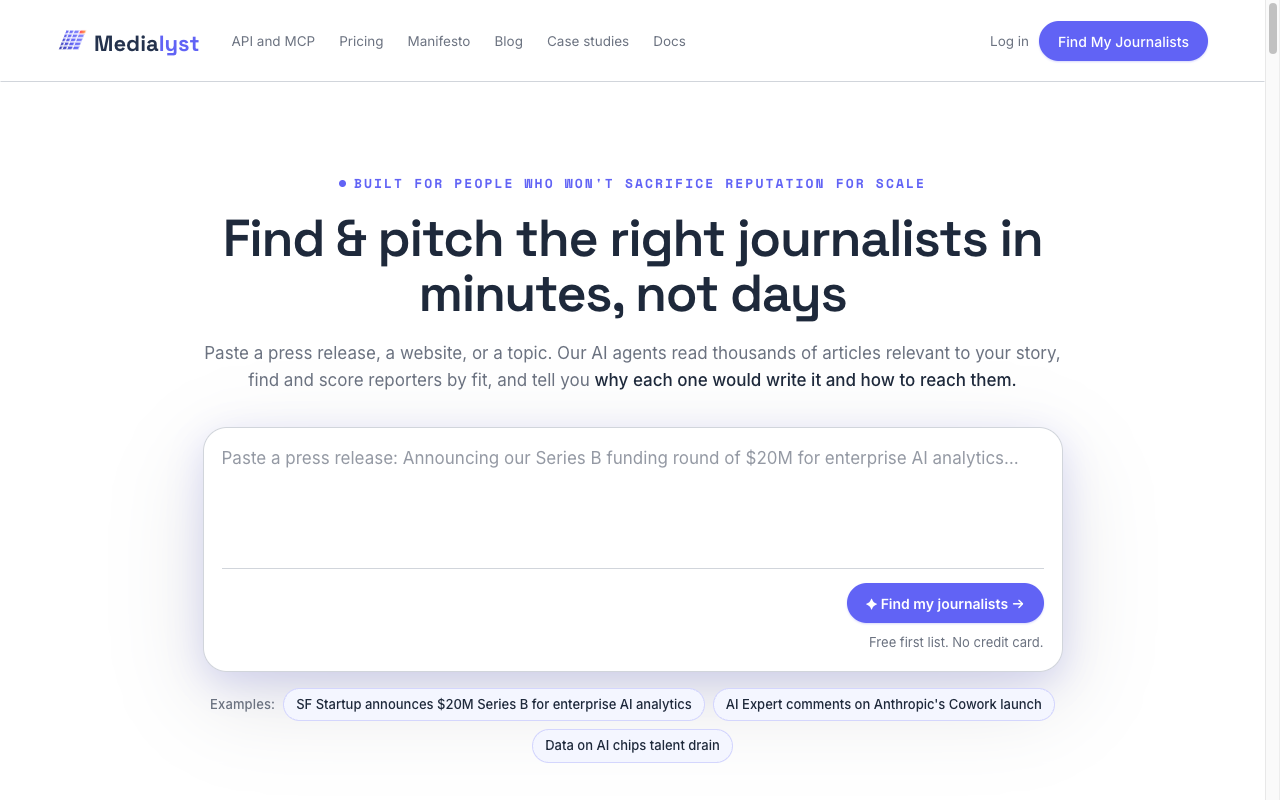
Medialyst is the AI-native media list builder. Instead of handing you a giant static database to filter and verify yourself, it reads hundreds of articles relevant to your specific announcement, surfaces the journalists who actually cover it, scores them 0–100 by fit with reasoning grounded in their recent work, and verifies every email in real time before it reaches you. It runs from a chat box — paste a release, a URL, or a one-line description — and from inside Claude, ChatGPT, or Cursor via a public REST API and a hosted remote MCP server. Pricing is public, monthly, and contract-free; your first list is free with no credit card.
Pros
Story-specific relevance scoring grounded in journalists' actual recent articles, not keyword filters
Every email verified in real time before delivery — built to kill the bounce-rate problem of static databases
Public, monthly, contract-free pricing with a free first list
Agent-native: public REST API + hosted remote MCP, usable inside Claude, ChatGPT, and Cursor
Upload any competitor CSV and the agent re-verifies and re-scores every contact
Cons
Newer than the legacy incumbents — not the choice if a recognizable enterprise brand name is itself the requirement
Focused on discovery, pitching, and verification rather than broad social-listening or share-of-voice dashboards
Best for: Teams leaving Cision who still want a traditional database but with better data accuracy and a far less painful interface — and can commit to an annual contract.
Pricing: Not published · Vendr median $13,000/yr
Free option: No free trial (demo only)
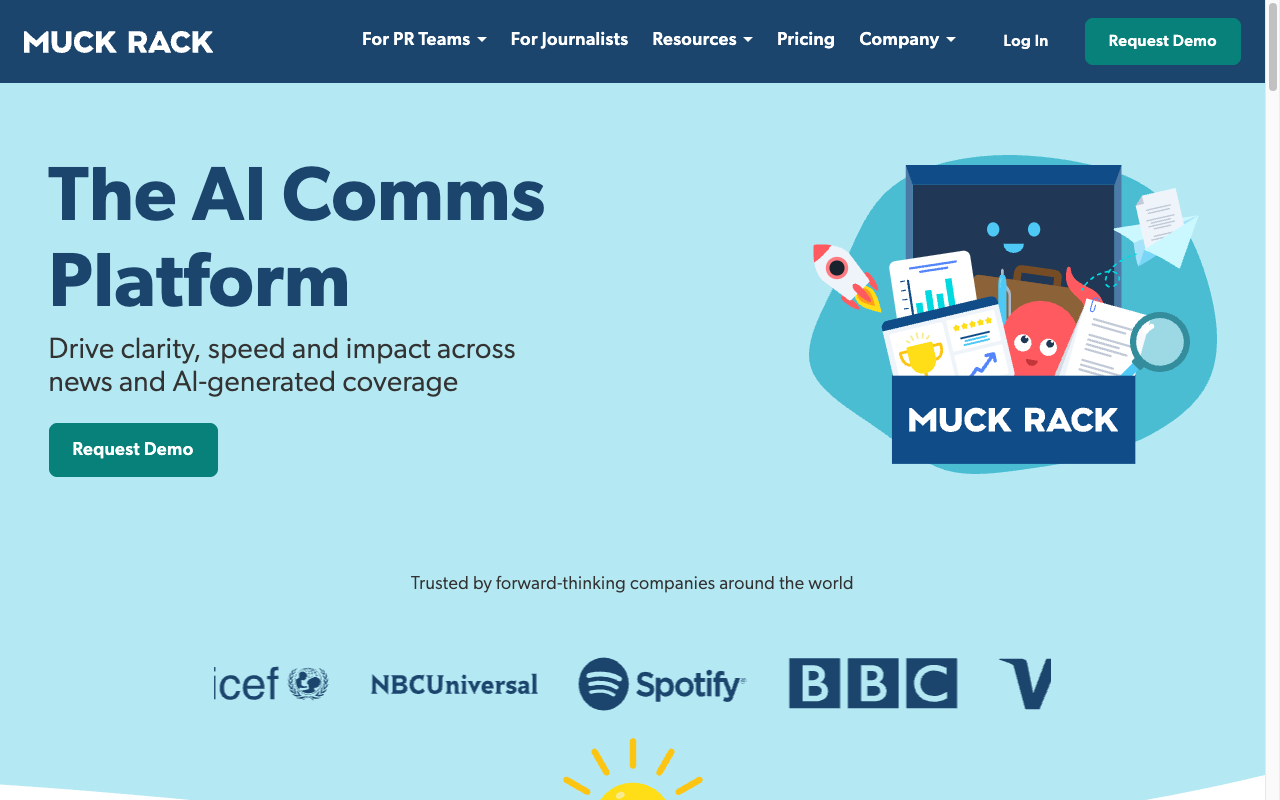
If your reason for leaving Cision is the data rot and the clunky platform — not the database model itself — Muck Rack is the obvious upgrade. It's built journalist-first, with profiles tied to real bylines, and most roundups put it at or near the top for accuracy; its UI is clean and modern where Cision's is a decade of acquisitions stacked on top of each other. It even tracks how often journalists get cited inside ChatGPT, Gemini, and Claude, which Cision can't match. The trade-offs are commercial and they'll feel familiar: it's quote-only with no public pricing (Vendr's median is about $12,750/yr), annual contracts only, no monthly billing, no refunds, and no real starter tier — so a solo or small team is still priced out, and contact emails still draw "hit or miss" reviews.
Pros
Strongest reputation for journalist data accuracy among legacy databases
Clean, modern UI and AI-citation tracking Cision lacks
Journalist-first profiles tied to real, recent bylines
Cons
Quote-only, annual contracts, no monthly option, no refunds
No true starter tier — solos and small teams are priced out
Contact emails still reported as "hit or miss" by reviewers
Best for: Enterprise teams whose primary need is broad media monitoring and social listening, with journalist outreach as a secondary use.
Pricing: $6,000/yr
Free option: No free trial (demo only)
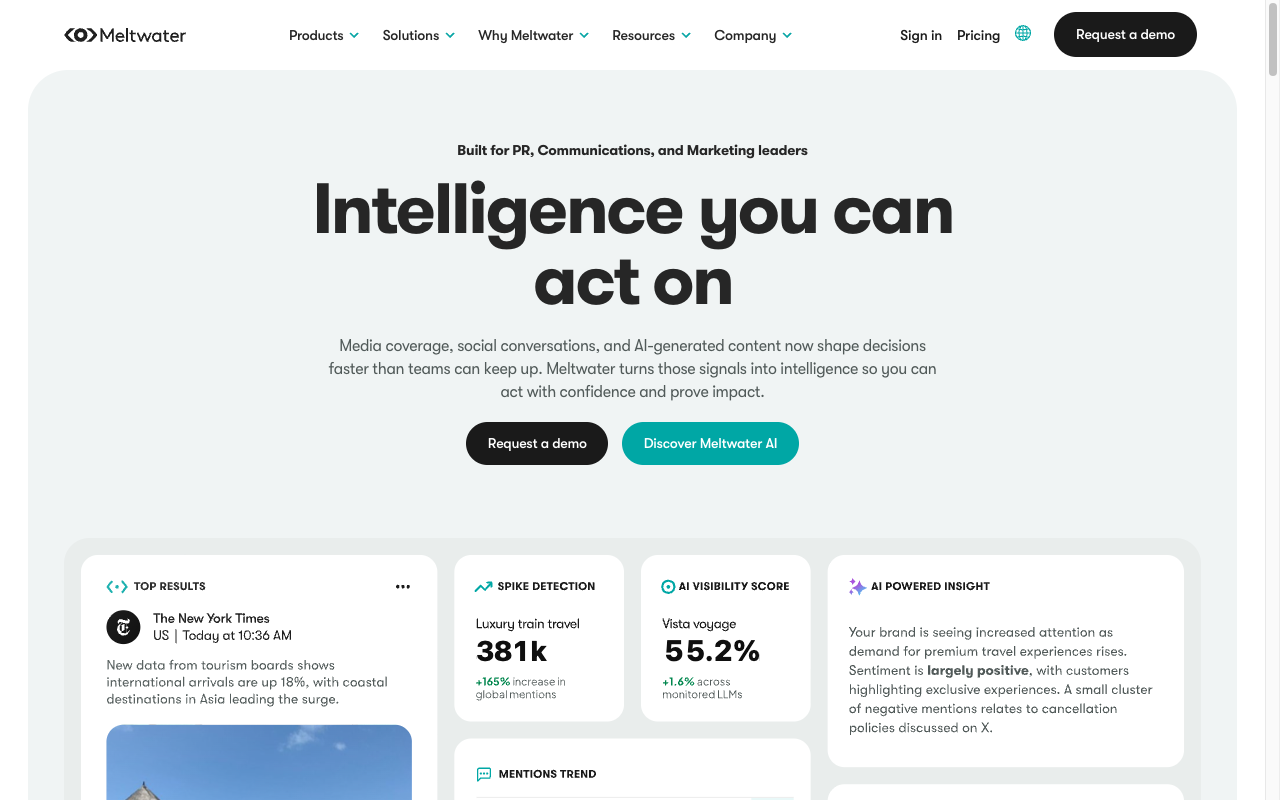
Meltwater is the other enterprise heavyweight a Cision buyer evaluates, and it's genuinely stronger than Cision at the listening side of the house — broad source coverage and useful social-listening dashboards are where it shines. If your job is more "track what's being said about us" than "find and pitch reporters," it's a real upgrade. But as an outreach database it draws the same legacy complaints you're escaping, plus a sharper one: reviewers report several dead email addresses per batch of reporters, with contact data refreshed only about annually. Pricing is opaque and heavy — Vendr's median buyer is near $25K/yr on a 12-month minimum with no trial — so you're swapping one expensive annual contract for another, just one tilted toward monitoring.
Pros
Best-in-class media monitoring and social listening
Very broad source coverage (270K+ sources)
Generally user-friendly with good account reps
Cons
Outreach database is secondary, with high reported bounce rates
Opaque pricing, ~$25K/yr median, 12-month minimum, no trial
The cost-transparent all-in-one with the best newsroom
Best for: Comms teams that want published pricing, a branded online newsroom, and a relationship CRM — and are happy to bring their own contacts.
Pricing: €100/mo
Free option: 14-day trial, no card
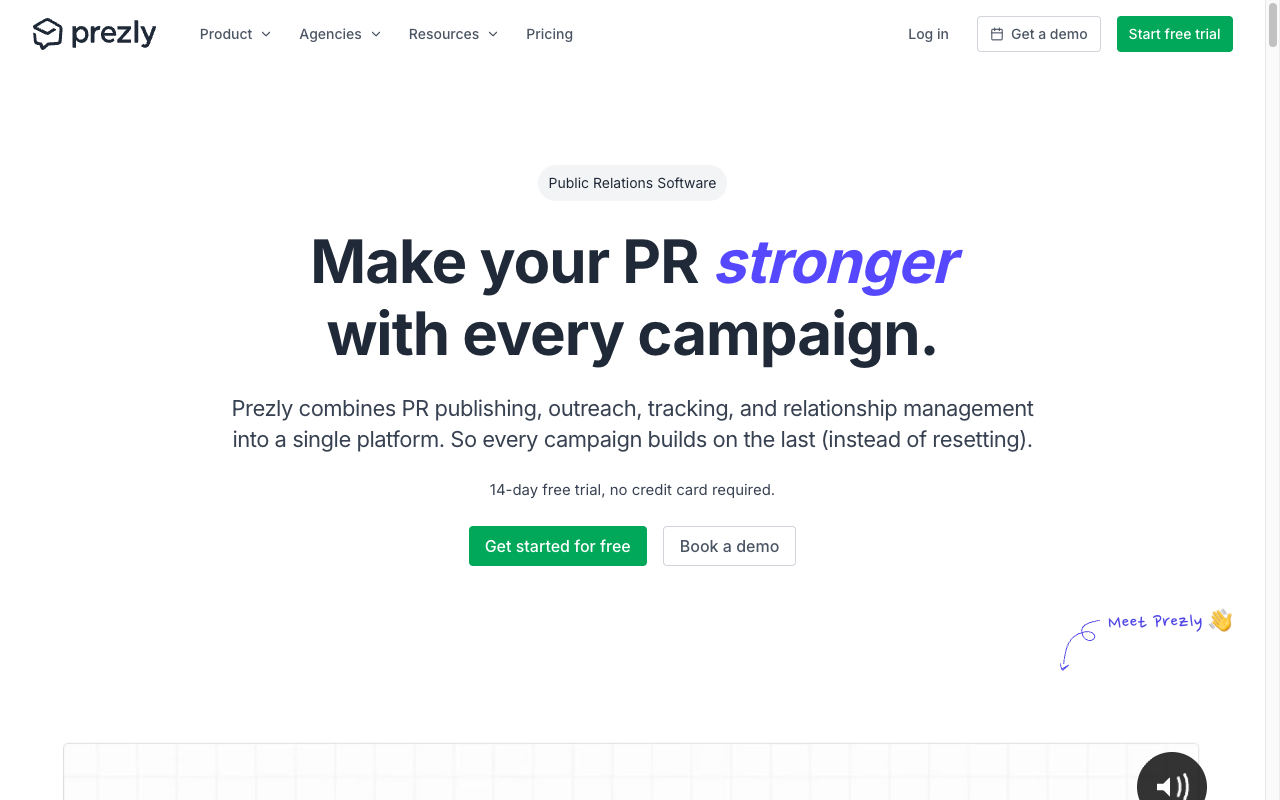
On the exact things Cision-leavers complain about — opaque pricing, annual lock-in, and absent support — Prezly is the cleanest reset. Plans are published openly from around €100/mo, there's a no-card 14-day trial, billing is straightforward, and its branded newsrooms, relationship CRM, and human support (answers on weekends) are the best in the category. The honest catch is scope: Prezly deliberately ships no built-in media database and no monitoring — it's a philosophical stance — so journalist discovery means bringing your own contacts or pairing it with a discovery tool. If you want a press portal and a relationship hub far more than you want a database, it's the strongest swap; if you came to Cision for the contacts, this isn't a one-for-one replacement on its own.
Pros
Most transparent, published pricing of any tool here
Best-in-class branded newsrooms and press portals
Relationship CRM with genuinely praised human support
Cons
No built-in media database — you bring your own contacts
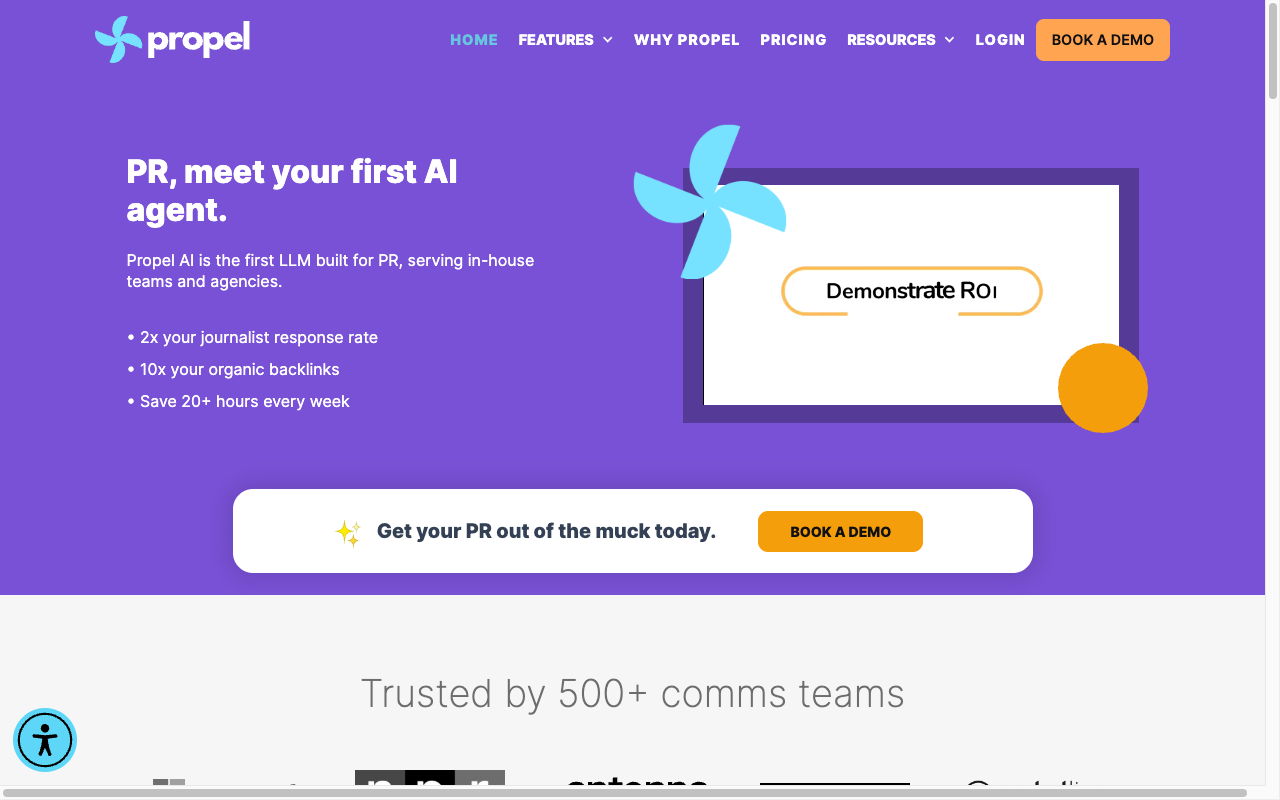
Propel is the value pick against Cision: a modern PR CRM with native Gmail, Outlook, and Slack plugins, so database, pitching, and analytics all happen where you already work instead of in a separate enterprise dashboard. Crucially for a budget-driven switch, its pricing is published — a free tier plus Premium from around $99/mo billed annually — which is a different planet from Cision's five-figure quote. Reviewers love the inbox-native workflow and the price. The honest limits: the journalist data still comes from a daily-refreshed static database (so the same freshness caveats apply), Premium's headline price is annual, and it's a smaller brand with a smaller database than the legacy incumbents — you're trading recognition and scale for value and usability.
Pros
Works natively inside Gmail, Outlook, and Slack
Published pricing from ~$99/mo — a fraction of Cision
Database + pitching + analytics in one, strong usability reviews
Cons
Journalist data still comes from a static (daily-refreshed) database
Premium's headline price is billed annually
Smaller brand and database than the legacy incumbents
Best for: Teams that want an affordable all-in-one with newsrooms — if they're comfortable with the post-acquisition uncertainty.
Pricing: $258–$589/mo
Free option: 7-day trial
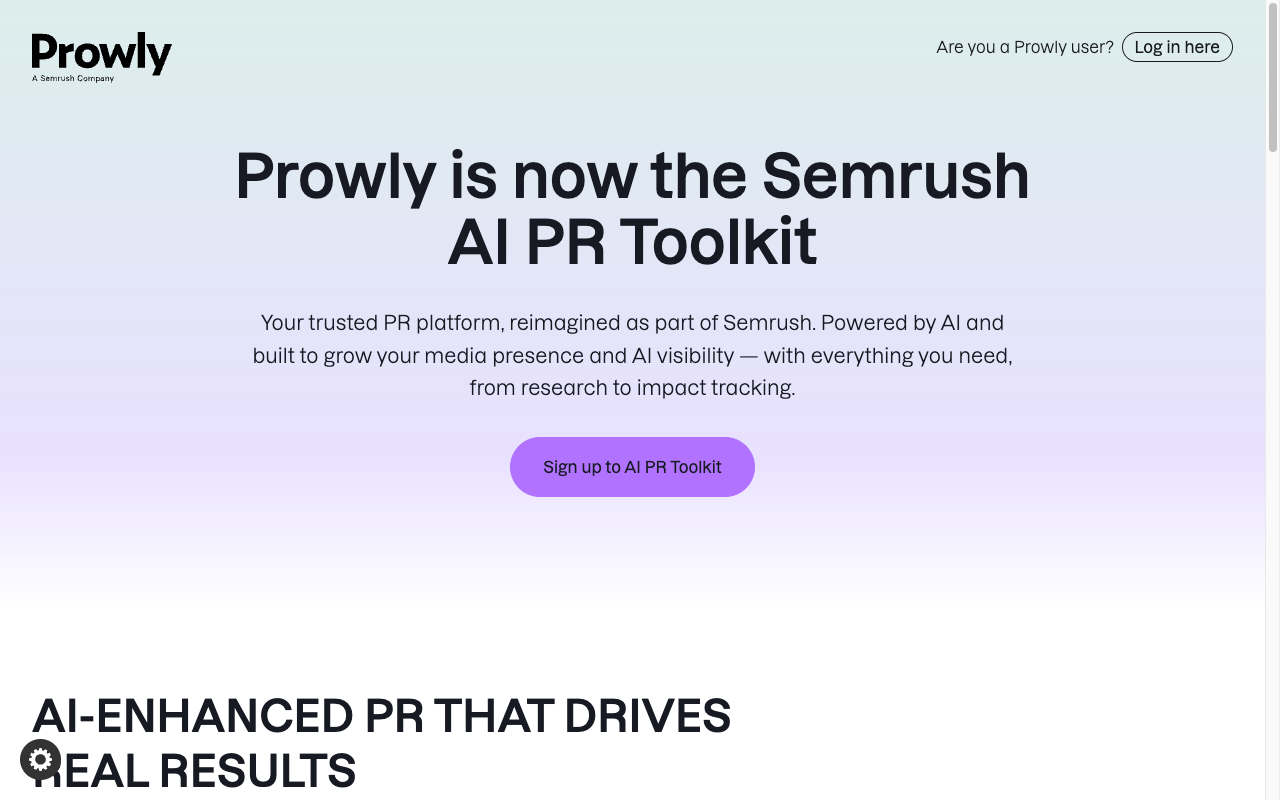
Prowly is the friendlier, cheaper all-in-one — published pricing from around $258/mo, a database, pitching, and branded newsrooms in one tidy product — and for a long time it was the obvious step down from Cision. The complication in 2026 is structural: standalone Prowly is now sold as the Semrush AI PR Toolkit, and Adobe closed its ~$1.9B acquisition of Semrush on April 28, 2026, so the PR line's roadmap is now an Adobe roadmap with no specific product commitment yet. It also carries the same legacy data caveats (stale contacts, bounce) plus reviewer reports of no-warning auto-renewals. Genuinely capable software — but you'd be switching off Cision partly to escape uncertainty, and this one ships with its own.
Pros
Affordable, published mid-market pricing with a 7-day trial
All-in-one: database, pitching, and branded newsrooms
Easier and friendlier than Cision out of the box
Cons
Now the Semrush AI PR Toolkit; Adobe acquisition leaves the roadmap unresolved
Same legacy data caveats — stale contacts and bounce
Best for: Mid-size teams that want a recognizable Cision-style database and monitoring at a friendlier price and with an easier interface.
Pricing: Quote only (~$8K–$15K/yr reported)
Free option: No free trial (demo only)
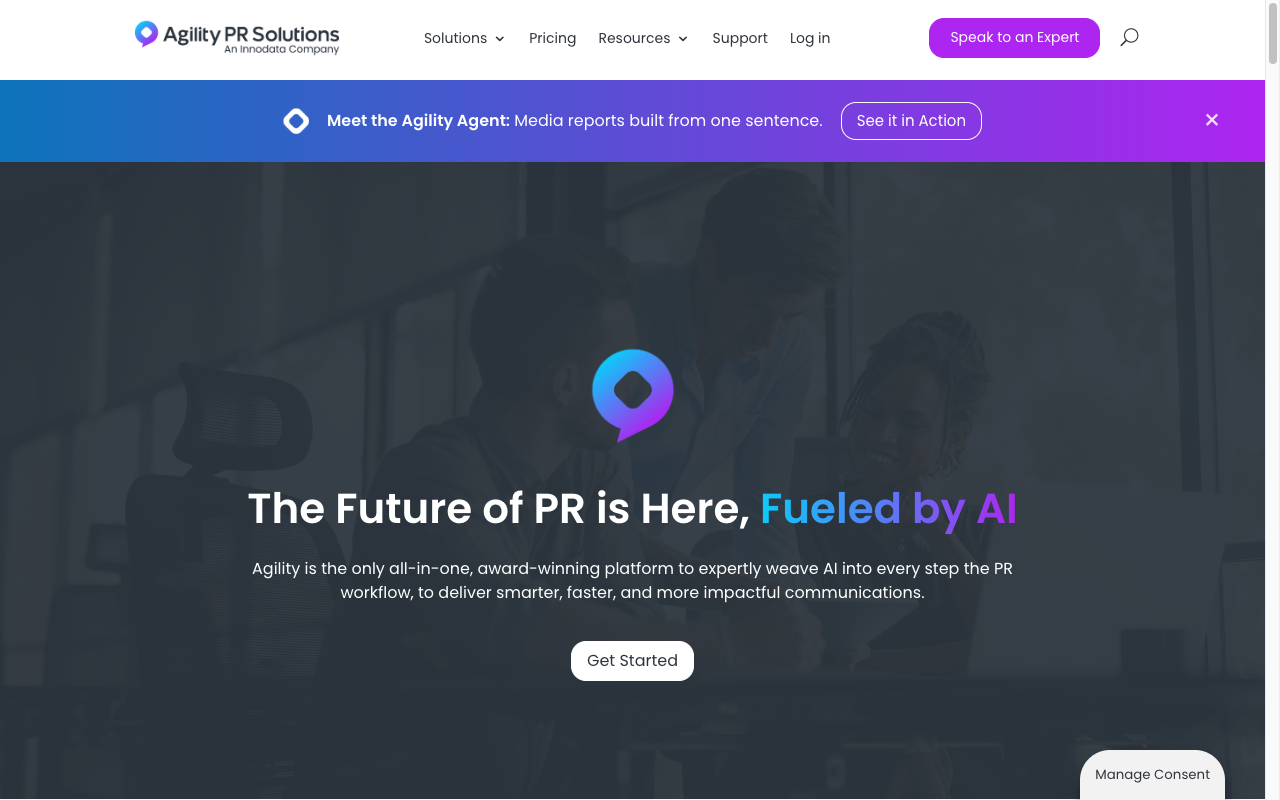
Agility (owned by Innodata) is the most direct like-for-like to Cision among the legacy databases: a 1M+ contact media database, monitoring, and reporting in one suite, but consistently reviewed as easier to learn and cheaper than Cision. Reviewers single out responsive, hands-on account support — the exact thing Cision-leavers complain is missing post-sale. The honest catch is that it's the same fundamental model you're trying to escape: a static human-curated database that draws the familiar stale-contact and bounce complaints, sold quote-only on annual contracts with no public pricing and no self-serve trial. It's a gentler, less expensive version of the thing — not a different thing.
Pros
Recognizable full-service database + monitoring, easier to learn than Cision
Reported to be meaningfully cheaper than Cision for similar coverage
Praised for responsive, hands-on account support
Cons
Same static-database model, with the familiar stale-contact complaints
Quote-only annual pricing, no public pricing, no self-serve trial
Smaller brand and global footprint than Cision or Meltwater
Paste a story. Get your journalist list in minutes.
Drop in a press release, your website URL, or a one-line description of your news. Medialyst reads what's relevant, finds reporters who actually cover it, scores them by fit, and verifies every email — your first list is free, no credit card.
First list free · No credit card
FAQ
Cision alternatives — common questions.
How much does Cision cost in 2026?
Cision doesn't publish pricing — quotes are custom, annual-only, and require a sales call. Third-party sources report entry PR-platform plans around $7,200/yr, typical subscriptions of $12,000–$15,000, and full enterprise suites of $20,000–$45,000+. Vendr's marketplace median is roughly $12,625/yr across 77 tracked transactions, ranging from about $3,150 to $30,553. There's no monthly option and no free trial, and auto-renewal clauses commonly require 3–5 months' advance notice to cancel.
What is the best Cision alternative in 2026?
It depends on why you're leaving. If the problem is cost, lock-in, and stale data, Medialyst is the closest like-for-like for discovery: it finds and scores journalists by fit for your specific story, verifies every email in real time, and starts at $149/mo on a monthly plan with no contract and no sales call — your first list is free. If you want to keep a traditional database but with better accuracy and a cleaner UI, Muck Rack is the strongest legacy pick. If your real need is monitoring and listening rather than outreach, Meltwater leads there.
Is there a cheaper alternative to Cision?
Yes — almost everything here is cheaper. Cision typically runs $10K–$30K+/yr on an annual contract. Medialyst's Starter plan is $149/mo billed monthly with no contract, no per-seat fees, and a free first list. Propel publishes pricing from around $99/mo (Premium, billed annually), Prowly from about $258/mo, and Prezly from around €100/mo — all with published prices and trials, versus Cision's quote-only model.
Why is Cision's contact data criticized?
Cision's database is the largest in the category at 850K+ contacts, but outdated data is its most frequent complaint across every review platform — reviewers report contacts who've moved outlets, bounced emails, and missing details. This isn't unique to Cision: any static, human-curated database decays quickly given newsroom turnover, which 2026's layoffs have accelerated. The two ways out are a competitor with tighter accuracy (Muck Rack) or an AI-native tool that enriches and verifies each journalist live at the moment you build a list (Medialyst), so the unit of truth is a freshly-researched contact rather than a row last touched in a quarterly refresh.
Can I move my Cision lists to a new tool?
Yes. Export your Cision media lists as a CSV. With Medialyst you can upload that CSV and the agent re-verifies and re-scores every contact against your story, enriching each with recent coverage — so you can compare results on your own data before your renewal window closes. Cision's auto-renewal clauses often require 3–5 months' notice, so check your cancellation date before you sign anything new.
Does any alternative replace PR Newswire press-release distribution?
Not directly. PR Newswire (Cision's paid wire) is one of only two dominant global wire services, and none of the alternatives here are a like-for-like wire — Medialyst, Muck Rack, Prowly, Prezly, and Propel are discovery and outreach tools, not paid distribution. The honest framing: if your strategy depends on blasting a release across the wire, Cision keeps that advantage. But Cision's own State of the Media 2026 research found 72% of pitches are considered irrelevant, so most teams get more coverage from targeted outreach to the right journalists than from mass distribution anyway.
What's the difference between a media database and an AI-native tool like Medialyst?
A traditional media database (Cision, Muck Rack, Meltwater, Prowly) gives you a large static list to filter with keywords or Boolean and then verify yourself. An AI-native tool reads the actual recent articles relevant to your announcement, surfaces journalists who genuinely cover that topic, scores them by fit, and verifies their emails in real time — so the unit of truth is a freshly-researched contact for your story, not a row that may have been refreshed quarterly. It also means you skip the sales call, the annual contract, and the Boolean-search learning curve entirely.
Product names and logos are trademarks of their respective owners and are used here only for purposes of comparison. Medialyst is not affiliated with, endorsed by, or sponsored by any of the tools listed. Pricing and feature claims are based on public documentation and customer reviews as of June 2026; please verify with each vendor.