1
Bouncer
EU-hosted verifier that resolves catch-alls on Google and Microsoft
Best for: Cleaning a campaign media list before a pitch at small-batch prices
Pricing: From $8 per 1,000 credits (pay as you go)
Free option: 100 free credits, no credit card
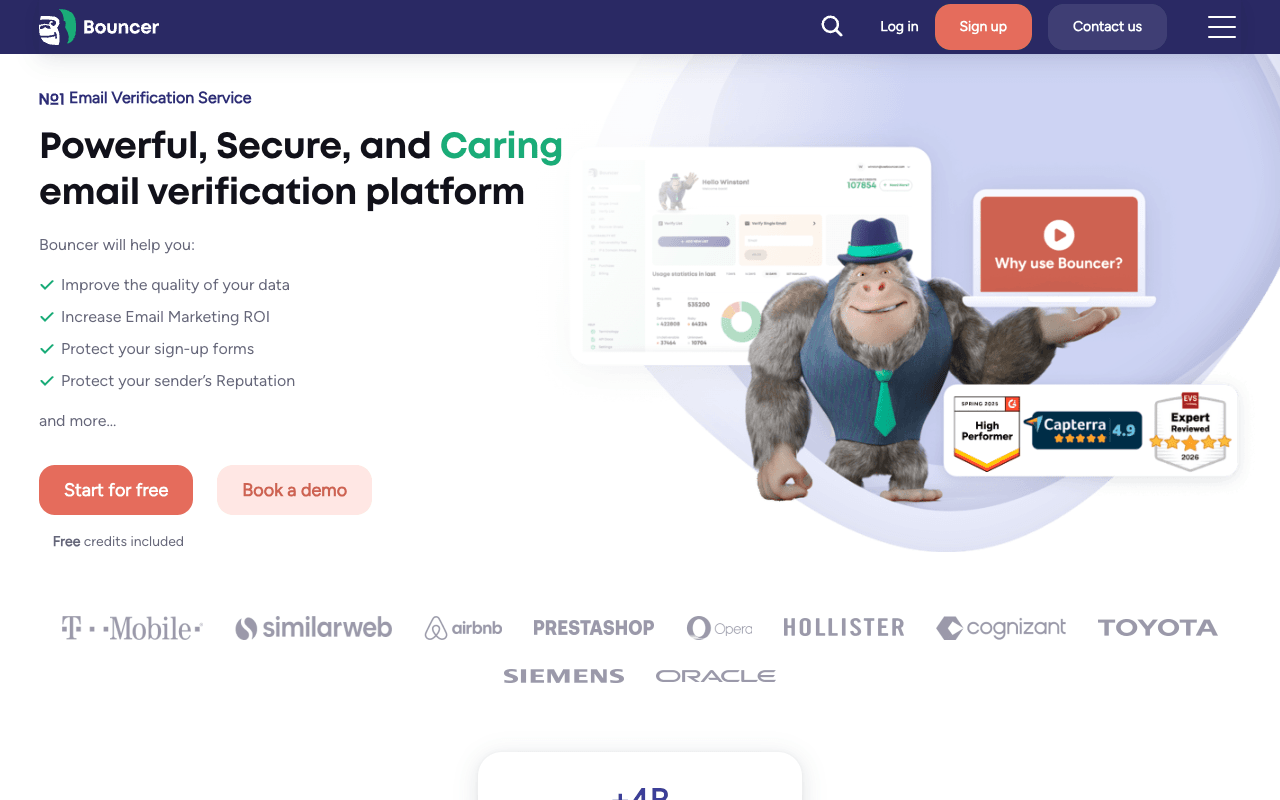
Bouncer is an EU-hosted verification service for bulk lists, single checks and an API, and it's the strongest all-round fit for a PR team cleaning media lists. The reason is catch-all handling: Bouncer says catch-all domains are where most verifiers give up and return "unknown," and that it resolves them on Google and Microsoft mail infrastructure. Results also carry a score plus role, free, disposable, toxicity and full-mailbox flags, so a press@ desk or a full inbox stands out before you pitch. Pricing suits campaign volume: 1,000 credits for $8, 10,000 for $60, and credits never expire. It doesn't charge for duplicates or unknown results, and free list sampling estimates a list's quality before you pay. Results are erased after 60 days, or sooner on request. The tradeoff: catch-all resolution is described for Google and Microsoft mail, so addresses on other newsroom mail systems can still come back as risky, with an accept-all flag.
For PR teamsUpload the campaign list the day before the pitch and drop the invalid addresses. Anything still marked risky (accept-all) gets confirmed against the reporter's recent byline before it goes in the send.
Pros
- Resolves catch-alls on Google and Microsoft mail
- $8 per 1,000 credits, and credits never expire
- No charge for duplicates or unknown results
- EU-hosted, SOC 2, results erased after 60 days
Cons
- Catch-all resolution is stated for Google and Microsoft mail only
- Minimum purchase is 1,000 credits
- Deliverability tools are a separate product with their own plans
2
Clearout
Verifier with Deep Verify for catch-all and gateway domains
Best for: Teams that build media lists in Google Sheets and pitch tier-one outlets
Pricing: From $16/mo billed annually (3,000 credits/mo); one-time from $40
Free option: 100 free credits, no expiry, no credit card

Clearout is the pick for teams that live in Google Sheets and pitch outlets whose mail sits behind corporate security gateways. Its Deep Verify mode is built to resolve more catch-all and gateway-protected addresses into valid or invalid. Clearout says it identifies Proofpoint, Mimecast, Barracuda and Microsoft EOP by their SMTP signatures, and that nothing is ever sent to the address. The Google Sheets add-on is included on every plan, including the free one, so a media list can be checked in the sheet where it was built. There's also a Chrome extension, an API and CRM integrations. Purchased credits never expire, and subscription credits roll over. The tradeoff is the entry point: the smallest one-time pack is 5,000 credits for $40 (10,000 is $65), more than one campaign needs. Light users can take the Starter subscription instead: 3,000 credits a month for $23 billed monthly, or $16 a month billed annually.
For PR teamsKeep the media list in Google Sheets, run the add-on before each send, and use Deep Verify on the rows that come back catch-all from big publishers.
Pros
- Deep Verify targets catch-all and gateway-protected domains
- Google Sheets add-on on every plan, including free
- Purchased credits never expire; subscription credits roll over
- GDPR, ISO and SOC 2 Type II, with a DPA
Cons
- Smallest one-time pack is 5,000 credits ($40)
- Free plan runs one bulk verification at a time
- Extra seats cost $25 each
3
Hunter
Email finder and verifier with a Sheets add-on and free checker
Best for: PR teams that need to find a reporter's address before checking it
Pricing: Free; paid from $34/mo billed yearly ($49 monthly)
Free option: Free plan: up to 100 verifications/mo
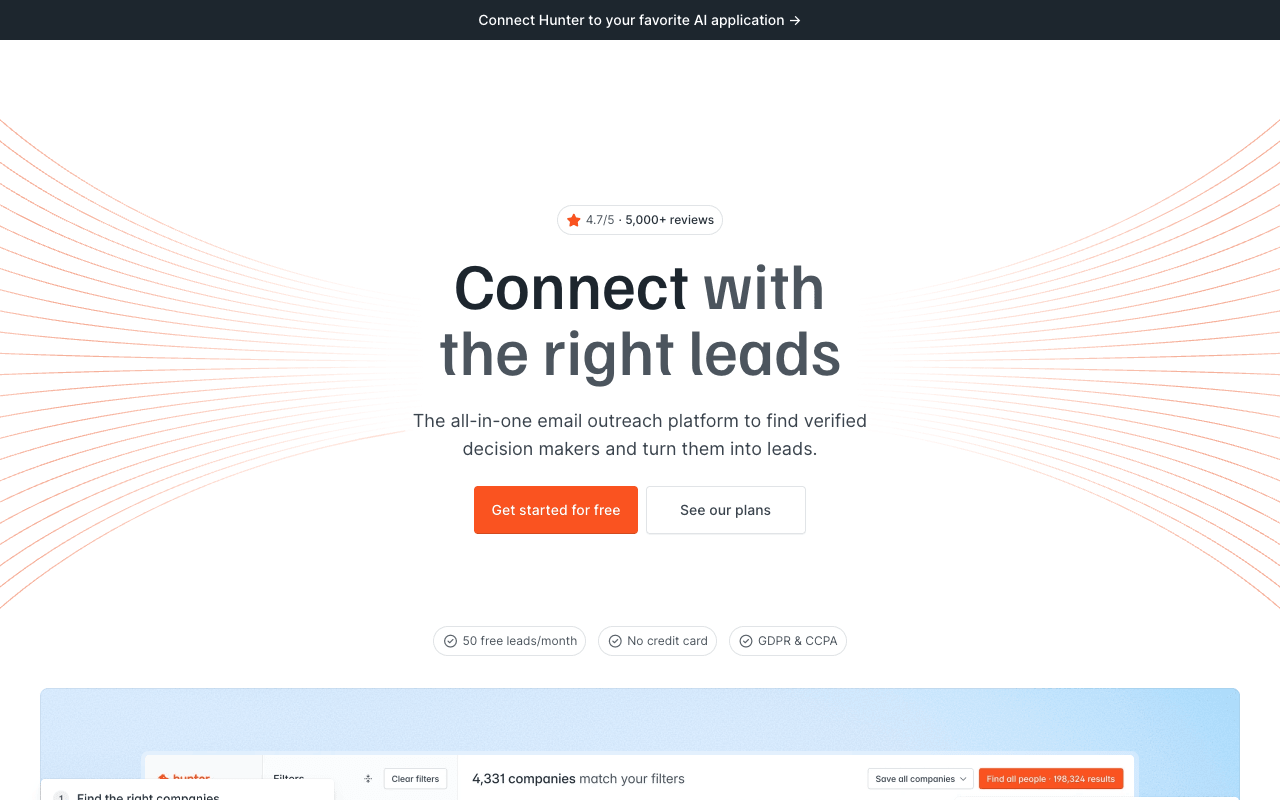
Hunter is an email finder and outreach platform, and its verifier page speaks to PR directly, suggesting you verify press lists to avoid outdated contacts and reach real editors. That fits how PR teams work: you often have to find or guess an address before you can verify it, and Hunter does both on one credit balance. A found email costs 1 credit and a verification half a credit. Hunter says it can verify accept-all addresses with several major email providers, and it checks addresses against its own B2B database. The web verifier works without signup, and the free plan covers up to 100 verifications a month. A Google Sheets add-on, browser extensions and an MCP server put checks where PR people already work, and every plan includes unlimited team members. Its FAQ is candid that verification can never prevent all bounces. The tradeoff: paid plans are subscriptions, from $34 a month billed yearly or $49 monthly, and monthly-plan credits don't roll over.
For PR teamsFind a missing reporter's address with the browser extension, verify it in the same step, and run the add-on across the campaign sheet before sending.
Pros
- Finder and verifier share one credit balance
- Free no-signup checker plus 100 free verifications a month
- Google Sheets add-on, browser extensions and MCP
- Unlimited team members on every plan
Cons
- Monthly-plan credits reset each month and don't roll over
- Paid plans are subscriptions, from $34/mo billed yearly
4
Verifalia
EU verifier with daily free checks and retention you control
Best for: Small, privacy-sensitive client lists and quick daily checks
Pricing: From $7.90 per 1,000 credits (pay as you go)
Free option: Free plan: 25 verifications/day
Verifalia is an Italian verification service with low small-batch pricing and close control over your data. Packs start at 1,000 credits for $7.90 (10,000 is $49.90), and pack credits never expire. The free plan verifies up to 25 addresses a day, enough to check a few reporters or a short list without paying. You choose a quality level per job: Standard costs 1 credit, High runs three validation passes with 50 seconds of anti-tarpit and greylisting time for 2 credits, and Extreme runs nine passes for 4 credits. That's the setting to try on a short, high-value list where a quick check came back inconclusive. You set how long submitted lists are kept, from 5 minutes to 30 days, and can delete them anytime, which helps when a client's media list counts as personal data. A Google Sheets add-on, API and SDKs round it out. The tradeoff: unused daily-plan credits expire at the end of each day, and higher quality levels double or quadruple the cost per address.
For PR teamsUse the free daily allowance for one-off reporter checks, and buy a 1,000-credit pack for campaign lists, with retention set to minutes for client data.
Pros
- $7.90 per 1,000; pack credits never expire
- 25 free verifications every day
- Retention you set, from 5 minutes to 30 days
- Google Sheets add-on and API
Cons
- Daily-plan credits expire at the end of each day
- High and Extreme quality levels cost 2 or 4 credits per address
- No refunds for unused portions of plans
5
ZeroBounce
Validation plus deliverability suite with 100 free checks a month
Best for: Agencies that run their own sending domain and want deliverability tools
Pricing: From $39 for 2,000 (pay as you go); ONE $99/mo
Free option: 100 free verifications/mo (business-domain signup)
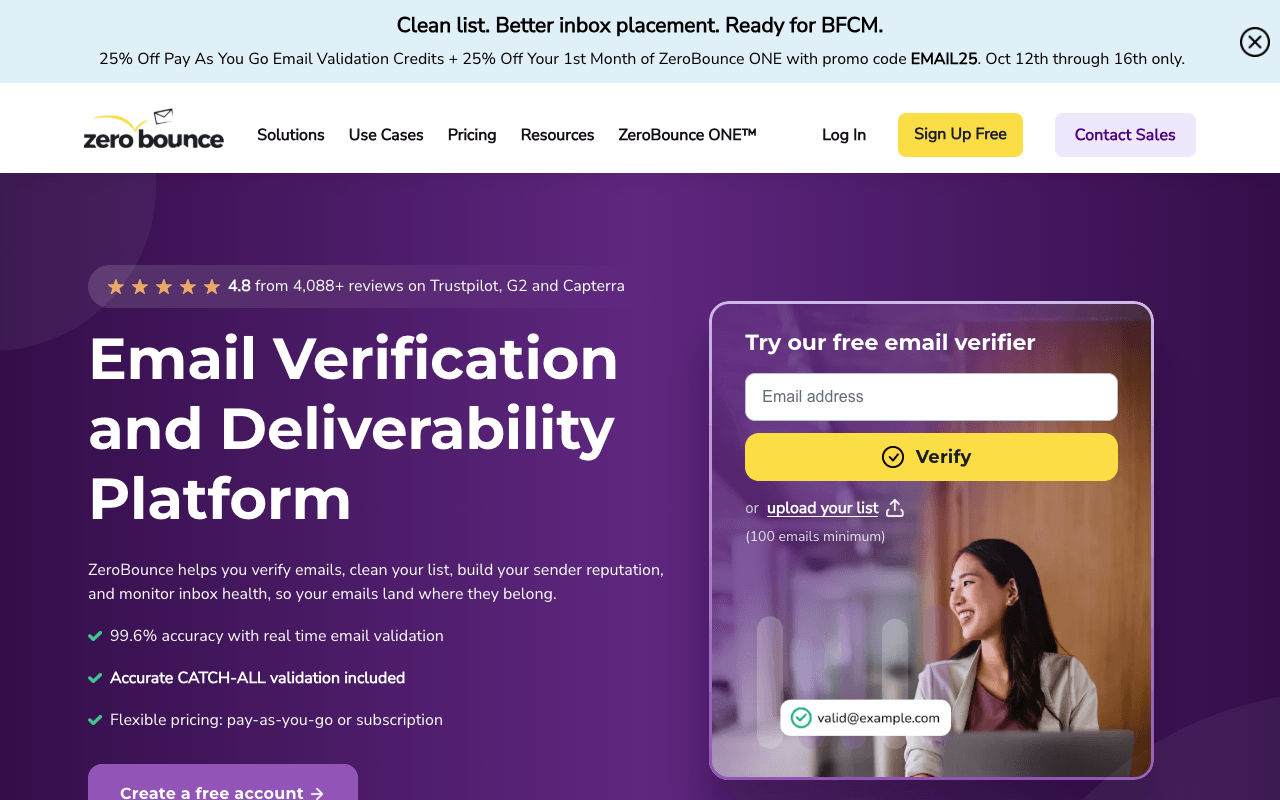
ZeroBounce is a large validation and deliverability suite, and the best fit here for an agency that manages its own sending domain and wants verification, inbox tests, blacklist monitoring and DMARC in one account. Its catch-all validation can resolve many individual addresses as valid or invalid, and ZeroBounce is upfront that some catch-alls stay unresolved. It never charges for unknown results or duplicates. Sign up with a business domain and you get 100 free verifications every month, which covers plenty of one-off reporter checks. Pay as you go starts at $39 for 2,000 validations, the minimum purchase. The ZeroBounce ONE subscription is $99 a month and bundles 10,000 validations, 10,000 finder lookups, 100 inbox tests, 10 blacklist monitors and 250 warmup seeds. Uploaded data is erased after 30 days, and it lists SOC 2 Type II, ISO 27001 and GDPR. The tradeoff for occasional users: credit expiry depends on whether you have an active ONE subscription and when your account was created.
For PR teamsUse the free monthly allowance for single reporter checks, and the ONE plan when the agency also monitors its sending domain's inbox placement and blacklist status.
Pros
- 100 free verifications a month with a business email
- Catch-all validation, with no charge for unknowns
- Deliverability tools for agencies running their own domain
- Data erased after 30 days; SOC 2 Type II and ISO 27001
Cons
- Minimum pay-as-you-go purchase is $39 for 2,000
- Credit expiry depends on subscription status and account age
- Free plan requires a business or premium-domain signup
6
Emailable
Simple verifier with 250 free credits and no-expiry pricing
Best for: Testing a verifier on a real campaign list before paying
Pricing: From $38 for 5,000 credits (pay as you go)
Free option: 250 free credits at signup
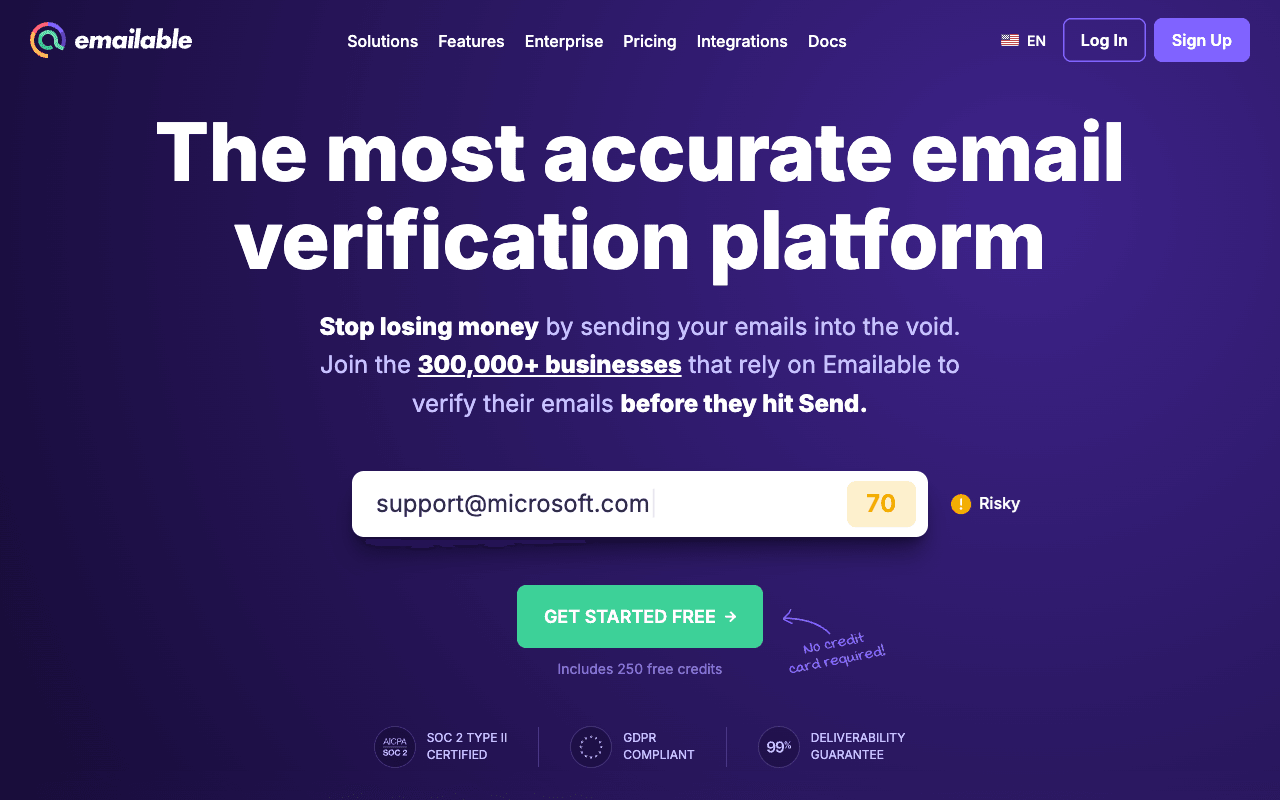
Emailable is a straightforward verifier with a useful starting allowance: every new account gets 250 credits, enough to test it on a real campaign list. Results come back as Deliverable, Risky, Undeliverable or Unknown, and credits spent on unknown results and duplicates are returned to your balance. Emailable says it never emails the address it's checking, relying on non-intrusive checks and its own data instead. Credits never expire, subscription credits roll over, and subscribing saves 15%. It connects to Google Sheets through Make or Zapier, alongside HubSpot, Mailchimp and Salesforce, and says it is SOC 2 Type II certified and GDPR and CCPA compliant, with data you can delete at any time. The tradeoff is the minimum purchase: 5,000 credits for $38 (10,000 is $60), which one media list won't use up. Because credits don't expire, the remainder carries into the next campaign.
For PR teamsRun the first campaign list on the free 250 credits, then buy a 5,000-credit pack that covers several launches.
Pros
- 250 free credits at signup
- Credits never expire; unknowns and duplicates refunded
- Plain four-status results
- SOC 2 Type II, GDPR and CCPA; delete data anytime
Cons
- Minimum purchase is 5,000 credits ($38)
- Google Sheets connects through Make or Zapier
7
Reoon Email Verifier
Budget verifier with up to 600 free checks a month
Best for: Solo publicists and founders pitching a few reporters a week
Pricing: From $11.90 for 10,000 credits (one time)
Free option: 20 free credits/day (up to 600/mo) + 100 at signup

Reoon is a budget verifier with a recurring free tier: 20 daily credits for life, up to 600 verifications a month, plus 100 instant credits, with no credit card. For a publicist who pitches a handful of reporters a week, that may be all the verification they need. Paid instant credits are cheap and never expire: 10,000 for $11.90, 25,000 for $29.66. Results are grouped into safe, catch-all, disposable, invalid and unknown, with a 0-100 score, and credits spent on unknown results are refunded automatically. Reoon says it never sends email to uploaded addresses and deletes uploaded data after 15 days by default. The tradeoff is catch-all handling: Reoon defines a catch-all as a domain that accepts mail for any name, so the mailbox cannot be confirmed, and advises sending to those addresses with caution as a separate segment. On a newsroom-heavy list, expect a catch-all pile to confirm by hand.
For PR teamsCheck each week's handful of new reporter addresses on the free daily credits, and buy a 10,000-credit pack when an agency list needs a full clean.
Pros
- Up to 600 free verifications a month
- 10,000 credits for $11.90, never expiring
- Unknown results refunded automatically
- Uploaded data deleted after 15 days by default
Cons
- Catch-all results stay unconfirmed, to send with caution
- Free daily credits renew when you log in
- Smallest instant-credit pack is 10,000
8
EmailListVerify
Low-cost bulk verifier from $6.99 per 1,000 credits
Best for: One-off cleans of a media-database export on a tight budget
Pricing: From $6.99 per 1,000 credits (pay as you go)
Free option: 100 free credits at signup
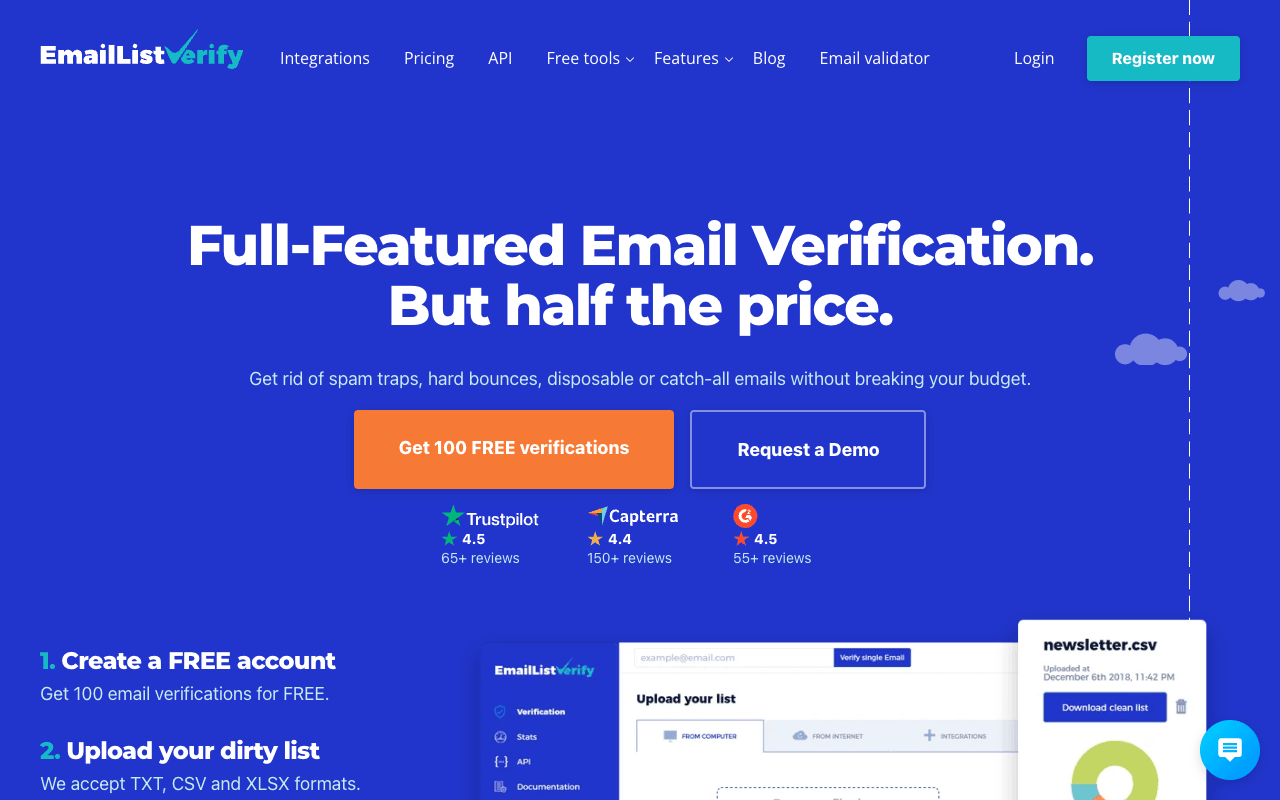
EmailListVerify has the lowest minimum purchase in this list: 1,000 pay-as-you-go credits for $6.99, and those credits never expire. Larger packs cost less per check (10,000 for $27.99), and monthly subscriptions start at $16 for 5,000 credits if your agency runs campaigns every month. It accepts TXT, CSV and XLSX files, so a media-database export can go straight in, and its catch-all checker spots domains that return valid for every address. New accounts get 100 free verification credits. There's also an email finder on the same balance, at 5 credits per address found with medium or higher confidence. The tradeoff: it's a plain bulk verifier. Its homepage suggests skipping catch-all domains rather than resolving them, so catch-all newsroom addresses need your own judgment, and finding an email costs five times as much as checking one.
For PR teamsUpload the XLSX export from your media database before a launch, pitch the valid rows, and research the catch-all rows by hand.
Pros
- $6.99 for 1,000 credits, never expiring
- Accepts TXT, CSV and XLSX uploads
- Flags catch-all domains
- 100 free credits at signup
Cons
- Suggests skipping catch-all domains rather than resolving them
- Email finder costs 5 credits per address found
9
MillionVerifier
Bulk verifier with catch-all checks included in the credit
Best for: Agencies cleaning a large master media database or many client lists
Pricing: From $39 for 10,000 credits (one time)
Free option: 100 free credits, no credit card
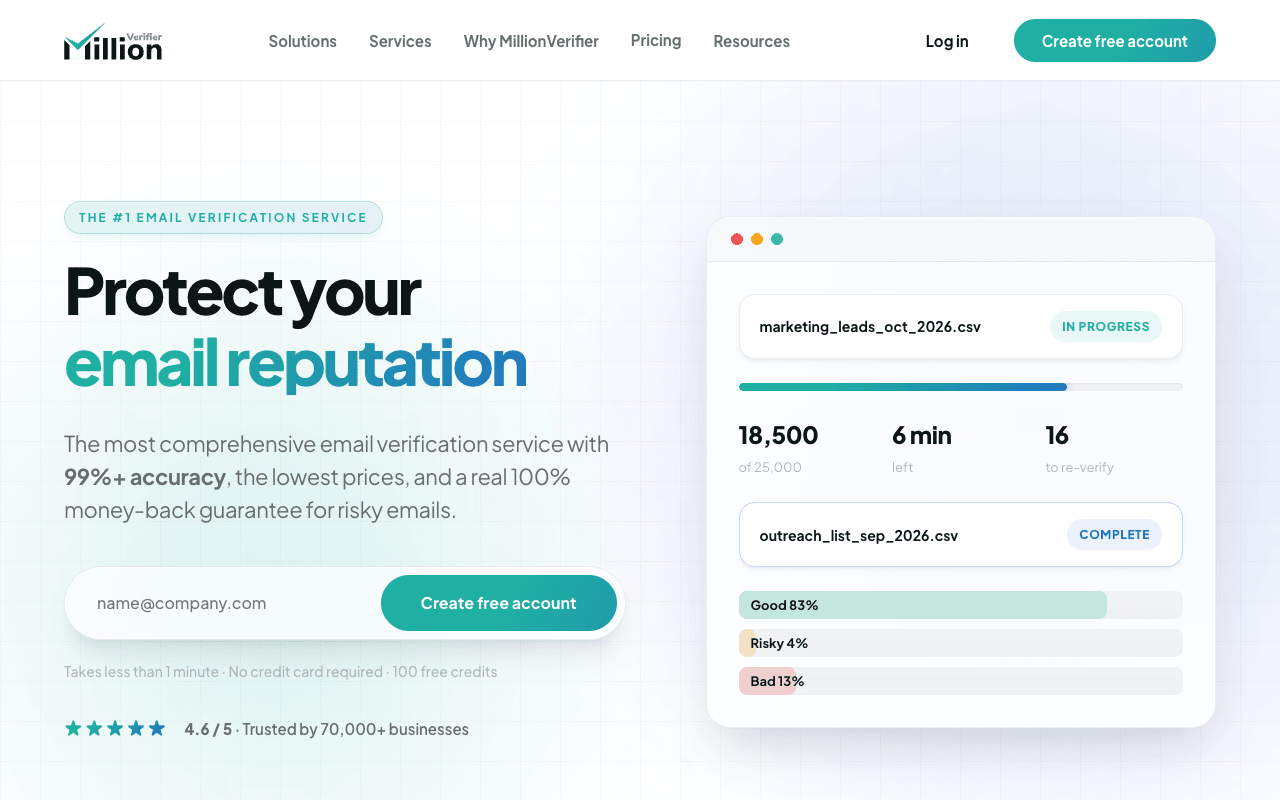
MillionVerifier is built for volume: 10,000 verifications for $39, 100,000 for $149 and a million for $449, with credits that never expire. That suits an agency cleaning a large master media database or several clients' lists at once. Catch-all checking costs one regular credit, and MillionVerifier says its engine resolves 30% to 40% of catch-alls into valid addresses (its own figure), and the rest are labeled Risky. It refunds risky results, offers a 100% money-back guarantee, and has a free real-time checker for one-off reporters. It says it never sells or uses your data, and you can sign its DPA on every plan, including free. New accounts get 100 free credits with no credit card. The tradeoff is the entry point: there's no pack below 10,000 credits, so a single 200-name campaign list leaves most of the purchase unused until the next one.
For PR teamsRun the agency's full journalist database through it once a quarter, and use the free single checker for one-off addresses in between.
Pros
- 10,000 verifications for $39; credits never expire
- Catch-all checks at no extra credit cost
- Risky-result refunds and a money-back guarantee
- DPA available on every plan, including free
Cons
- No pack below 10,000 credits
- Built for bulk cleaning, more volume than one campaign needs