1
BuzzStream
Outreach CRM for link building and digital PR
Best for: Digital PR teams that want pitching, follow-ups and link tracking in one place
Pricing: Starter $49/mo (1 user); Growth $174/mo (3 users); monthly, no minimum term
Free option: Free trial (length not stated)
BuzzStream is an outreach CRM built for link building and digital PR, and it covers more of the daily loop than anything else here. You build lists of journalists and bloggers based on your history with each writer, find contact details, pitch from templates, and see opens, clicks and replies on every plan. It also tracks the placements you earn and monitors links (1,000 on Starter, 25,000 on Growth, 100,000 on Professional), so the pitch and the proof sit in one record. Bulk sending, scheduling, automated follow-ups, link reporting and an Ahrefs integration start on Growth at $174/mo for 3 users ($58 per additional user). ListIQ, a separate Chrome extension from $24/mo, builds media lists by researching articles and journalists on the web or in a Google Sheet. The tradeoff is that the entry plan is small: Starter is one user, 500 contacts and 30 prospecting searches.
For PR teamsLog every journalist pitched for a client campaign, schedule follow-ups, and match the links that land back to the outreach that earned them.
Pros
- Outreach, reply tracking and placement tracking in one CRM
- Link monitoring on every plan, from 1,000 links
- Monthly plans with no minimum term
- ListIQ add-on researches articles and journalists for lists
Cons
- Automated follow-ups and bulk send start on Growth ($174/mo)
- Starter is limited to 1 user and 500 contacts
- ListIQ is a separate, credit-based product
2
Ahrefs
Backlink index with new, lost and mention alerts
Best for: Proving which links a campaign earned and chasing unlinked mentions
Pricing: Lite $129/mo billed monthly ($108/mo billed annually); Standard $249/mo; Advanced $449/mo
Free option: Ahrefs Free for your own verified sites
Ahrefs is an SEO platform, and for digital PR it is the measurement layer. Alerts notify you whenever a site or URL gains or loses backlinks, and when a brand picks up a web mention, which is how a team spots new coverage links and finds mentions that ran without one. Site Explorer shows which websites link to a client or a competitor, which also surfaces the outlets already linking in your space. Content Explorer, from Standard at $249/mo, tracks web mentions and finds link prospects. Lite is $129/mo billed monthly ($108/mo billed annually) with one user; extra users cost $40, $60 or $80 a month depending on plan, and Enterprise ($1,499/mo) requires an annual commitment. Ahrefs Free covers your own verified sites with up to 1,000 backlinks visible at once. The tradeoff for PR: Ahrefs shows which links landed, not which journalists to pitch next, so pair it with an outreach tool and a list builder.
For PR teamsSet backlink and mention alerts for each client domain, then pull the month's new links into the client report.
Pros
- New and lost backlink alerts for any site or URL
- Web mention alerts for unlinked coverage
- Content Explorer finds link prospects (Standard and up)
- Free tier for your own verified sites
Cons
- Content Explorer and broken backlinks start at $249/mo
- Extra users cost $40-$80/mo each, by plan
- Enterprise requires an annual commitment
3
MedialystWe make this
Finds the journalists who cover your story, scored by fit
Best for: Building the target list for a data-led or reactive campaign
Pricing: From $97/mo billed annually ($149/mo monthly)
Free option: Free first list, 100 credits, no credit card
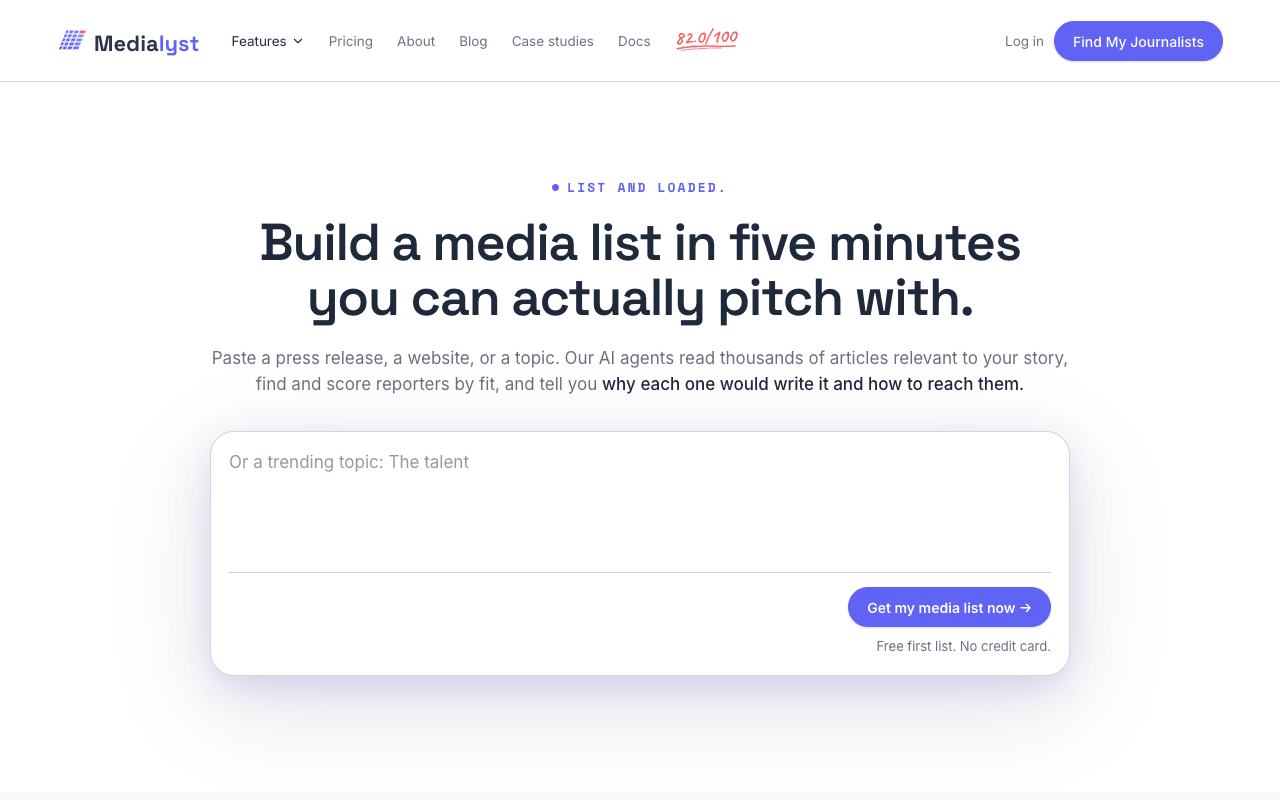
Medialyst handles the targeting step: which journalists actually cover this story. Paste a press release, a URL or a one-line description of your data campaign or reactive comment, and it reads articles relevant to that story, surfaces the journalists who cover it, and scores each one 0-100 by fit, with reasoning grounded in their recent work. Every email it delivers was validated in the last 14 days or is re-checked when you build the list, and you pay one credit only when a verified email is delivered; misses are free. You review and send from the list yourself, with open, click and reply tracking. Starter is $97/mo billed annually or $149/mo monthly, with no per-seat fees and no contract, and a public API and MCP server let you run it inside Claude, ChatGPT or Cursor. The tradeoff: it doesn't offer link tracking or coverage reports, and a person sends every pitch, so pair it with a link tracker and, for follow-up workflows, an outreach CRM.
For PR teamsPaste the campaign summary or release, keep the highest-fit journalists, and pitch them from the list with a person reviewing every email.
Pros
- Story-level targeting, not beat tags
- Pay only when a verified email is delivered
- No per-seat fees, no contract, 14-day money-back guarantee
- API and MCP access with credits shared across app and agents
Cons
- No backlink or coverage tracking
- A person sends every pitch, so it isn't built for volume sends
4
Semrush AI PR Toolkit
Prowly's PR suite, now part of Semrush
Best for: Teams that want database, pitching and monitoring in one suite
Pricing: From $149/mo billed annually; +$20/mo per extra user
Free option: 7-day free trial (no emailing journalists during the trial)
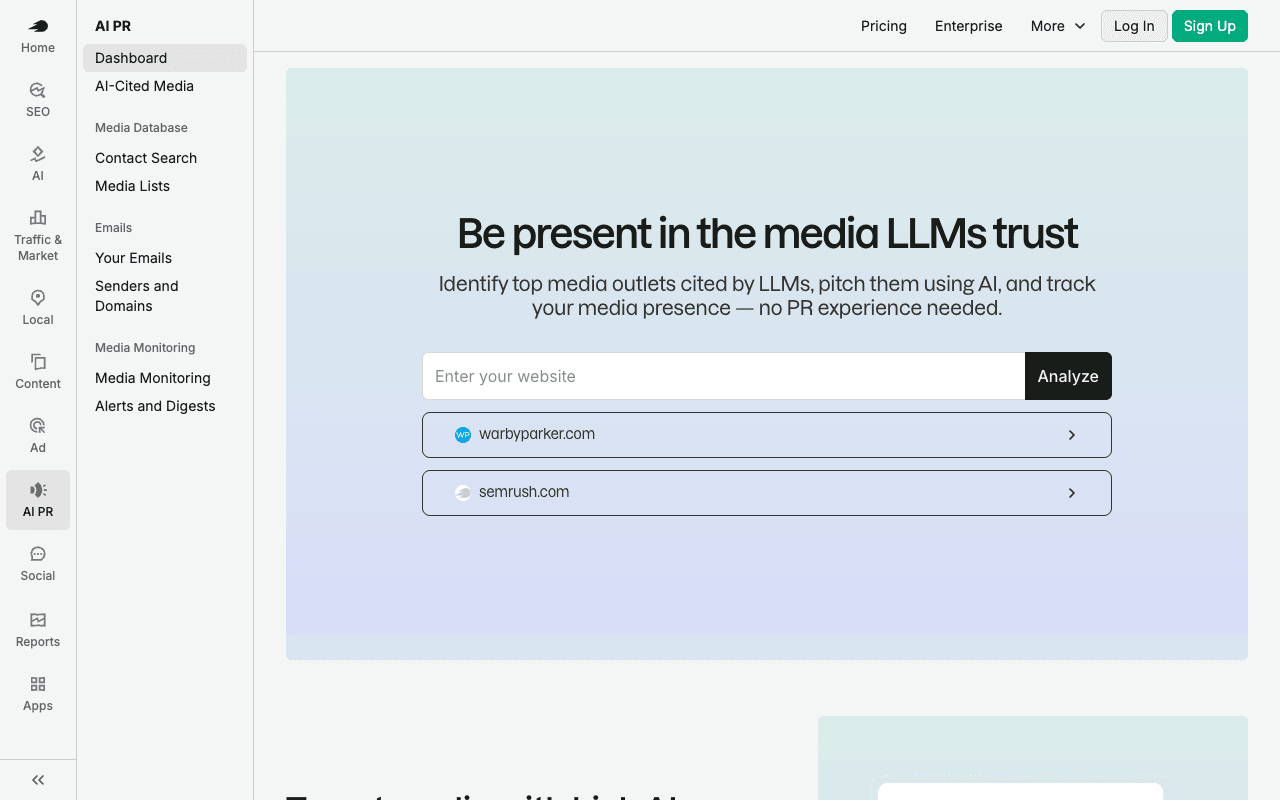
Prowly is now the Semrush AI PR Toolkit, and it is the broadest PR suite on this list. Every plan includes a global media database with AI search, AI-driven journalist recommendations, an AI-cited media finder for the outlets that shape LLM responses, a pitching tool with AI-drafted emails, and email analytics. Pro ($279/mo billed annually) adds online media monitoring, outlet audience and traffic insights, contact export, scheduled follow-up emails and tracking of which pitches led to coverage. Business ($499/mo billed annually) adds competitor media tracking and benchmarking. Base is $149/mo billed annually, and additional users are $20/mo. The 7-day free trial lets you test a plan, but you can't email journalists directly during the trial. The tradeoffs: contacts from the media database are capped per month (250 on Base, 500 on Pro, 1,000 on Business), and Semrush prices its SEO plans separately, so a team that also wants SEO data pays for a second subscription.
For PR teamsSearch the database for a campaign's journalists, pitch them with scheduled follow-ups, and see which pitches turned into coverage.
Pros
- Database, pitching and monitoring in one product
- AI-cited media finder for outlets that shape AI answers
- Pitch-to-coverage tracking on Pro
- Low add-on price per extra user
Cons
- Database contacts capped at 250-1,000 per month by plan
- SEO plans are priced separately from AI PR plans
- Follow-ups and monitoring start on Pro ($279/mo)
5
Pitchbox
Outreach platform for link building and AEO at volume
Best for: Link building agencies running outreach across many clients
Pricing: From $210/mo billed annually ($300/mo billed monthly); 1-year commitment
Free option: Free trial available after a demo
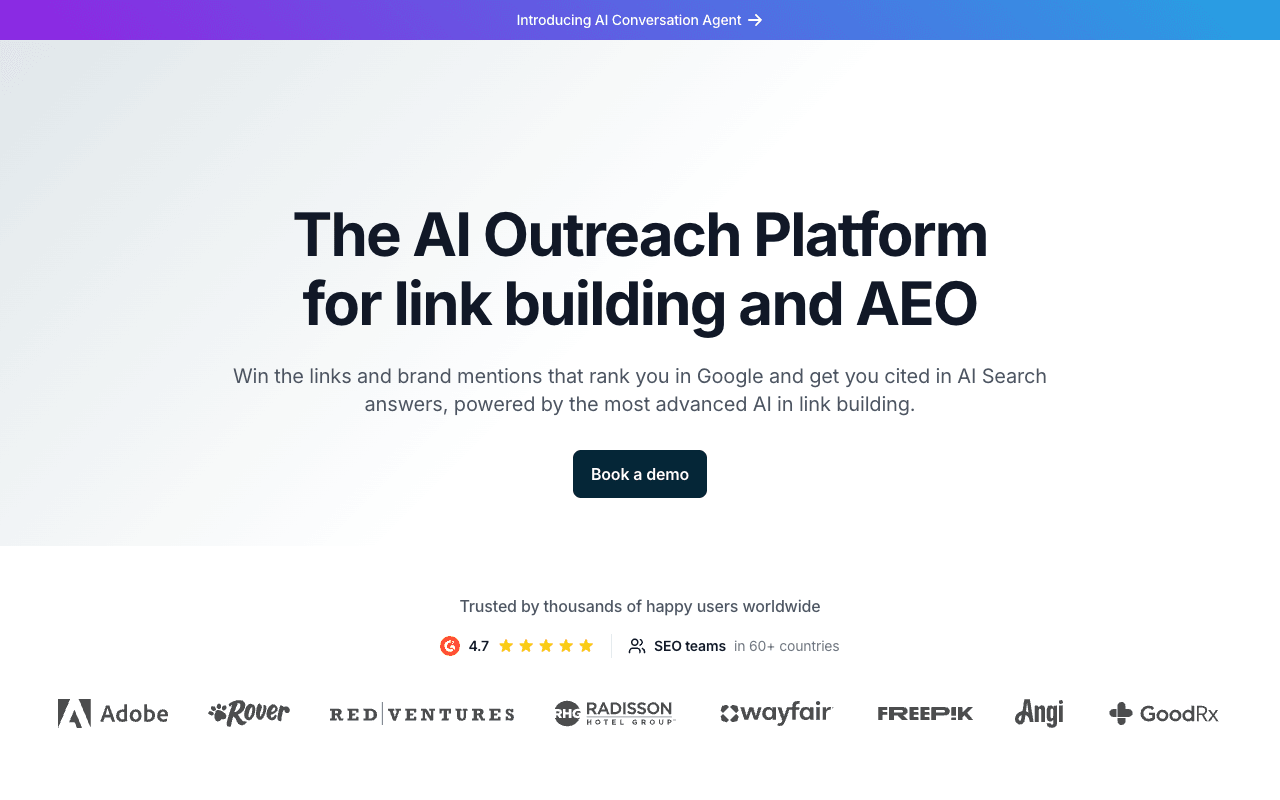
Pitchbox calls itself "The AI Outreach Platform for link building and AEO", and it is built for teams that run outreach at volume across many sites and clients. Prospecting returns relevant high-authority sites enriched with verified contact data, and campaign types include digital PR, link reclamation, broken backlinks and guest posting. Advanced adds white-label client reports, unlimited users and 25 workspaces for agencies. Pro is $210/mo billed annually or $300/mo billed monthly (2 users, 2,000 outreach emails, 1,000 links monitored). Advanced is $420/mo annually ($600 monthly) with 5,000 emails, and Scale is $825/mo annually ($1,200 monthly) with 25,000. The tradeoff is commitment: Pitchbox says all plans require a one-year commitment regardless of billing frequency. Its prospecting is site-based, so for journalist-led campaigns, pair it with a story-level journalist list.
For PR teamsRun link reclamation and digital PR campaigns for several clients from separate workspaces, with white-label reports for each.
Pros
- Digital PR, link reclamation and broken-link campaign types
- White-label reports and up to 25 workspaces on Advanced
- Link monitoring included on every plan
Cons
- One-year commitment on all plans, even when billed monthly
- Pro includes 2 users and 1 workspace
- Free trial goes through a demo first
6
CoverageBook
Coverage reports with a client link counter
Best for: Agencies that send clients branded coverage and link reports
Pricing: From $99/month (Bronze); annual plans get one month free
Free option: 30-day free trial, no credit card
CoverageBook does one job: turning coverage into client-ready reports quickly. For digital PR, it finds the links in your coverage, counts them and analyses their strength through Domain Authority scores, giving the account team a client link counter to share. Bronze is $99/month for 100 clips a month and up to 5 users; Bronze Plus is $169 (200 clips, 10 users), Silver $229 (400 clips, 50 users) and Gold $599 (1,200 clips, 100 users). Annual plans get one month free, there's no contract, and charities and non-profits get 30% off. CoverageBook says it is trusted by over 18,753 agency and in-house PR professionals. The tradeoffs are deliberate: it says it intentionally does not monitor or alert you to coverage, and it doesn't calculate AVE, so you bring the clips from Ahrefs alerts or a monitoring tool.
For PR teamsDrop the month's coverage into a client report and send a link counter with Domain Authority scores instead of a spreadsheet.
Pros
- Finds, counts and scores links inside coverage
- Up to 5 users from the entry plan
- 30-day trial with no credit card
- No contract; 30% off for charities and non-profits
Cons
- Doesn't monitor or alert you to coverage, by design
- Monthly clip allowances by plan (100 to 1,200)
7
BuzzSumo
Content research, journalist database and backlink alerts
Best for: Finding campaign ideas and the journalists writing on a topic
Pricing: From $199/mo billed yearly; PR & Comms $299/mo billed yearly
Free option: Free trial (length not stated)
BuzzSumo is the ideation tool on this list. Content Analyzer and Trending show what is getting attention on a topic, which is where many data-led campaign ideas start. The PR & Comms plan adds a media database built to find journalists writing about your brand, market and competitors "right now, not a year ago", plus outreach and coverage reports. Backlink Analyzer tracks the uptake of backlinks to domains and URLs over time, and alerts cover backlinks and journalists. Content Creation is $199/mo billed yearly for 1 user and 2 alerts; PR & Comms is $299/mo billed yearly for 5 users and 5 alerts; Suite is $499/mo for 10 users. The tradeoffs: the media database starts at the $299 plan, alerts are capped by plan, and BuzzSumo says it can't refund the remaining months if you cancel an annual plan early.
For PR teamsResearch what is getting attention in a client's category, shape a data story around it, and find the journalists writing on that topic this month.
Pros
- Content research for campaign ideation
- Journalist discovery by current topic
- Backlink and journalist alerts
Cons
- Media database starts on PR & Comms ($299/mo billed yearly)
- Alerts capped by plan (2 to 50)
- No refund for remaining months on early annual cancellation
8
Qwoted
Journalist requests matched to your experts' expertise
Best for: Agencies running expert-commentary programs for several clients
Pricing: Free Basic; Pro $149/mo; Teams custom
Free option: Free Basic plan: 2 pitches/mo, 2-hour delay
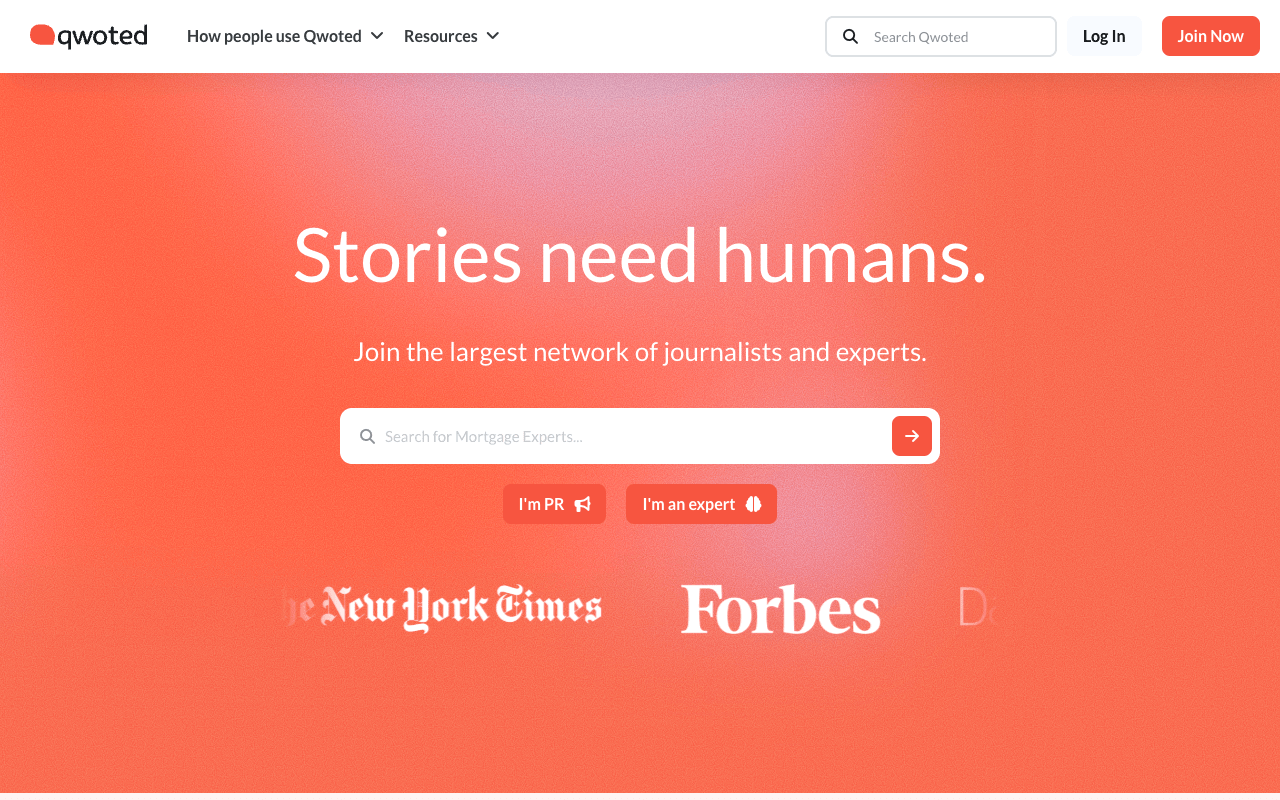
Qwoted brings media opportunities to you. You create profiles for your thought leaders or clients, and it alerts you in real time to opportunities that match their expertise, then notifies you the moment a pitch is read (profile-view alerts are on Teams). There is also a media database with search filters. For agencies, one account can represent several experts, which suits expert-commentary programs that earn mentions and links. Basic is free with 2 pitches a month and a 2-hour delay on opportunities; Pro is $149/mo for 35 pitches a month with no delay, an events and awards database and pitch intelligence; Teams is custom-priced with unlimited pitches. The tradeoffs: the free tier's delay matters when requests close within hours, and under a policy Qwoted announced in July 2026, free members see the outlet upfront but the reporter's name only once the journalist responds to their pitch.
For PR teamsSet up a profile for each client spokesperson, get alerted to matching requests, and pitch the ones where the expert has something specific to add.
Pros
- Requests matched to each expert's expertise
- Notifies you the moment a pitch is read
- Free plan to start
Cons
- Free plan: 2 pitches a month with a 2-hour delay
- Pro is capped at 35 pitches a month
- Free members see reporter names only after the journalist responds
9
Featured (HARO, Connectively)
AI PR co-pilot from the team that runs HARO
Best for: Answering journalist requests from HARO, LinkedIn and more
Pricing: Free; Lite $29/mo billed annually ($39 monthly); Pro $79/mo billed annually ($99 monthly)
Free option: Free forever plan, no credit card
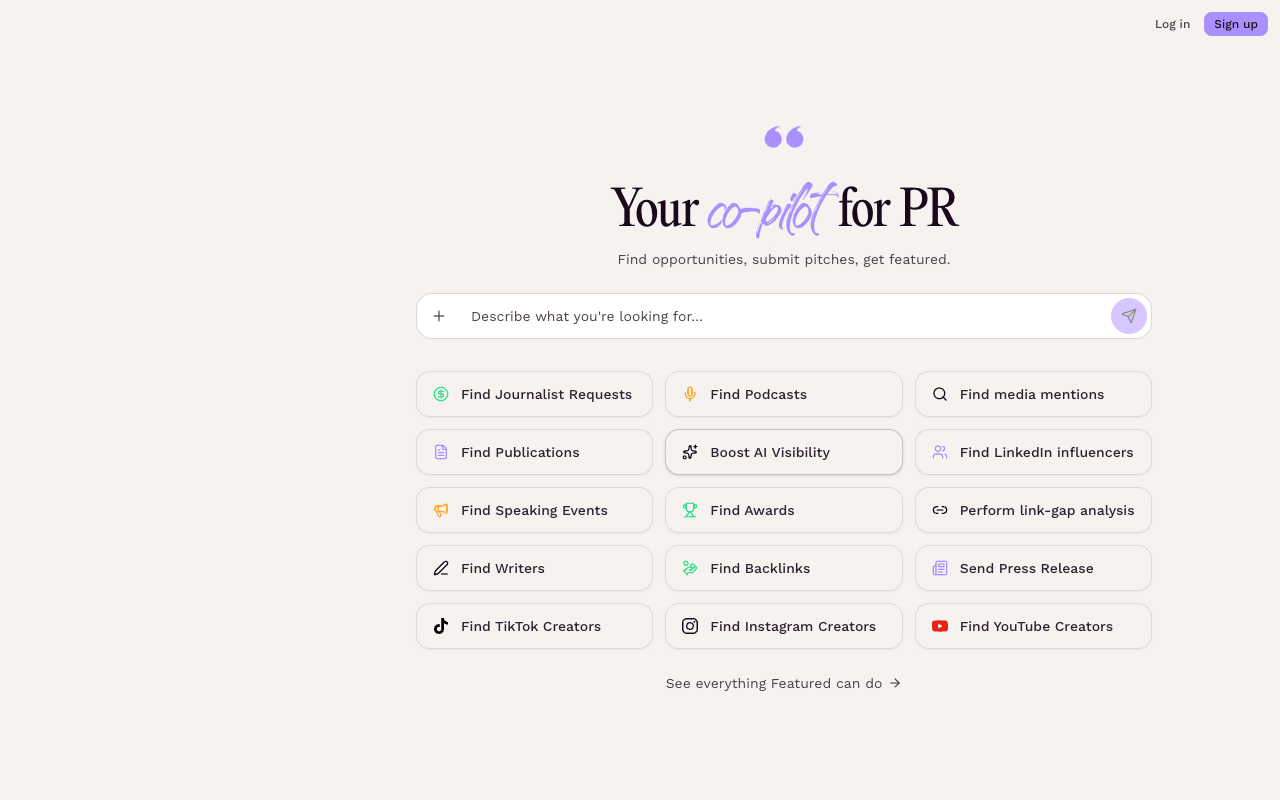
Featured runs HARO, Connectively and Featured as three brands, and Featured itself is an AI "co-pilot for PR" built around journalist requests. You respond to journalist queries from HARO, LinkedIn and more in one place, and the same account finds podcasts, media mentions and backlinks, with a link-gap analysis. HARO sends free journalist requests by email each weekday, and Featured's press page says HARO subscribers are up 54% year over year and that HARO and Connectively now use AI detection on every pitch. Plans differ by daily usage, not features: "All plans include every feature." Free is free forever with no credit card; Lite is $29/mo billed annually ($348) with 5x the AI usage of Free; Pro is $79/mo billed annually; Pro+, for agencies, is $239/mo billed annually. The tradeoff: usage is a daily allowance that resets every day, so your request volume decides the plan.
For PR teamsMonitor HARO and similar request feeds for each client's experts, answer the relevant ones fast, and track the backlinks those answers earn.
Pros
- HARO and LinkedIn journalist requests in one place
- Every feature on every plan, including Free
- Backlink finding and link-gap analysis
Cons
- Usage is a daily allowance that resets each day
- Agency-level usage (Pro+) is $239/mo billed annually