1
Podseeker
Platform: podcast database and pitching workspace for PR teams
Best for: Platform for PR agencies booking several clients on podcasts in-house
Pricing: $99/mo, 3 seats included
Free option: 3-day free trial (card required)
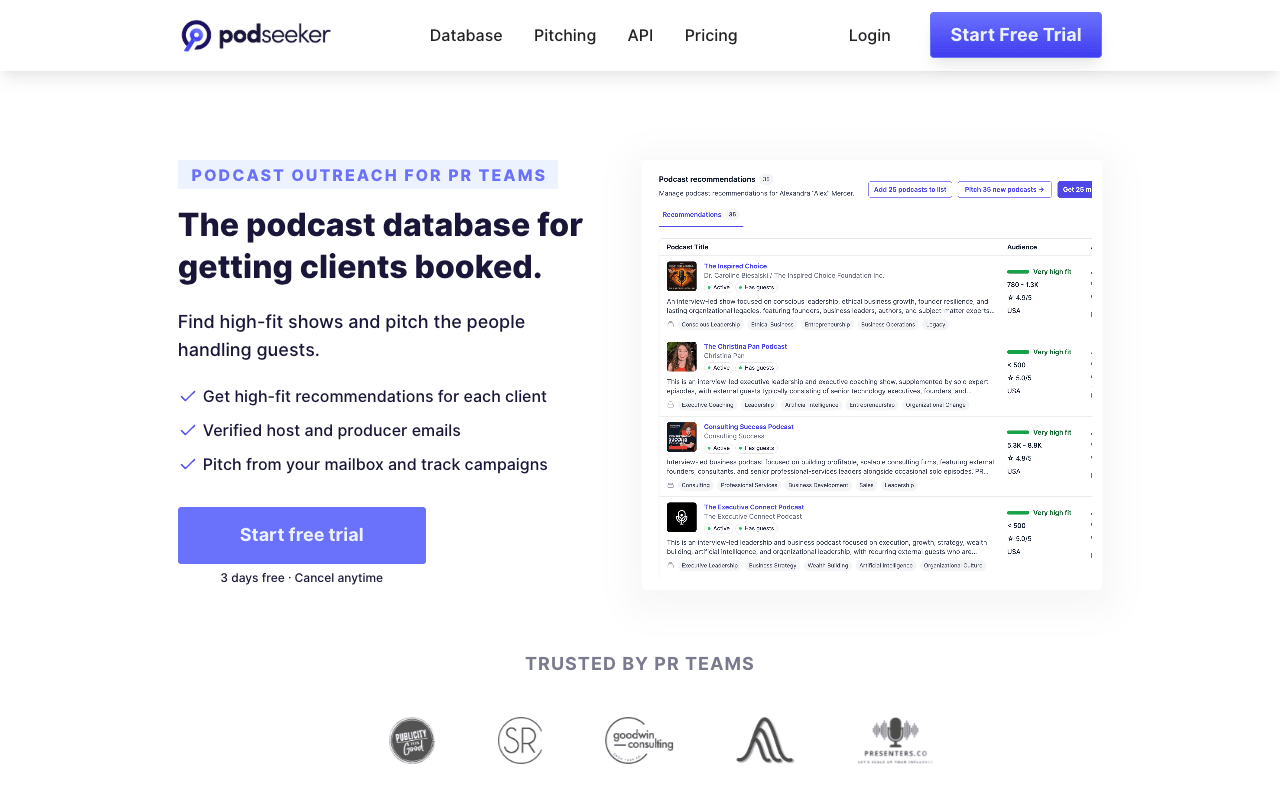
Podseeker is a podcast database and pitching workspace that describes itself as podcast outreach for PR teams, and it is the closest fit here for an agency booking clients in-house. You build a profile for each client (bio, expertise, speaking topics), and it recommends active shows that interview guests and that the client hasn't pitched, ranked by a Client Fit score with a reason for each. It finds host and producer emails when available, checks them for deliverability, and its data team researches gaps through concierge lookups. Pitches send from your own Gmail, Outlook or SMTP mailbox, follow-ups stay in the same thread and stop when a person replies, and nothing sends without your approval. Each client keeps its own lists, pitches, notes and replies. Disclosure: Podseeker also published the pitching study cited on this page, drawn from its own customers. The tradeoffs are monthly caps (400 pitches, 400 enrichments) and a 3-day trial that needs a card.
For PR teamsSet up a profile per client, approve a shortlist of fit shows, and send pitches and follow-ups from the account lead's inbox, then track replies and bookings per client.
Pros
- Per-client profiles with fit-ranked show recommendations
- Host and producer emails, checked for deliverability
- Sends from your own mailbox; nothing goes out without approval
- One published price with 3 seats included
Cons
- Monthly caps: 200 recommendations, 400 pitches, 400 enrichments
- 3-day trial needs a card; CSV exports start after it ends
2
Rephonic
Platform: podcast database with audience data and contacts
Best for: Platform for PR teams that vet shows on audience data before pitching
Pricing: From $99/mo (1 user); $990/yr billed annually
Free option: 7-day free trial (card required)
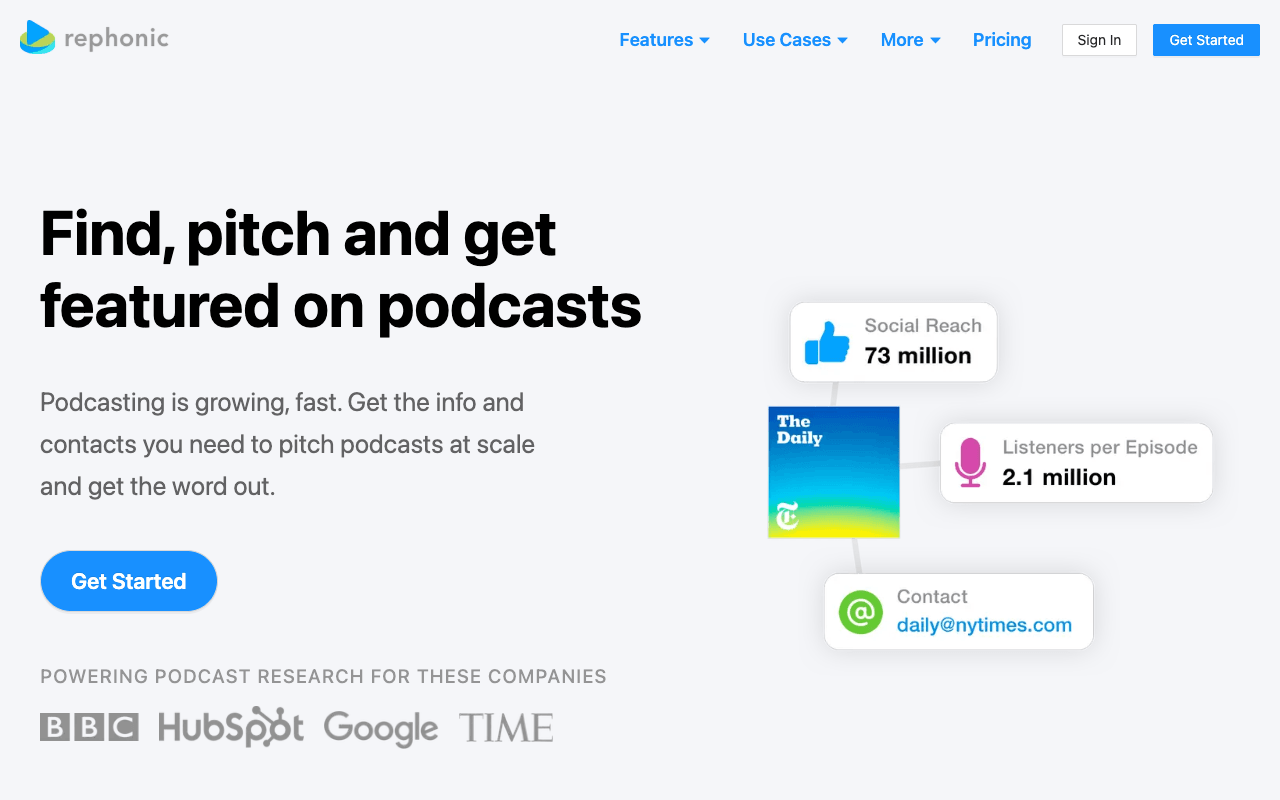
Rephonic is a podcast database built around audience data, and it says it covers more than four million podcasts. For each show it gives listener numbers, gender skew, audience location, engagement, chart rankings, related shows and contact details, including email addresses and social accounts. Filters let you build lists like marketing podcasts with more than 5,000 listeners that skew female, which is the kind of evidence a client wants before approving targets. Target lists stay up to date and can be shared with your team, and a pitch editor with templates sends from your own email account or CRM. Its homepage names PR for clients as a use case. Plans scale by users and searches: Light is one user and 100 searches a month, Standard ($149/mo) has five users, 500 searches and 20 concierge credits, and Business ($299/mo) gives ten users unlimited searches. The trial needs a card and excludes campaign exports and the concierge service.
For PR teamsFilter shows by topic and audience for a client, share the target list for approval, then pitch from the account lead's inbox.
Pros
- Listener, demographic and engagement data per show
- Contacts include email addresses and social accounts
- Pitch from your own email or CRM with templates
- Shared target lists; up to 10 users on Business
Cons
- Search quotas on Light (100/mo) and Standard (500/mo)
- Trial excludes campaign exports and the concierge service
3
PodMatch
Marketplace: AI host-guest matching with a per-client agency plan
Best for: Marketplace for agencies that want low-cost matches across a client roster
Pricing: Agency: $64/mo for 2 clients, +$32/mo per extra client
Free option: None; 100% money-back guarantee
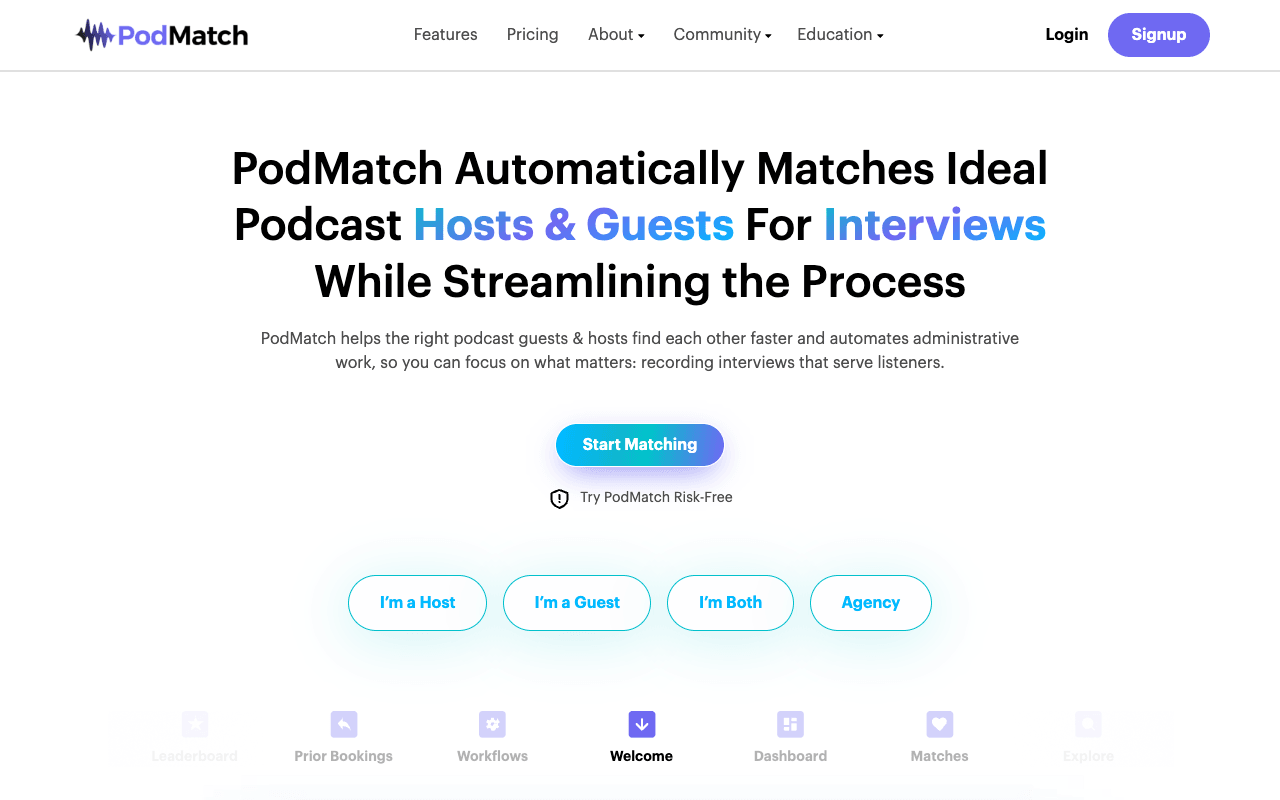
PodMatch is a marketplace that matches podcast hosts and guests with AI, then handles messaging, scheduling and episode release links inside the platform. Its Agency plan is built for representatives managing several guests: a dedicated profile for each client, unlimited matches per client, estimated download stats and social reach for hosts, and automated emails sent about your clients. Before you accept a match you can review a host's reliability, acceptance and response-rate stats, and there is an optional host interview release form. Pricing is easy to pass through: $64 a month covers two clients, and each additional client is $32. The tradeoff is the model. You reach only hosts who joined PodMatch, and conversations happen in PodMatch rather than your email (its own pitch is that you never exchange an email). Results vary with each client's profile and niche, so it works best as a volume channel next to direct pitching.
For PR teamsCreate a profile per client, review matches against host reliability stats, and accept the ones that fit before scheduling inside PodMatch.
Pros
- Profile per client with unlimited matches
- Host reliability, acceptance and response-rate stats
- Per-client price an agency can pass through
- Scheduling, release forms and episode links in one place
Cons
- Reaches only hosts who joined PodMatch
- Conversations stay in PodMatch, not your inbox
4
Interview Valet
Agency: done-for-you booking you can white-label for clients
Best for: Agency for PR firms that want to resell podcast booking under their brand
Pricing: From $1,500/mo (6-month commitment)
Free option: Free consultation
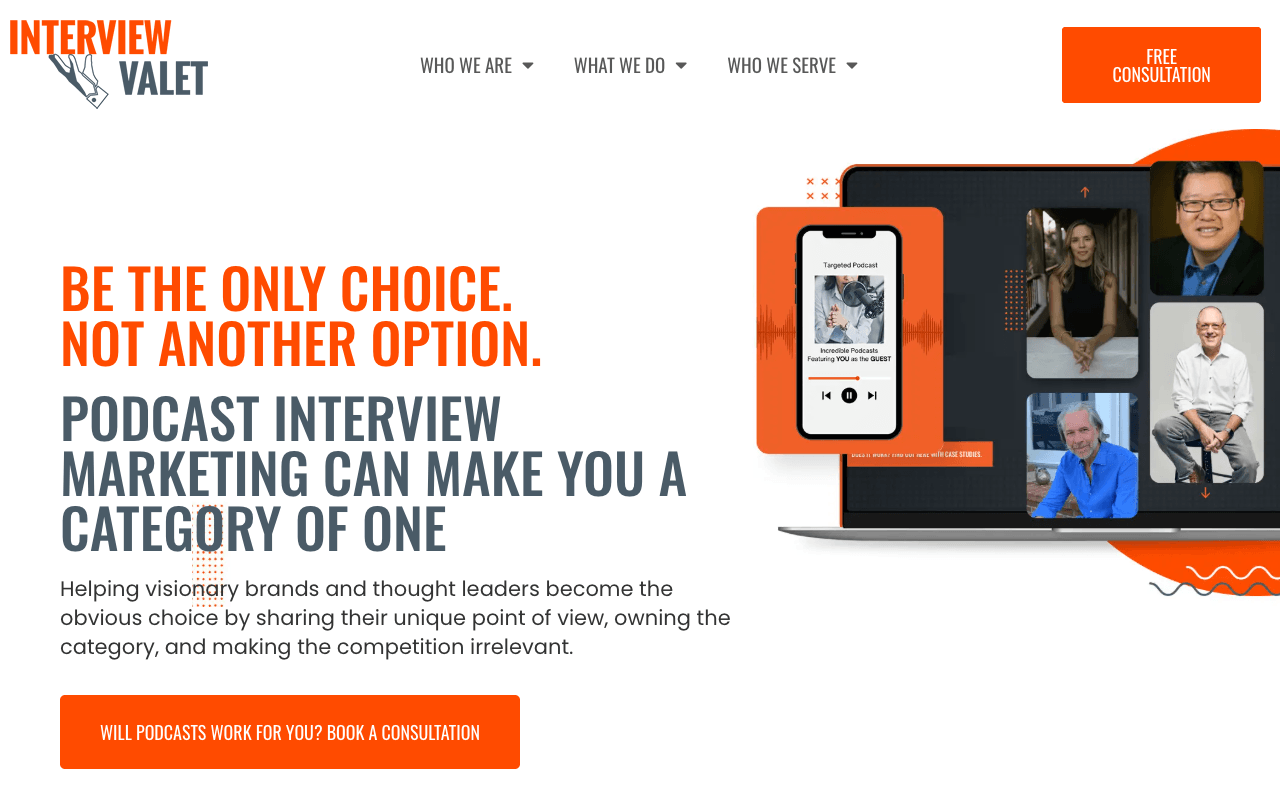
Interview Valet calls itself a Podcast Interview Marketing agency rather than a podcast booker: done-for-you booking plus guest prep and promotion, with an option built for PR firms. It subcontracts its service under your brand. Its agency page says it handles the strategy, introductions and execution while you keep the client, the credit and the margin. For a direct client, the first week covers an audience analysis, a one sheet and a curated list of target shows. The following weeks cover personalized introductions to hosts, scheduling, prep materials and guest training, with a monthly optimization call, and recording starts from week six. Each client gets a dedicated strategist, an interview management dashboard and shows picked through what it calls a triple-layer review. Campaigns start at $1,500 a month on a 6-month commitment, and it says it is selective about who it works with. The tradeoff for a PR team is control: outreach runs through Interview Valet, so your team reviews its work rather than pitching hosts directly.
For PR teamsResell podcast booking to an existing client under the agency's name while Interview Valet runs the research, introductions and scheduling.
Pros
- White-label subcontracting for PR and marketing agencies
- Dedicated strategist and interview management dashboard
- Guest training and prep materials included
Cons
- 6-month minimum commitment
- Selective about clients; starts with a consultation
5
Fame Connect
Agency: B2B podcast booking with content per appearance
Best for: Agency for B2B executives who want bookings plus reusable content
Pricing: $2,000/mo (2 external bookings/mo)
Free option: None (apply)
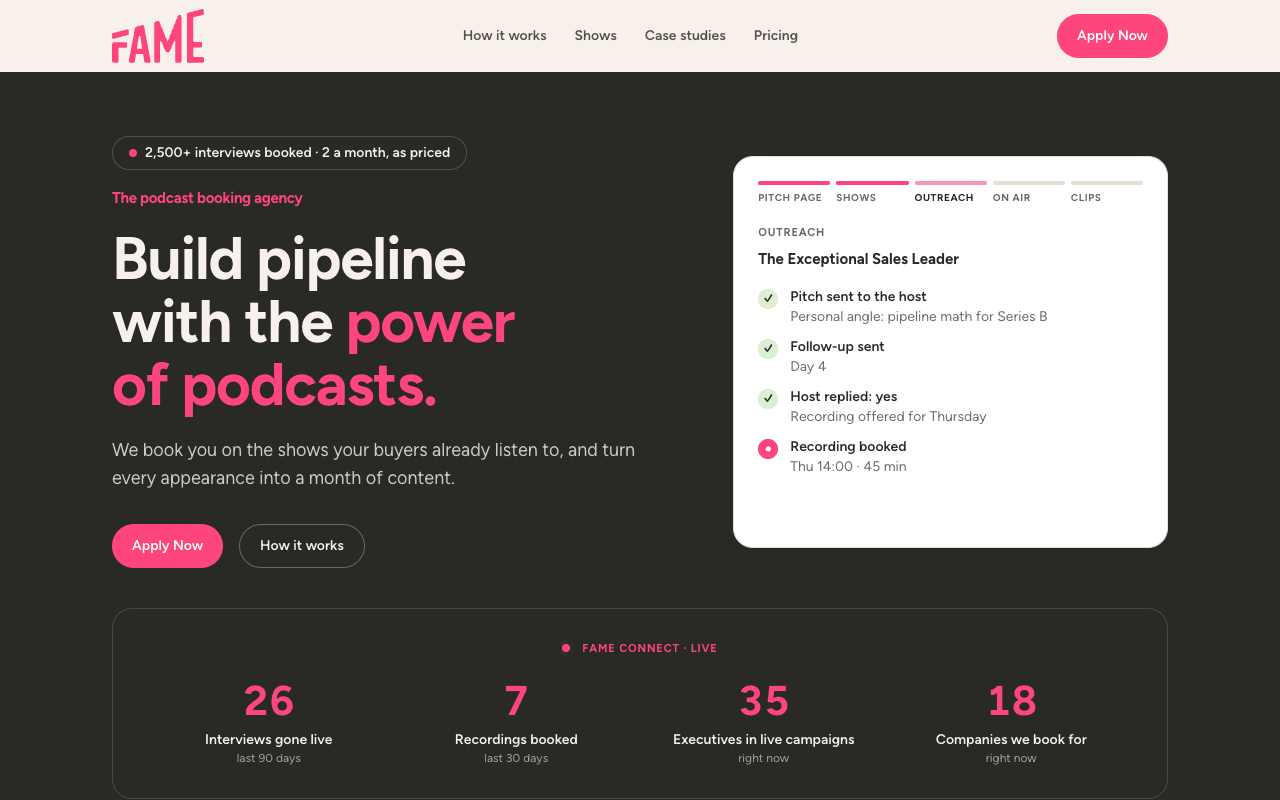
Fame Connect is a B2B podcast booking agency that sells podcasts as a pipeline channel: it books executives on the shows their buyers already listen to and turns each appearance into content. You may know it by its old name. Its FAQ says Speak On Podcasts was acquired by Fame in 2024 and is now Fame Connect. The plan is fixed: $2,000 a month for two external bookings a month, one internal booking per quarter on a Fame-produced show, and five video clips plus four written assets per booking, with no separate production or media fee. Fame builds the target list from who the client is trying to reach rather than the easiest shows to book, and the client approves that list before any outreach goes out. The tradeoffs are a single plan as priced, and that the quarterly internal booking is on Fame's own show rather than an outside podcast.
For PR teamsApprove a buyer-based show list for a B2B executive, then use the clips and written assets from each booking in the client's owned and sales channels.
Pros
- Fixed price with bookings and content included
- Client approves the target list before outreach
- Five video clips and four written assets per booking
Cons
- One plan as priced; no published multi-client tier
- Quarterly internal booking is on a Fame-produced show
6
Heartcast Media
Agency: done-for-you booking with published, guaranteed approvals
Best for: Agency for B2B leaders who want a written booking guarantee
Pricing: From $1,250/mo + $399 setup (12-month term)
Free option: None
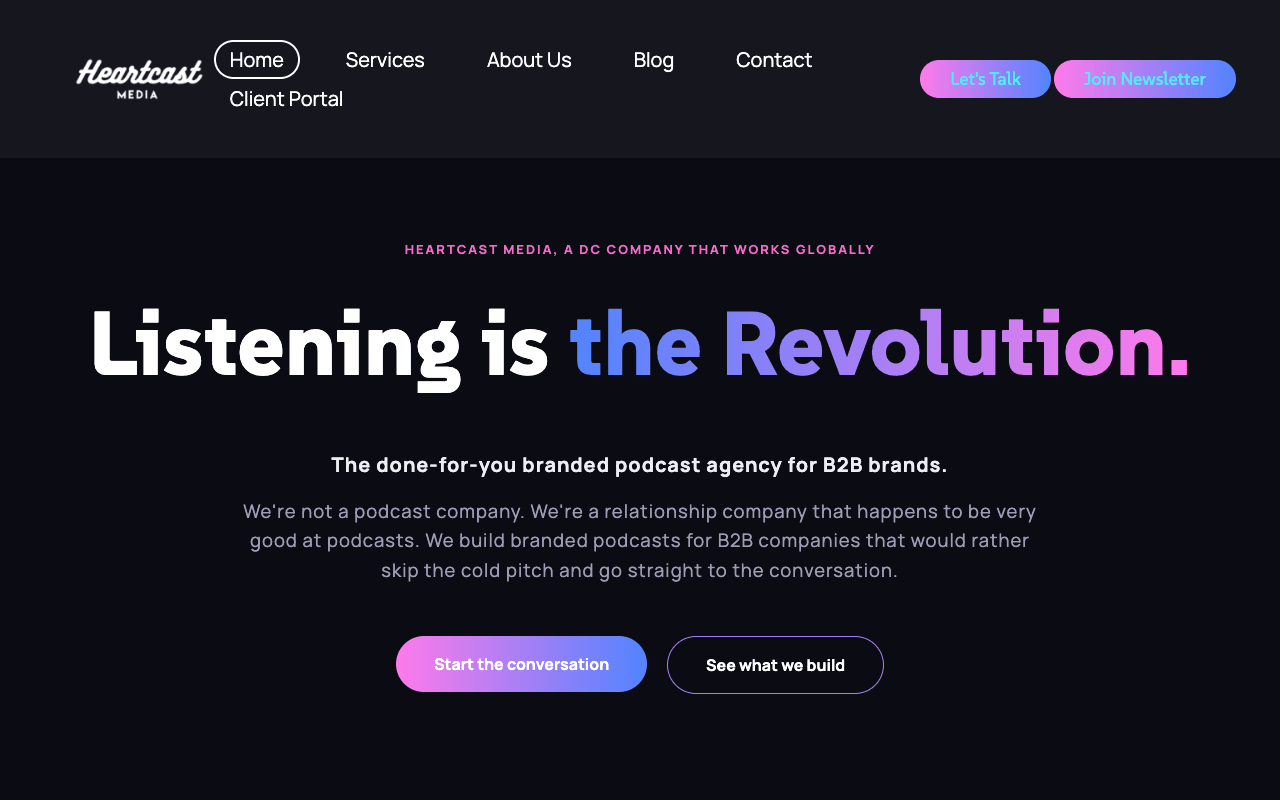
Heartcast Media is a B2B podcast agency whose done-for-you guest booking service says it has personal relationships with 900+ podcast hosts, and it assigns a dedicated agent to each client. It publishes its prices and puts its guarantee in writing: if it falls behind the monthly approvals pace, it doesn't bill your next cycle until it catches up. Professional is $1,250 a month for 2 approvals and Full Court is $1,950 a month for 4, both on 12-month terms, and every plan carries a $399 one-time setup that covers a Shure mic kit. For a fixed push, such as a launch, there is a Campaign plan: 12 appearances in 6 months, guaranteed, for $8,500 with no contract. All plans include 10 short-form clips per episode and a professional media kit. Before signing, ask how Heartcast defines an approval (host agreed, recorded or published), since that is the unit the guarantee covers.
For PR teamsBook a no-contract Campaign plan around a client's launch or book release, then reuse the short-form clips from each episode.
Pros
- Prices and guarantee published on its site
- No-contract Campaign plan: 12 appearances in 6 months
- 10 short-form clips per episode included
Cons
- Monthly plans run on 12-month terms
- $399 setup on every plan
- Guarantee is counted in approvals; confirm the definition
7
Podchaser Pro
Platform: podcast data, demographics and role-based contacts
Best for: Platform for larger PR teams that need deep show data and contacts
Pricing: Quote only
Free option: Free public site; Pro by demo
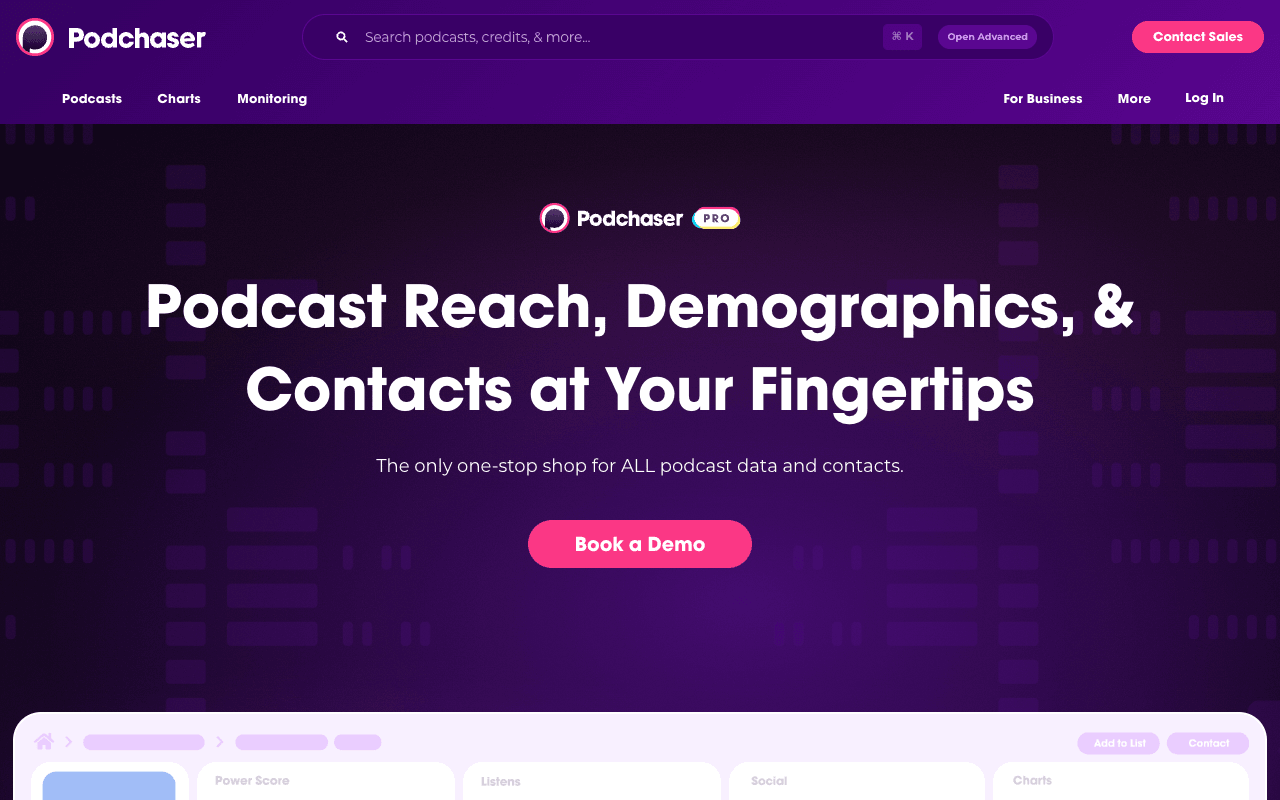
Podchaser Pro is a podcast data platform with audience reach, listener demographics and contacts broken out by role for each show, and its listed use cases include publicists, podcast guest placement and public relations. Vetting goes deep: a Power Score built from more than 30 data points, brand safety metrics, social handles and analytics, and creator and guest credits that show who a show has interviewed. Contacts are one click with bulk exporting, and Podchaser says many aren't publicly available. Shareable custom lists and notes on any podcast page help an account team track targets, and there is an API. It also covers sponsor data and ad rate cards, which matters when a client buys podcast ads as well as earning guest spots. The tradeoffs: pricing depends on your team's needs and data usage and comes from a demo, and the Pro page doesn't advertise sending pitches, so plan to pitch from your own email.
For PR teamsCheck a show's guest credits, demographics and brand safety before putting it on a client's list, then export the right contact by role.
Pros
- Contacts broken out by role, with bulk export
- Demographics, Power Score and brand safety metrics
- Guest credits show who a show has booked
- Sponsor data for clients who also buy podcast ads
Cons
- Quote only; pricing set in a demo
- Pro page doesn't advertise pitch sending
8
Listen Notes
Search engine: podcast search with daily-priced Premium
Best for: Search engine for short research sprints on a client's show list
Pricing: $13.80/day billed daily; $6.90/day billed monthly (max $207/mo)
Free option: Free basic search; no Premium trial
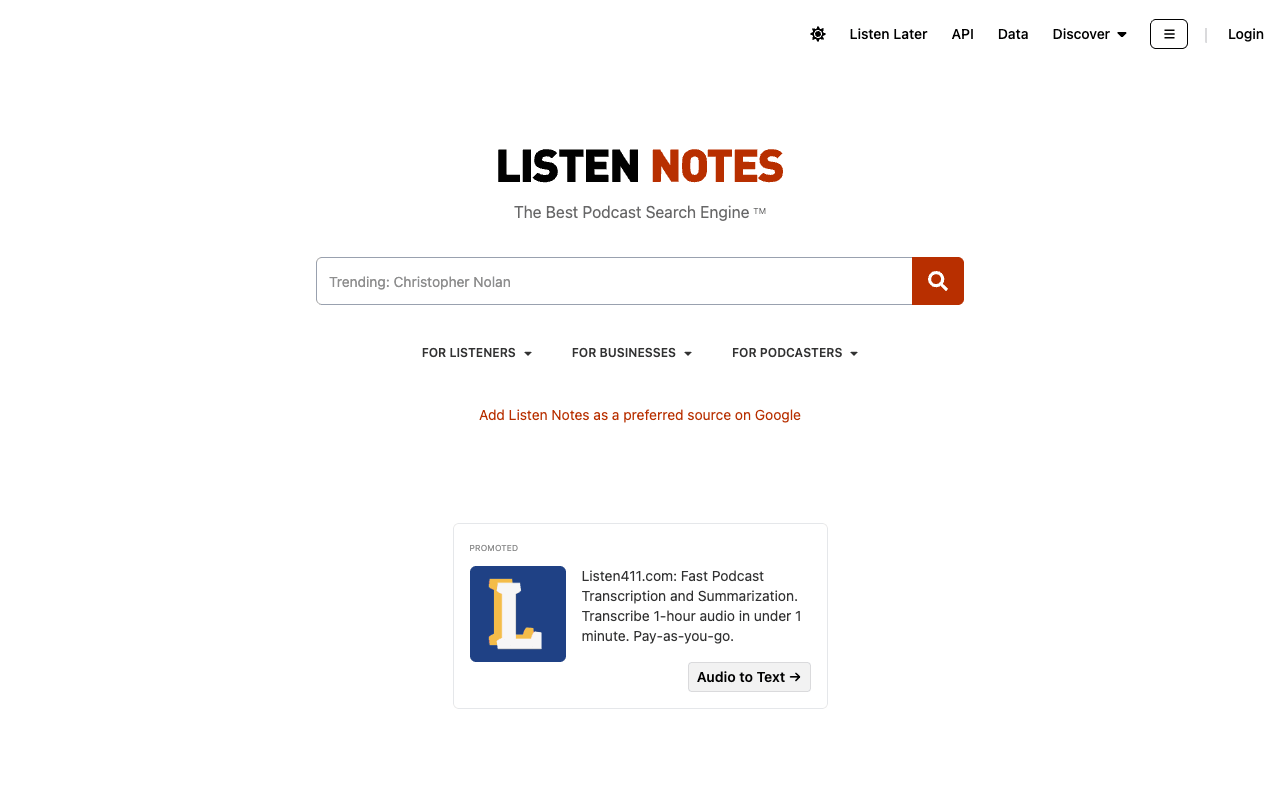
Listen Notes is a podcast search engine with a free public site and a paid Premium tier priced by the day. Super Search adds unlimited queries with advanced filters, shows the podcast email, returns more results per query, searches by RSS, Apple Podcasts or Spotify link, and lists similar podcasts. That similar-shows list is a quick way to grow a client's shortlist from one show the client already likes. Listen Alerts monitors podcast mentions with real-time RSS feeds and daily email digests, which helps catch when a client comes up in new episodes. It also publishes a podcast PR guide in its help center. Pricing suits short sprints: $13.80 a day billed daily, 2-day access for $27.60, or $6.90 a day billed monthly with a $207 cap for the month. The tradeoffs: it is research only, with no pitching or sending advertised, Premium has no free trial, and each login is for one person.
For PR teamsBuy two days of access to expand a client's target list from shows it already likes, then pitch from your own inbox.
Pros
- Pay by the day for short research sprints
- Shows the podcast email and similar podcasts
- Listen Alerts for podcast mentions
- Super Search covers 2 accounts by default
Cons
- Research only; no pitching or sending advertised
- No Premium free trial; one person per login
9
PodcastGuests.com
Marketplace: free guest-opportunity newsletter plus expert directory
Best for: Marketplace and free starting point for hosts already asking for guests
Pricing: Free newsletter; directory from $15/mo (billed annually)
Free option: Free guest-opportunities newsletter
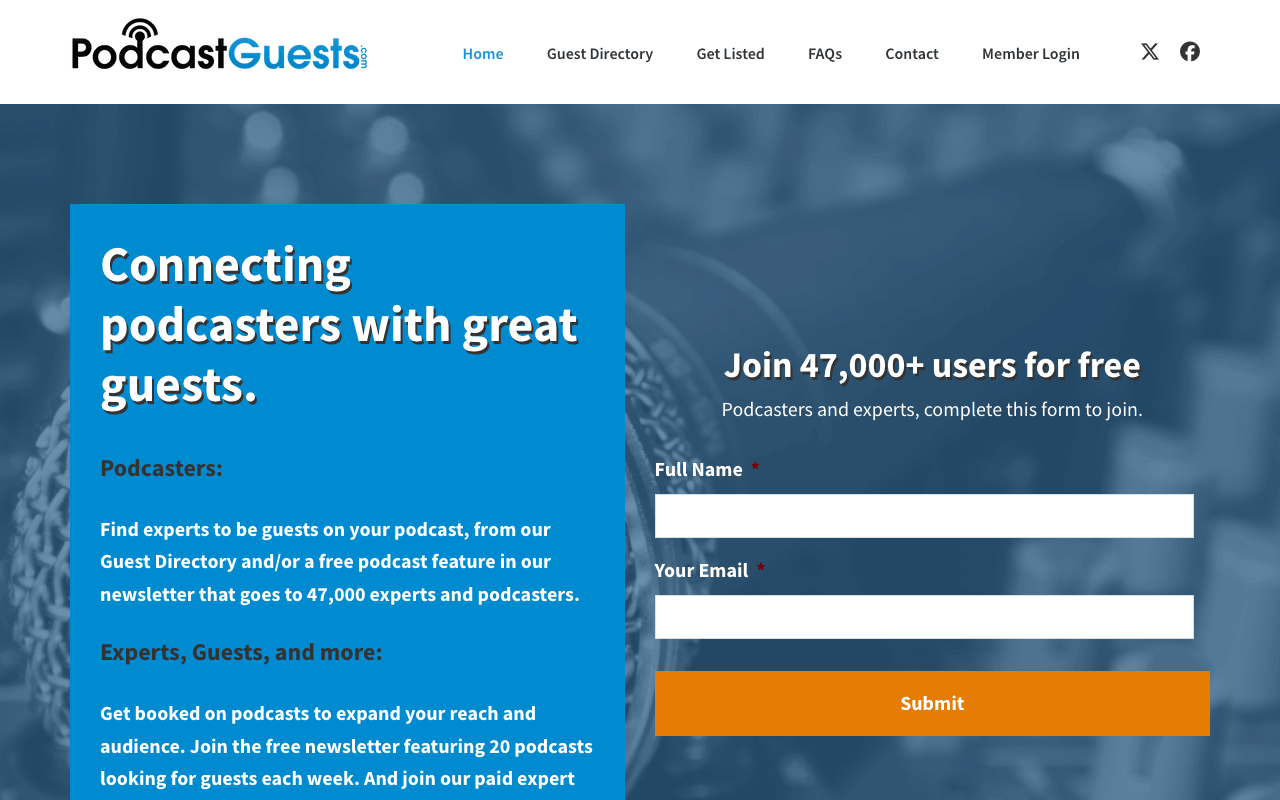
PodcastGuests.com is the lowest-cost way on this list to see podcasts asking for guests. Its free newsletter sends two emails a week with 10 guest opportunities on other shows, and you apply through a short form. The paid expert directory works the other way round: podcasters find your client's profile and contact you directly. Basic is $15 a month billed annually or $20 billed monthly, and Premium, which it says gets the best results and adds a rotating newsletter feature, is $33.25 a month billed annually or $45 monthly. Agencies with five or more active clients on Premium get a 15% discount. For a PR team it works as a supplement: a steady source of hosts who have already said they want guests, next to your own pitching. The tradeoffs are that you apply alongside every other newsletter subscriber, and directory leads depend on podcasters finding the profile.
For PR teamsScan the twice-weekly newsletter for shows that fit a client and apply, while a Premium directory profile brings inbound requests.
Pros
- Free twice-weekly list of shows seeking guests
- Directory lets podcasters contact your client
- 15% agency discount with 5+ Premium clients
Cons
- Newsletter opportunities go to every subscriber
- Directory leads depend on podcasters finding the profile