1
Traackr
Enterprise creator platform with seeding, approvals and benchmarks
Best for: Agencies running gifted and paid creator programs for large consumer clients
Pricing: Quote only
Free option: None published
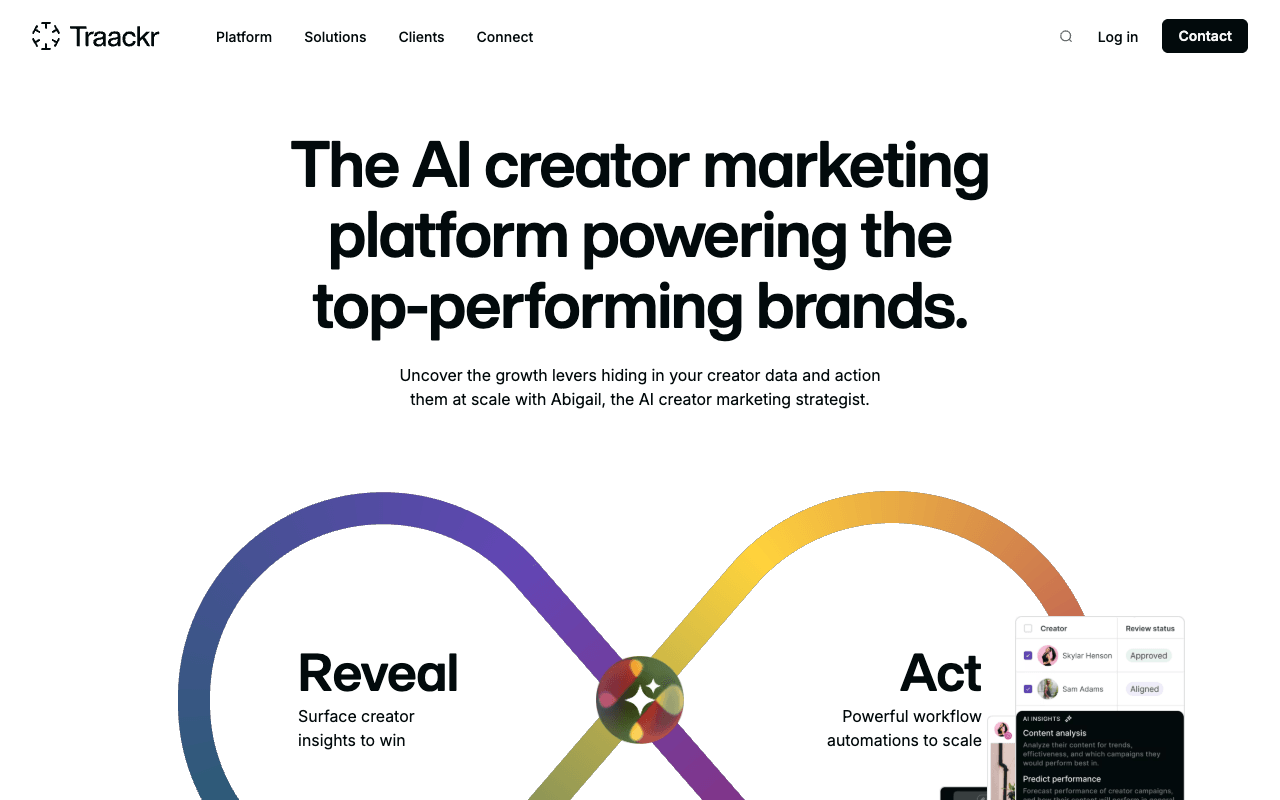
Traackr is an enterprise creator-marketing platform with a dedicated agency offering, and it is the closest match here to how PR agencies run creator programs. Its agency page promises fast talent approvals with data-backed lists, and centralizes paid collabs, gifted product, brief sends and KPI tracking in one place. The seeding flow captures creator preferences and addresses, connects to Shopify to automate fulfillment, and tracks performance afterward. Vetting covers audience quality and brand-safety monitoring, with predictive performance forecasts, its enterprise page lists disclosure monitoring, and reports are configurable per campaign KPI. For multi-market clients it offers share of voice across 70+ markets and competitor creator benchmarks, and it has added a new AI product, Abigail, built for enterprise creator marketing. The tradeoff is cost visibility: Traackr publishes no prices, you schedule a call to hear packages, and it positions itself for global enterprise brands, so it suits agencies with large consumer accounts more than a boutique with one small client.
For PR teamsBuild a creator shortlist for a launch, get the client's approval on it, then ship seeding product through the same workflow and report who posted.
Pros
- Agency page covers talent approvals, gifted product and brief sends
- Seeding flow captures addresses and automates Shopify fulfillment
- Share of voice across 70+ markets and competitor benchmarks
- Brand-safety monitoring and predictive performance forecasts
Cons
- No public pricing; packages come from a sales call
- Positioned for global enterprise brands
2
Sprout Social Influencer Marketing
Influencer platform with a dedicated workspace for each client
Best for: Agencies that need each client's creators, safety rules and results kept separate
Pricing: Quote only
Free option: None published (demo only)
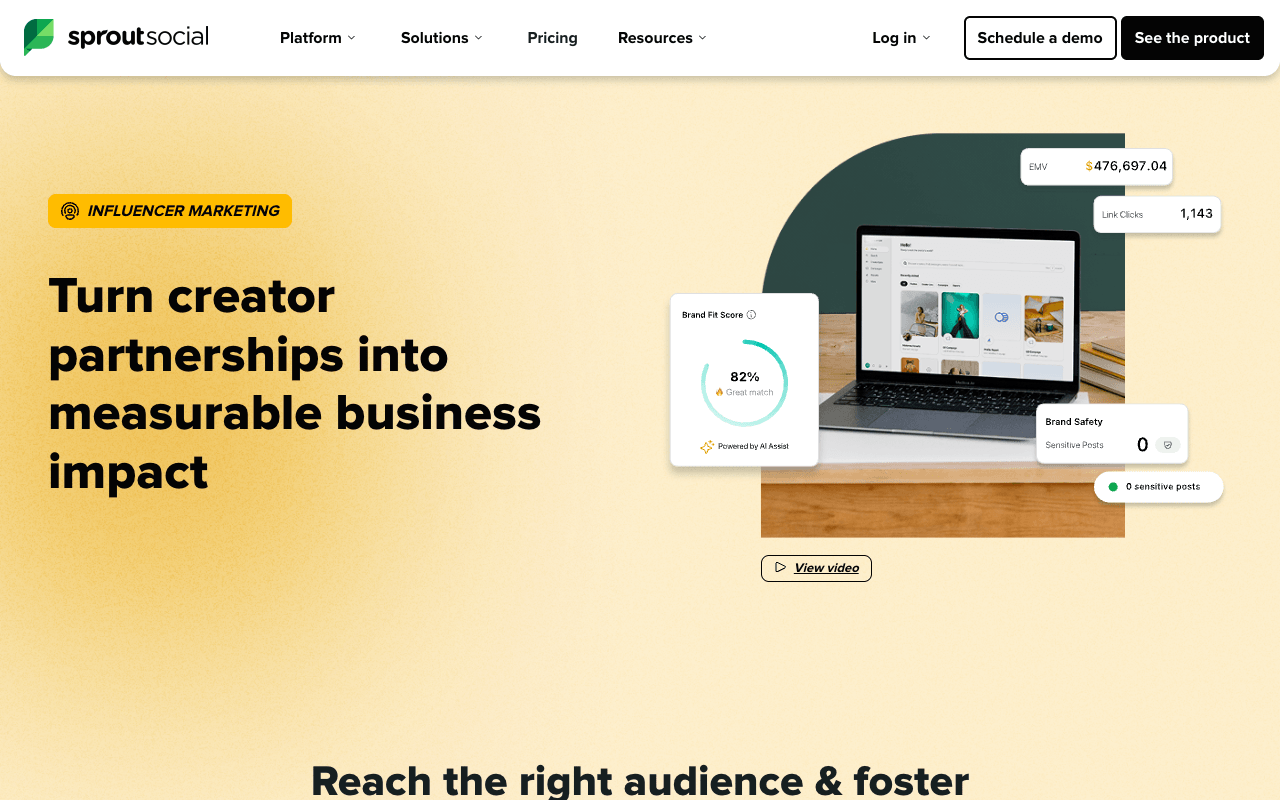
Sprout Social Influencer Marketing, formerly Tagger, is sold separately from Sprout's social media plans, and its pricing page says no Sprout plan is required. The feature that matters for agencies is Dedicated Workspaces for every client or sub-brand in your portfolio, each with its own brand-safety settings, Brand Fit Score and metrics, so one client's creators and results never mix with another's. Discovery is AI topic-led across 10M+ social profiles, and branded application pages collect creators who come to you. Configurable brand-safety reports analyze years of a creator's content before a client signs off. Outreach, contracting, content approvals and payments run in one workflow, and approvals and feedback route without seat limitations, which helps when several client stakeholders review. Reports are customizable, with affiliate links, UTMs or pixels for conversion tracking. The tradeoff: pricing is demo-only, and it is a separate budget line from any Sprout social plan you already pay for.
For PR teamsOpen a workspace per client, run discovery and brand-safety checks there, and route creator approvals to client stakeholders without buying them seats.
Pros
- Separate workspace, Brand Fit Score and metrics per client
- Approvals and feedback routed without seat limitations
- Brand-safety reports covering years of creator content
- Outreach, contracts, approvals and payments in one flow
Cons
- No public pricing; demo required
- Sold separately from Sprout's social media plans
3
Meltwater Influencer Marketing
Influencer module inside Meltwater's PR and media suite
Best for: Agencies already monitoring client coverage in Meltwater
Pricing: Quote only (most contracts 12 months minimum)
Free option: None (no self-serve trial; guided demo)
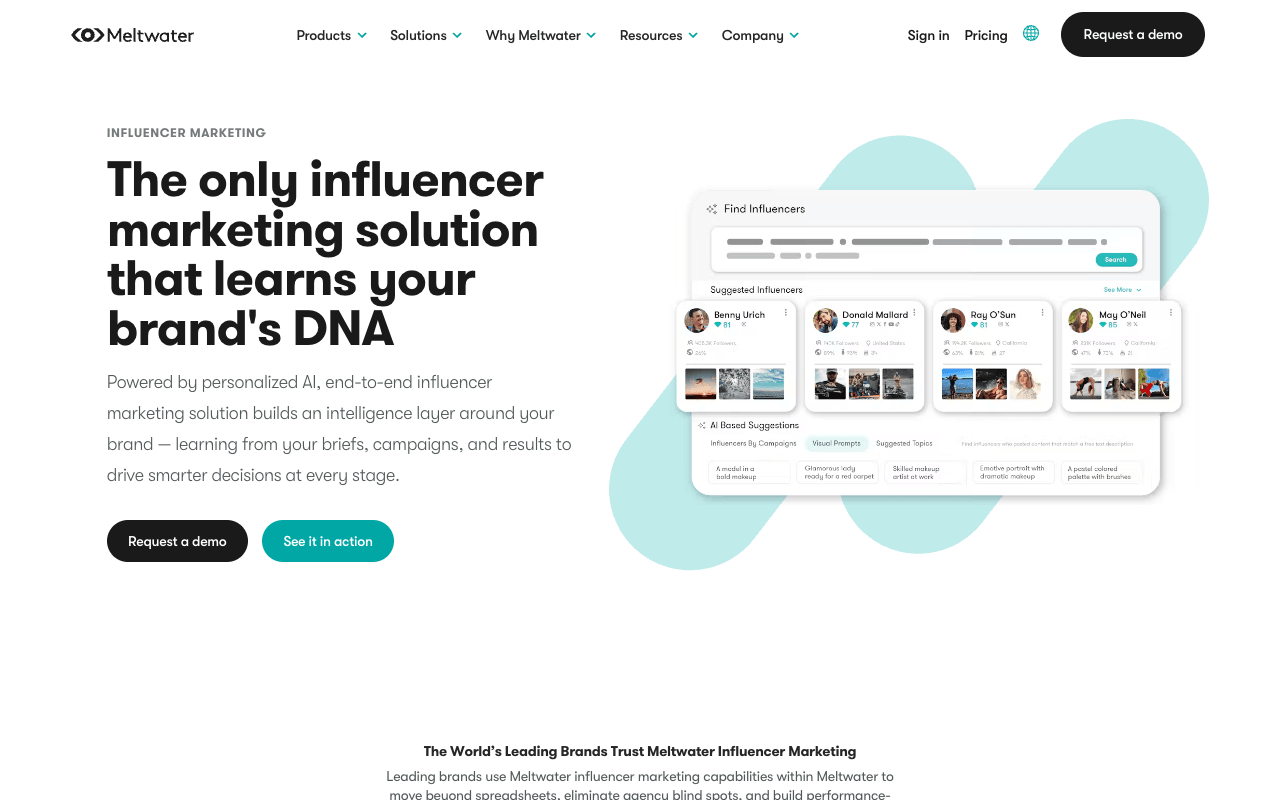
Meltwater's influencer marketing module sits inside the media intelligence suite many PR agencies already use for monitoring, and Meltwater says it connects influencer performance to broader PR, social and competitive intelligence. Its pricing page lists Influencer Marketing on the Enterprise and Agency plans, and the Agency plan is built for agencies managing multiple brands, clients and campaigns, from a Starter tier for small agencies to Enterprise Agency. Its FAQ says agencies use it for multiple clients, with reports they can download and customize. Discovery runs from a brief or prompt across a 30M+ creator database, with bot detection and a True Reach metric to screen inflated audiences. Product gifting, content approvals, contracts, milestones and payments are covered, and reporting includes Estimated Media Value (EMV). The tradeoffs are contract shape and price visibility: pricing is tailored, most agreements run at least 12 months, complex setups may carry a one-time onboarding charge, and Meltwater doesn't offer a self-serve trial.
For PR teamsReport a client's creator posts next to their earned coverage and social monitoring, from the same suite the account team already uses.
Pros
- Agency tiers for multiple brands, clients and campaigns
- Bot detection and a True Reach metric for vetting
- Covers product gifting, approvals, contracts and payments
- Sits next to PR and social monitoring in one suite
Cons
- Tailored pricing with a 12-month minimum on most agreements
- No self-serve free trial
- Possible one-time onboarding charge for complex setups
4
Influencity
All-in-one influencer platform with published prices
Best for: Small and mid-size agencies that want a full workflow without a sales cycle
Pricing: From $198/mo billed monthly or $1,900/yr billed annually
Free option: 7-day free trial on all plans, no credit card
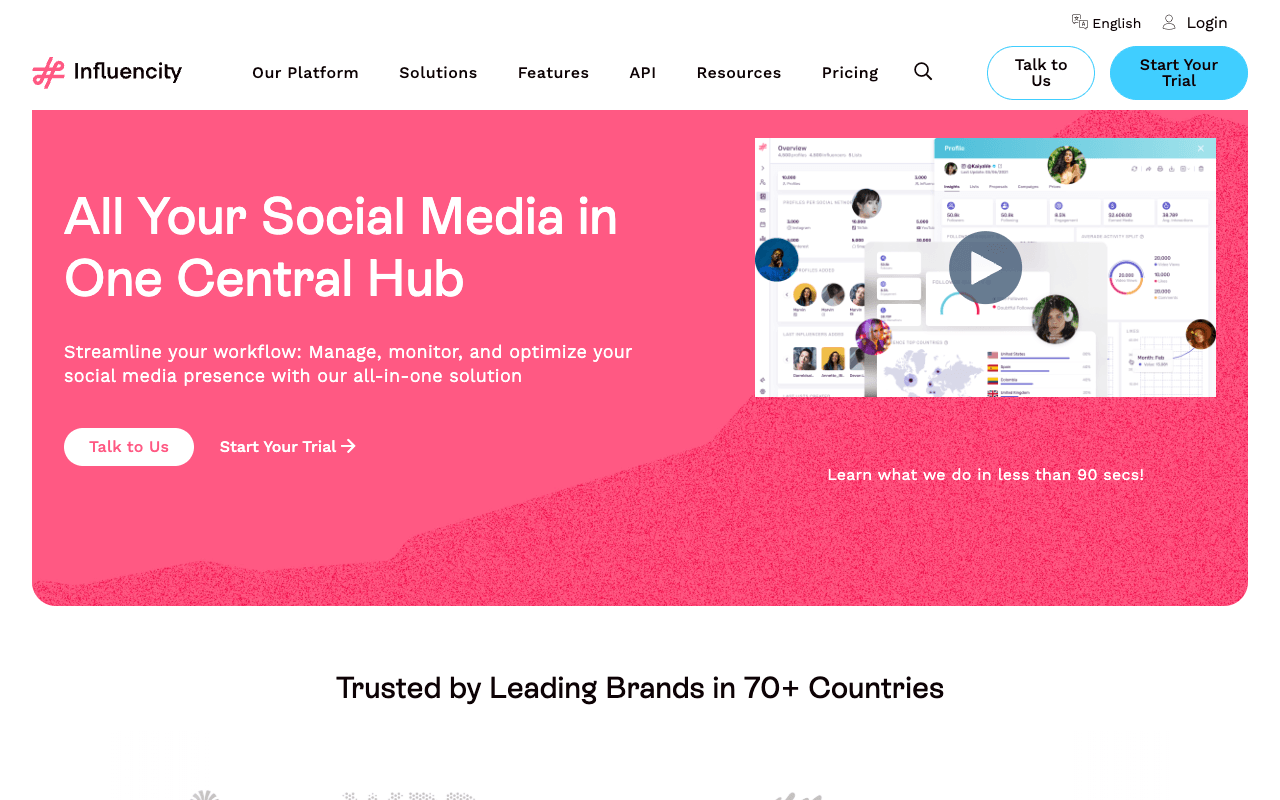
Influencity is the most transparent full-workflow option here. It has an agency landing page, publishes its prices (annual billing is 20% off) and offers a 7-day free trial on all plans with no credit card. Professional ($398/mo billed monthly or $3,816/yr) lets you share interactive creator rosters with a client for approval, without the client registering, adds bulk outreach and includes 10 campaign reports. Limits differ by billing: the annual Professional plan includes 3 users, email sequences and Gmail or Outlook integration, while the monthly one includes 1 user. Audience quality stats cover Instagram, TikTok, YouTube and Twitch, and rosters, proposals and reports can be shared by live link. Business ($1,398/mo monthly or $13,420/yr) adds brand-safety vetting, the Shopify integration, global creator payments and 5 users. The tradeoffs for agencies: multiple workspaces are stated only on the quote-based Enterprise plan, and creator emails are available only where the creator made them public.
For PR teamsSend a client an interactive roster to approve without making them register, run bulk outreach, and share the campaign report by live link.
Pros
- Published monthly and annual prices
- Client roster approvals from the Professional plan
- Rosters, proposals and reports shared by live link
- 7-day trial with no credit card
Cons
- Multiple workspaces stated only on Enterprise (quote only)
- Monthly Professional includes 1 user; annual includes 3
- Shopify integration and brand-safety vetting start on Business
5
CreatorIQ
Enterprise creator system with client-facing agency tools
Best for: Agencies running large, multi-market creator programs for enterprise clients
Pricing: Quote only
Free option: None published
CreatorIQ is an enterprise creator-marketing system that says it is trusted by 1,300+ brands and agencies, and its agency features are the most client-facing we found. You can share talent pitch sheets for approval and grant a client a view-only database: a co-branded, secure, view-only extension of your environment. Clients and partners can review, comment on and approve planned creator content, and campaign wrap reports can be published or exported directly. AI models collect creator posts that mention the brand, with metrics that refresh every eight hours, and SafeIQ handles AI brand-safety screening. Contracts and payments are built in, along with competitive benchmarking and a Sprinklr integration. The tradeoff is scale and price visibility: CreatorIQ positions itself for creator marketing at scale and prices by quote only, so it fits agencies holding large enterprise accounts better than project work for smaller clients.
For PR teamsPitch creators to the client on shareable sheets, let them approve planned content in a view-only space, and publish the wrap report at the end.
Pros
- Talent pitch sheets for client approval
- Co-branded, view-only client database
- Clients can comment on and approve planned content
- Wrap reports published or exported directly
Cons
- Quote only, via a pricing request form
- Positioned for creator marketing at enterprise scale
6
Favikon
Creator scoring across 9 networks, including LinkedIn and X
Best for: B2B, tech and exec-led clients whose creators post on LinkedIn and X
Pricing: From $159/mo billed yearly ($199/mo billed monthly)
Free option: 7-day free trial on Core and Pro
Favikon is a creator discovery and scoring tool, and it is the pick here for B2B, tech and exec-led clients whose relevant creators live on LinkedIn and X rather than only Instagram and TikTok. It scores 10M+ creators across 9 networks on authenticity, authority and audience quality, and its authenticity checks look for engagement pods, comment rings and manipulation on LinkedIn and X. You can share a list with a client without exporting anything, message creators by email (plus social DMs on Pro), and export per-campaign reports with posts, engagement, views, reach and EMV for client review. Pro adds an MCP connection for using it inside Claude or GPT. Prices are published: Core is $199/mo billed monthly or $159/mo yearly, Pro $299/mo monthly or $239/mo yearly. The tradeoff is campaign volume: Core allows 1 active campaign and Pro 5, and API access is on Enterprise only.
For PR teamsFind credible LinkedIn and X voices for a B2B launch, share the vetted list with the client, and export the campaign report for review.
Pros
- Covers LinkedIn and X alongside Instagram, TikTok and YouTube
- Share a list with a client without exporting
- Exportable campaign reports with reach and EMV
- Published monthly, quarterly and yearly prices
Cons
- Core allows 1 active campaign; Pro allows 5
- API access listed on Enterprise only
7
Modash
Self-serve creator search with inbox outreach and Shopify gifting
Best for: Small agencies that want deep Instagram, TikTok and YouTube search on a monthly plan
Pricing: From $199/mo billed annually ($299/mo billed monthly)
Free option: 14-day free trial, no credit card
Modash is a self-serve creator search and workflow tool with clear monthly pricing. It indexes 380M+ creator profiles with 1K+ followers on Instagram, TikTok and YouTube, with AI and image search, 37 filters, lookalikes and audience data by location, demographics, interests and quality. Outreach runs from your real Gmail or Outlook inbox, and its Shopify gifting flow sends free product and automatically tracks who posts, which maps neatly onto PR seeding. Content tracking is automatic, and downloadable creator PDF profiles are handy for client approval decks. Essentials is $299/mo billed monthly or $199/mo billed annually, Performance $599/mo or $499/mo annually, and you don't have to commit to a full year. The tradeoffs for agencies: Modash positions itself as Shopify-first for in-house teams and shows no agency plan, Essentials allows 2 team members, and it covers three networks.
For PR teamsSearch for creators by audience location and niche, gift product through Shopify, and track who posted without chasing screenshots.
Pros
- Audience data by location, demographics, interests and quality
- Outreach from your own Gmail or Outlook inbox
- Shopify gifting with automatic post tracking
- No annual commitment required
Cons
- Positions itself for in-house teams; no agency plan on its pricing page
- Instagram, TikTok and YouTube only
- Essentials allows 2 team members
8
HypeAuditor
Influencer analytics built around audience and fraud checks
Best for: Agencies that need to prove a creator's audience is real before pitching them
Pricing: Quote only (free media plans and campaign management)
Free option: Free media plans, campaign management and feature demos
HypeAuditor is built around audience analytics and fraud detection, and it's the tool an agency reaches for when a client asks whether a creator's audience is real. Its homepage cites a 227.3M+ database with 35+ filters across Instagram, YouTube, TikTok, X and Twitch, with audience, performance and fraud insights on each profile, and it offers a free Instagram fake-follower checker. Its agency page adds a Media Plan tool that estimates KPIs for client pitches, competitor analysis, bulk outreach, campaign tracking with shareable client dashboards, and automated, presentation-ready reports. Creator payments run through PayPal. You can start free with media plans and campaign management, plus demo versions of other features. The tradeoff is price visibility: paid tiers are quote only, and its agency page cites both a 50M+ and a 227.3M+ creator database, so ask what your plan includes.
For PR teamsRun a fraud and audience check on every proposed creator, then build a media plan with KPI estimates for the client pitch.
Pros
- Audience, performance and fraud insights per creator
- Media Plan tool with KPI estimates for client pitches
- Shareable client dashboards and automated reports
- Free media plans and campaign management to start
Cons
- Paid tiers are quote only
- Agency page cites both 50M+ and 227.3M+ database sizes
9
GRIN
Creator management with an AI agent, sold month-to-month
Best for: Agencies that want gifting workflows without an annual contract
Pricing: Free; paid from $200/mo (Growth $500/mo for multiple brands)
Free option: Free plan with no time limit; 30-day Starter trial
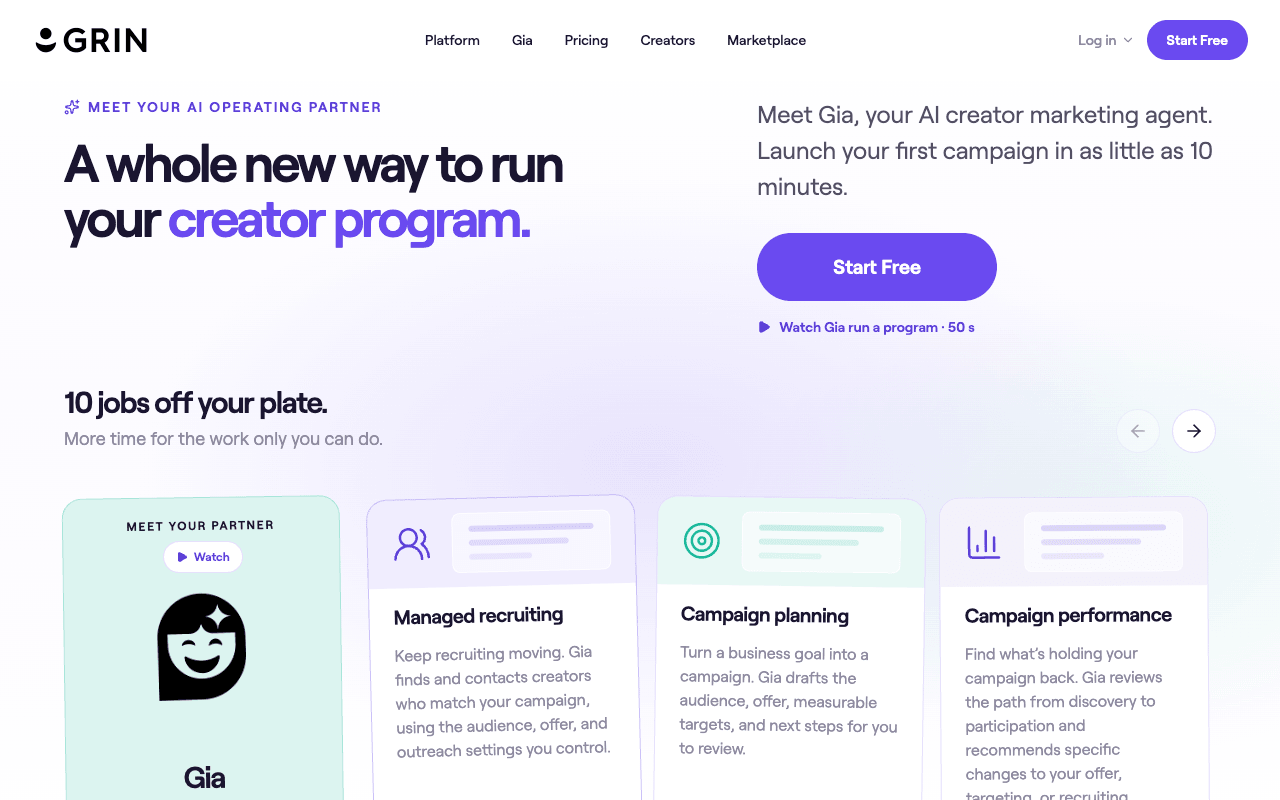
GRIN is a creator management platform that publishes usage-based pricing for GRIN with Gia, its AI agent, and offers free migration for existing GRIN Classic accounts. Gia finds and contacts creators, drafts outreach, reviews content against the brief and prepares reports for your team, leadership or brand partners. Gifting workflows and gifting logistics are built in, the CRM holds unlimited contacts on every plan, and affiliate links, codes and GMV tracking cover clients who sell online. For agencies, the useful part is the contract: prices are monthly, plans are month-to-month with no annual contract, no minimum commitment and no required sales call, and pricing isn't per seat. There's a Free plan with no time limit, and every new account gets a 30-day trial of Starter. The tradeoffs: multiple brands start at Growth ($500/mo), and AI work is metered by credits (included monthly credits don't roll over), so monthly cost depends on usage.
For PR teamsRun gifting for a client on a month-to-month plan, with Gia drafting outreach and preparing the report for the client.
Pros
- Month-to-month, no annual contract or minimum commitment
- Not priced per seat
- Gifting workflows and logistics built in
- Free plan with no time limit
Cons
- Multiple brands only from Growth ($500/mo)
- Credits meter AI work; included credits don't roll over
- Paid plans require a card up front
10
Heepsy
Budget creator search with a free plan and LinkedIn coverage
Best for: Freelance publicists and small agencies testing creator work for one client
Pricing: Free; paid from $69/mo billed annually ($89/mo billed monthly)
Free option: Free plan, no credit card
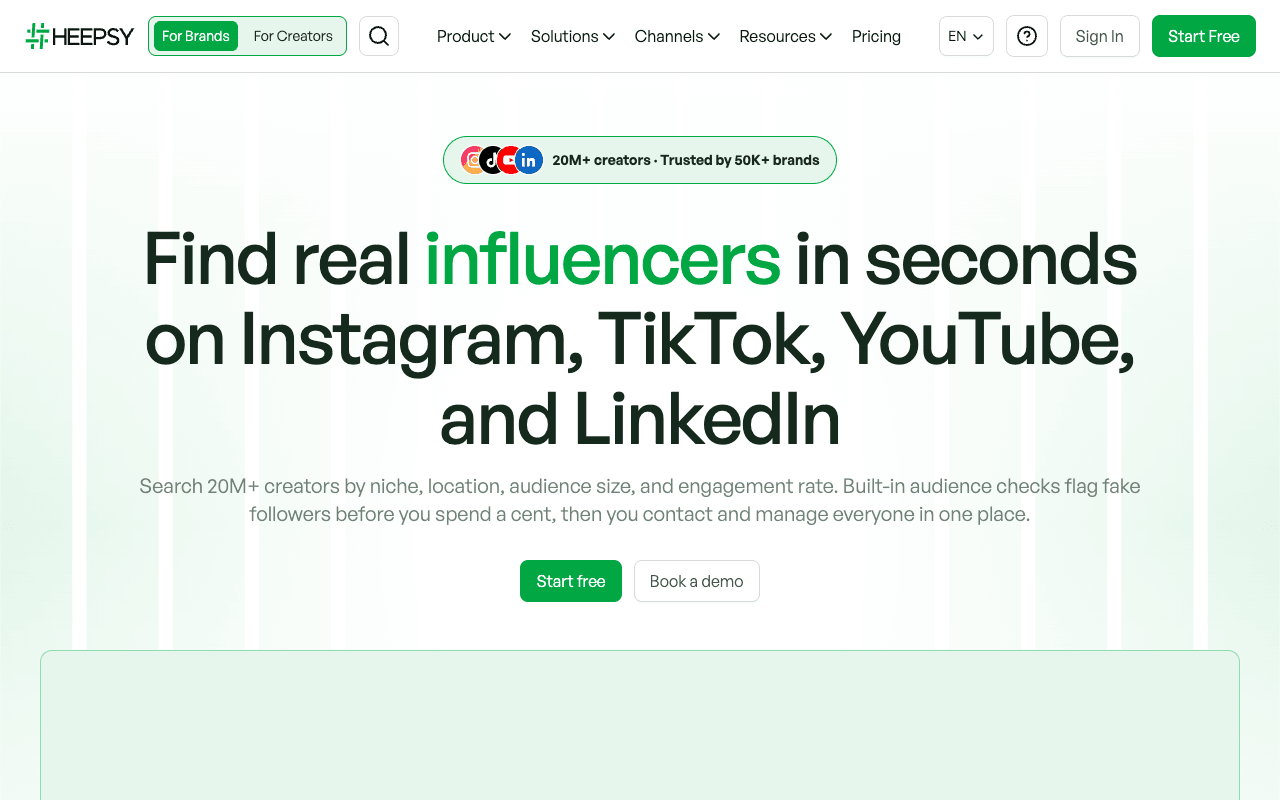
Heepsy is the budget entry: creator search with a free plan, paid tiers from $69/mo billed annually ($89 monthly) and no annual lock-in. It covers 20M+ creators across Instagram, TikTok, YouTube and LinkedIn, so it reaches some B2B voices that Instagram-first tools don't. Starter and up include individual and bulk email with two-way email sync. Plus ($149/mo annually or $199 monthly) adds audience authenticity and audience quality score filters, creator payments and campaign reporting, with 100 tracked creators. Content, click and sales tracking connect to Shopify and WooCommerce. For a freelance publicist or a small agency trying creator work for one client, it's a low-risk way to build a vetted shortlist before committing to a bigger platform. The tradeoffs: agencies are routed to custom pricing, audience authenticity filters start on Plus, and monthly caps (300 outreach emails and 5 tracked creators on Starter) limit volume.
For PR teamsBuild and vet a short creator list for one client on a free or entry plan before the agency commits to a larger platform.
Pros
- Free plan with no credit card
- Covers LinkedIn as well as Instagram, TikTok and YouTube
- Audience authenticity filters from Plus
- No annual lock-in
Cons
- Agencies are routed to custom pricing
- Starter caps outreach at 300 emails a month
- Starter tracks content from 5 creators