1
Throughline Group
Live coaching: 1:1 and group media training in NYC, DC or online
Best for: Comms leads preparing US executives for TV, print and hostile interviews
Pricing: Quote only
Free option: Free e-book download
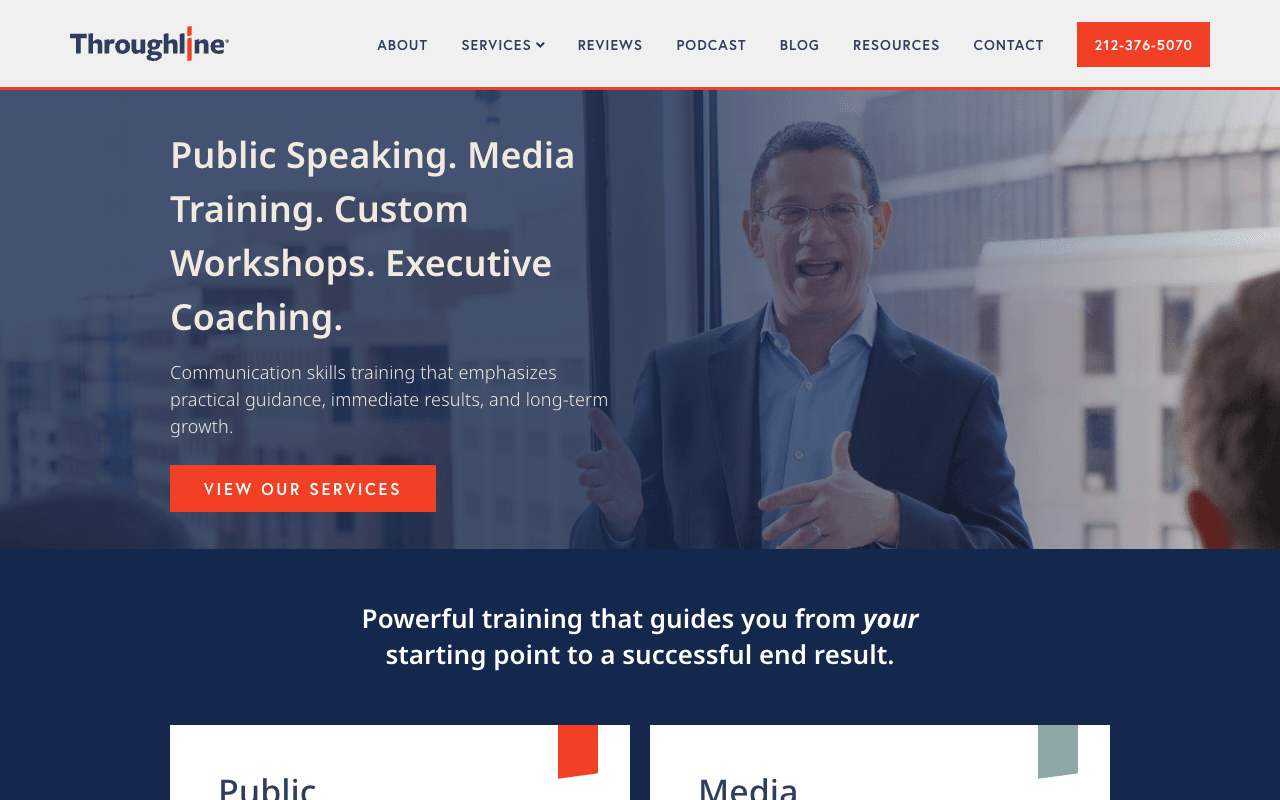
Throughline Group is Brad Phillips's firm (mrmediatraining.com now redirects to it), offering one-on-one coaching and custom group workshops in New York City, Washington, D.C., or live online. Training centers on several rounds of videotaped practice interviews, each followed by specific feedback on message and delivery, and the recordings are yours to keep. It prepares leaders for questions that are "unexpected, surprising, challenging, or even hostile," and workshops cover how to comment when you can't. Phillips worked at ABC's Nightline and CNN's Reliable Sources, and colleague Christina Mozaffari worked at NBC News. Executive clients get a free one-hour follow-up call within a year, a monthly article for ten months, and the firm's book, The Media Training Bible. The tradeoff is cost visibility: Throughline publishes no prices, so you'll need a quote before you can put a number in the budget or a client's scope.
For PR teamsBook one-on-one sessions for an executive ahead of a launch or a difficult story, then rewatch the recorded practice interviews before the next big interview.
Pros
- One-on-one or small group, in person or live online
- Several videotaped practice rounds with feedback after each
- Covers hostile questions and commenting when you can't
- Free follow-up call and monthly articles after executive training
Cons
- No published prices; quote only
- In-person sessions are based in New York City and Washington, D.C.
2
Success in Media
Live coaching: executive media training led by Jess Todtfeld
Best for: An executive with a TV hit, podcast or tough interview coming up soon
Pricing: Quote only
Free option: None listed; quote reply within one business day
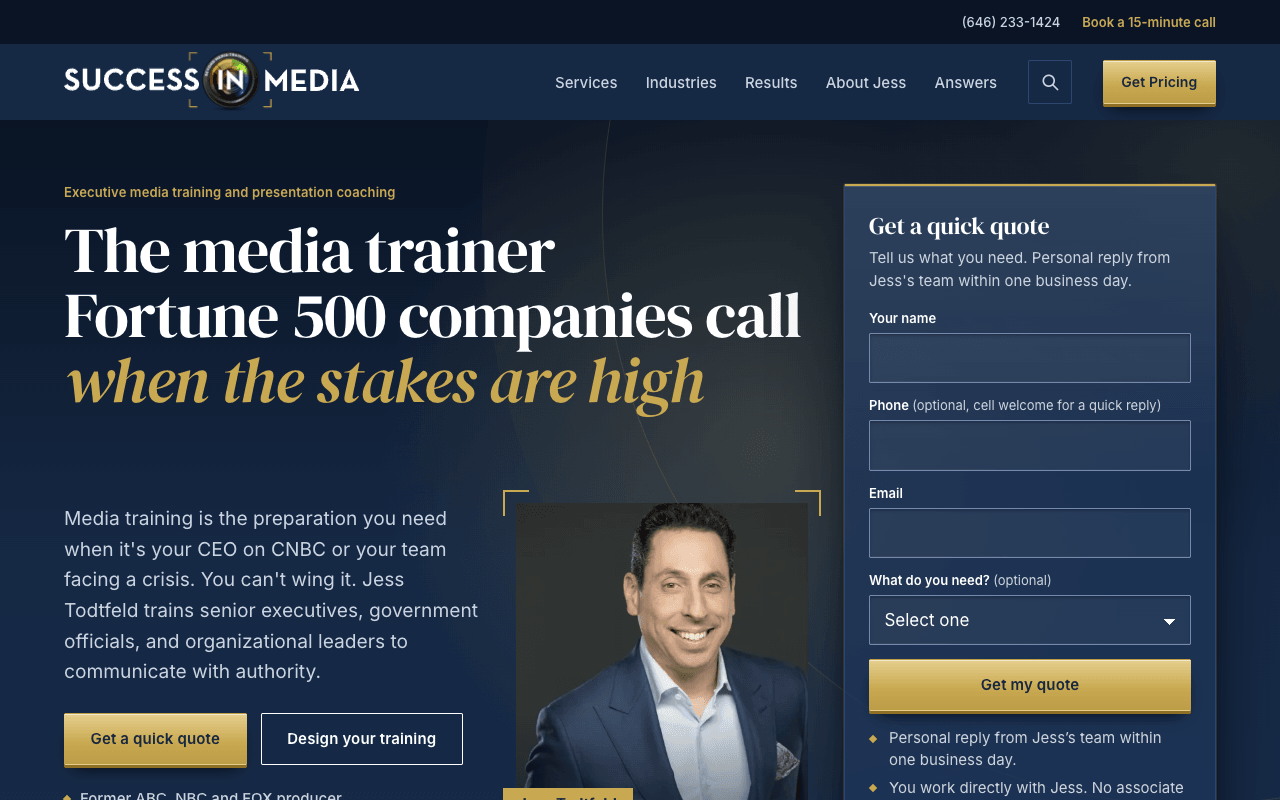
Success in Media is Jess Todtfeld's practice, and the site is explicit: "You work directly with Jess. No associate trainers." Todtfeld says he spent 13 years producing at ABC, NBC and FOX. Programs are custom-built and run at your location, his New York studio on Madison Avenue, or live online, as a half-day, full-day or multi-session engagement. Sessions cover TV, radio, print and podcast interviews, message development, hostile questions and crisis communication. You practice your own answers on camera, watch the playback and get corrected, and his Sound Bite Quote System aims for a quotable answer in 30 seconds or less. Every program includes a 365-day support program, and the site says virtual sessions are often the fastest path when a media hit or interview is coming up soon. The tradeoffs: prices are quote only, and with no associate trainers, every session depends on one trainer's calendar.
For PR teamsWhen a booking lands for next week, set up a live remote session so the spokesperson rehearses their actual answers on camera and reviews the playback before the interview.
Pros
- Every session run by Todtfeld himself
- TV, radio, print and podcast prep in one program
- Remote sessions for interviews coming up soon
- 365-day support program included
Cons
- Quote only; no prices on the site
- One trainer, so availability depends on his calendar
3
Media First
Live coaching: journalist-led training online, on-site or in studio
Best for: UK and international teams that need crisis drills and broadcast practice
Pricing: Quote only
Free option: Free library of short interview-tip videos
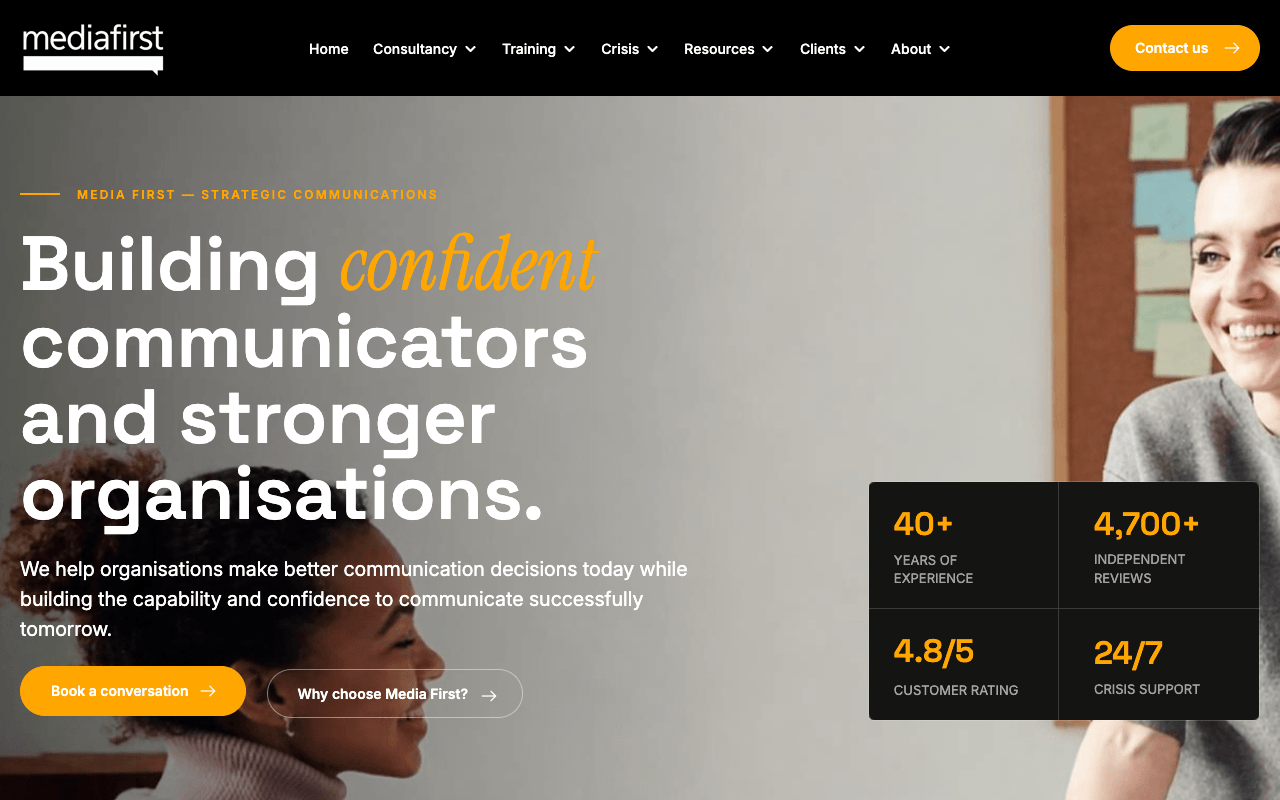
Media First is a UK communications training and crisis firm offering spokesperson, executive, crisis, and broadcast and on-camera media training. Courses run online, at your offices or in professional broadcast studios across the UK, and each is tailored to the organisation. Participants work through realistic interviews and challenging questions with current and former journalists; trainers listed include Sean Ryan (senior editorial roles at The Sunday Times and The Times) and Sophie Long (more than two decades as a BBC correspondent and anchor). Broadcast training covers television, radio, podcasts and video interviews. After the course, delegates get a detailed written feedback report, video uploads and 30 days' complimentary access to Thirty Seven, the firm's AI interview-practice tool, so spokespeople can keep practising. Media First also offers 24/7 crisis support. The tradeoffs: live training is quote only, and the broadcast studios it lists are in the UK.
For PR teamsRun a crisis media drill for the leadership team, then keep spokespeople practising between sessions with the 30 days of AI practice included after the course.
Pros
- Current and former national journalists play the reporter
- Spokesperson, executive, crisis and broadcast tracks
- Written feedback report and 30 days of AI practice after the course
- 24/7 crisis support from the same firm
Cons
- Quote only for live training
- Its broadcast studios are in the UK
4
Media Training Worldwide
Self-paced course: TJ Walker's video courses plus live sessions
Best for: Spokespeople who need the fundamentals this week at a published price
Pricing: $597 flagship course; $197 critique; live training quote only
Free option: Free personalized video proposal
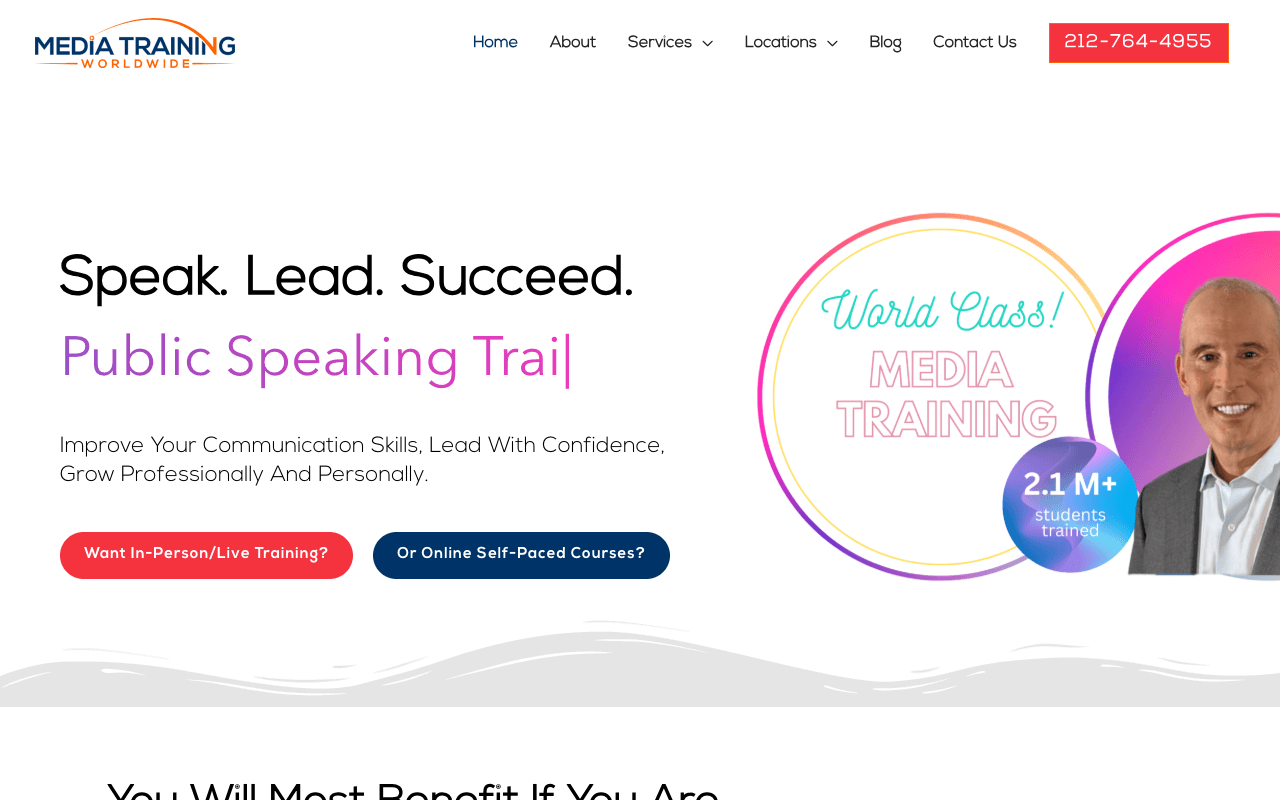
Media Training Worldwide is TJ Walker's New York-based media and public speaking business, and one of the few providers that publishes prices. The flagship course, "Media Training: Look Great on TV-Get the Exact Quotes You Want" ($597), has more than 100 videos plus homework and covers on-camera appearance, a "3-part, 30-second message", answering questions and sound bites. It now includes two live online sessions with Walker, held on the first Monday of each month at 2:00 PM Eastern, and he critiques your speaking videos. The $197 Media Interview Protection Plan gets your message points, sound bites and appearance critiqued, and Personal Media Training ($10,000) includes up to 10 personalized video critiques and a live video session. Industry versions for financial services ($397) and healthcare ($497) are also listed. The tradeoff: the core is self-study, so feedback depth depends on which product you buy, and in-person or live training is quote only.
For PR teamsGive a new subject-matter expert the flagship course before their first interview, or buy the $197 critique to check one spokesperson's message points and sound bites.
Pros
- Exact published prices for courses and critiques
- Flagship course includes two live sessions and video critiques
- Industry versions for finance and healthcare
Cons
- Mostly self-study; live feedback depends on the product
- In-person and live training are quote only
5
Thirty Seven by Media First
AI practice tool: mock interviews with AI journalists
Best for: Spokespeople rehearsing a specific announcement or crisis interview
Pricing: £59/user/mo billed monthly or £495/user/yr (GBP)
Free option: No free tier listed; 30 days included with Media First courses
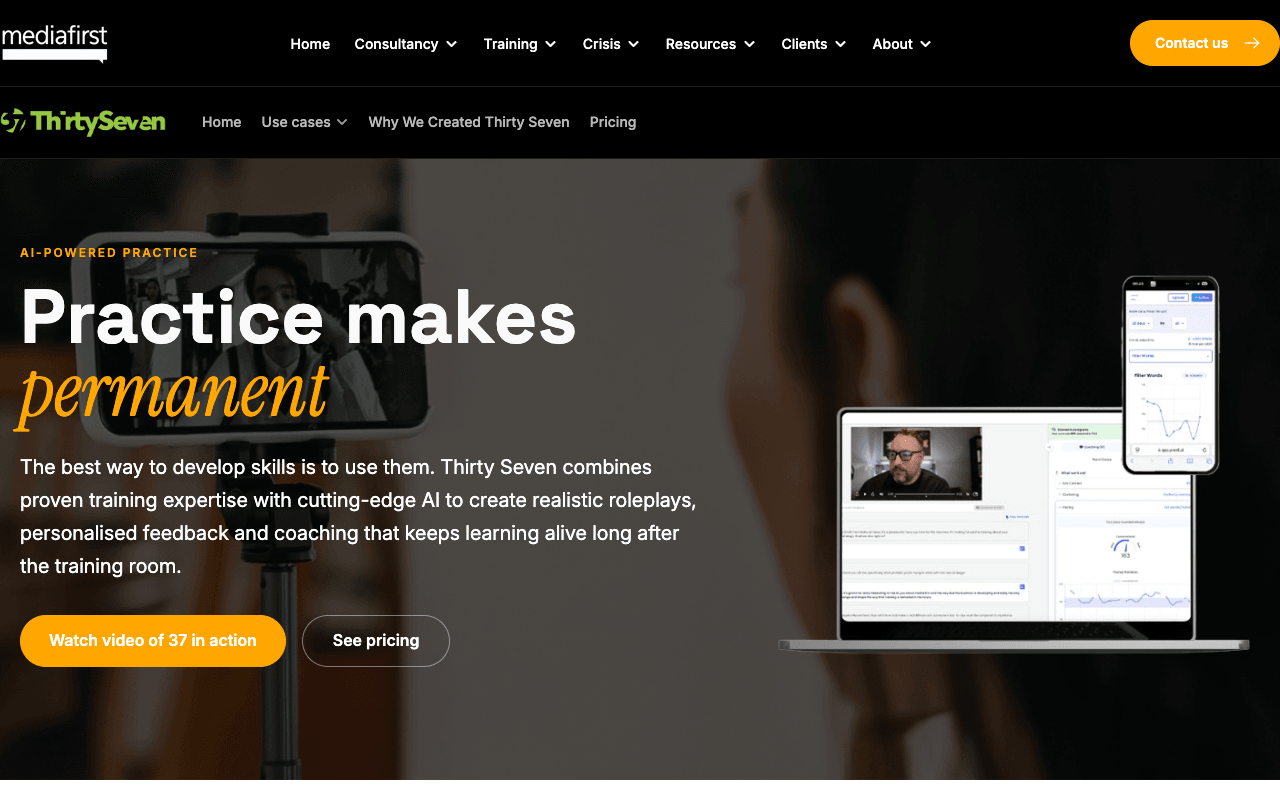
Thirty Seven is Media First's AI practice tool, and the most media-specific one we found. Spokespeople practise interviews with AI journalists ranging "from friendly and supportive to sceptical, abrupt and highly challenging," and you can upload press releases, statements or key messages so it builds the interview around your actual news. It adapts to television, radio, podcast and print interviews and includes crisis interview prep. After every roleplay it gives written and graphical feedback on whether your key message landed, difficult and hostile questions, jargon, repeated negative language, eye contact, filler words and pace, and it coaches when and how to bridge. Prices are in British pounds: Select, with one pack (the Communications pack includes media), is £59 per user per month billed monthly or £495 per user per year, a £213 saving. Complete, with both packs, is £74 a month or £695 a year. Team and enterprise plans are quote only. The tradeoff: feedback comes from software, not a human trainer.
For PR teamsUpload the release the day before the announcement and have the spokesperson run the interview against a sceptical AI journalist until the key message lands.
Pros
- Builds interviews around your own release or statement
- Journalist personas from friendly to hostile
- Feedback on key messages, bridging and hostile questions
- Published per-user pricing
Cons
- Priced in GBP; no free tier shown on the pricing page
- AI feedback, not a human trainer
6
VirtualSpeech
Self-paced course with AI practice: studio, radio and ambush drills
Best for: Low-cost media training with practice drills for individual spokespeople
Pricing: $45/mo or $399/yr (full course library)
Free option: None listed
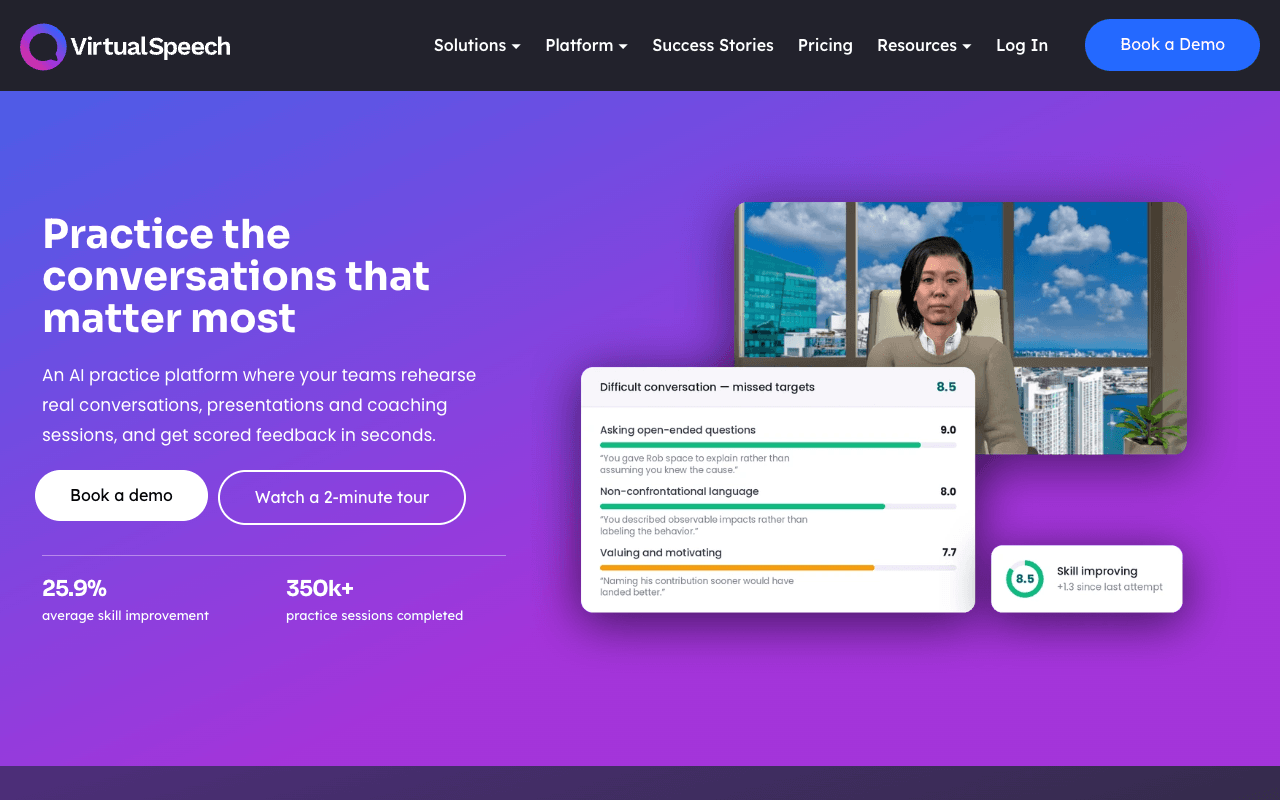
VirtualSpeech's Media Training course is self-paced: 29 online lessons, six practice exercises and about two hours of learning, aimed at senior managers, startup founders and company spokespeople, with a slight focus on crisis communications. The practice exercises are the draw: a BBC-styled studio interview, a press conference, a down-the-line interview, a radio or podcast interview, and a media ambush where you answer hostile questions. They run in the browser, or in VR if you have a headset, with AI-generated questions, custom questions, voice analysis, recording and feedback after each session. You get a digital certificate at the end. Individual access is $45 per month or $399 per year and covers the whole course catalogue; enterprise and education pricing is quote only. The tradeoff: it's structured practice rather than a session with a journalist, and the course page doesn't list trainer backgrounds.
For PR teamsAssign the course to a spokesperson ahead of a launch, then have them repeat the press conference and ambush drills until the answers hold up.
Pros
- Five interview scenarios, including ambush and press conference
- Online or VR practice with AI-generated questions
- Published monthly and annual prices
- Subscription covers the full course catalogue
Cons
- No free tier listed on the pricing page
- Course page doesn't list trainer backgrounds
7
Yoodli
AI practice tool: roleplay practice, including media interviews
Best for: Low-cost rehearsal between coached sessions
Pricing: Free; Pro $8/mo, Advanced $20/mo (billed annually)
Free option: Starter: up to 5 roleplays total, no credit card
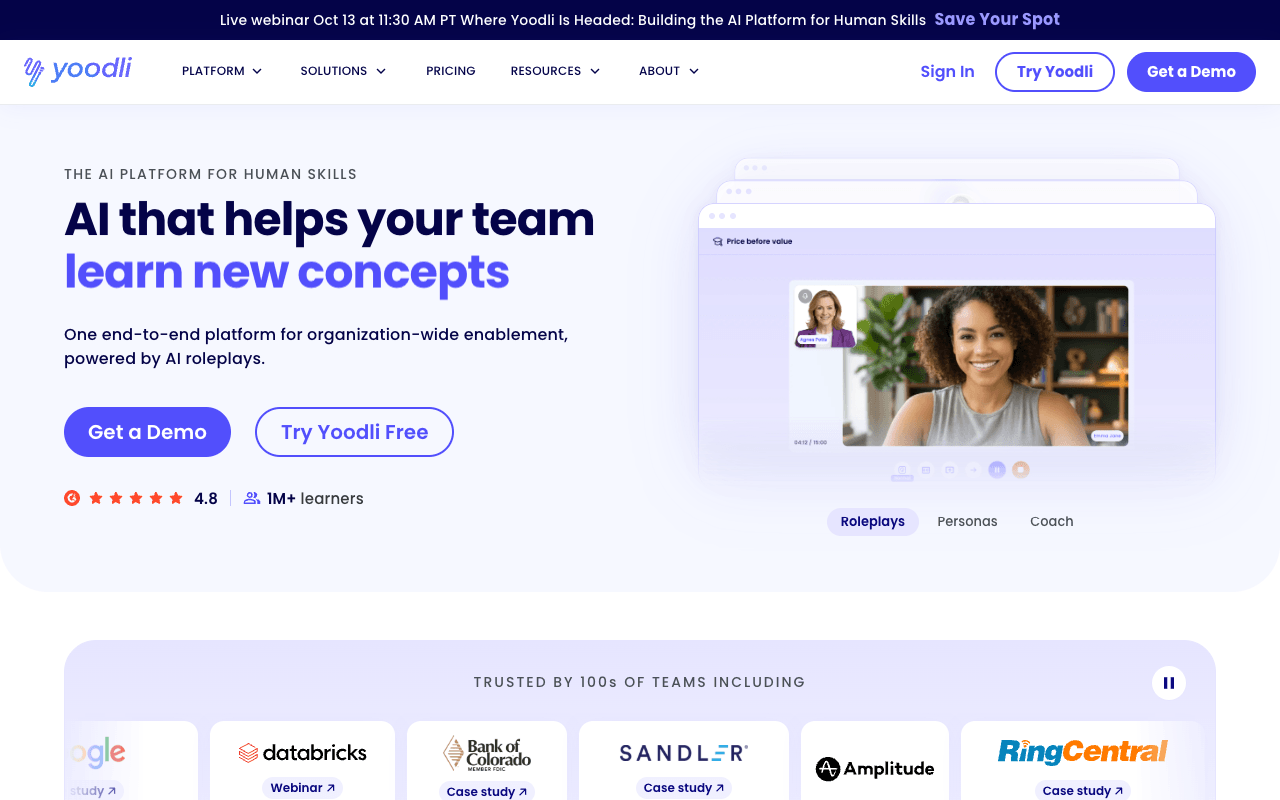
Yoodli is an AI roleplay platform for communication practice. Its corporate communications page lists media interviews alongside board presentations, earnings calls, executive meetings and town halls, and positions it as a private, judgment-free space for leaders to rehearse between coaching sessions. It runs live AI roleplays and gives feedback, including on recordings you upload. Pricing is the lowest on this list: Starter is free for up to five roleplays total with no credit card, Pro is $8 a month billed annually for up to ten roleplays a week, and Advanced is $20 a month billed annually for unlimited roleplays, with your data excluded from AI training. Yoodli says Advanced is reimbursable as a learning benefit. Team and enterprise plans start with a demo. The tradeoff: Yoodli is built for communication practice in general, and media interviews are one listed use among many, so it complements media training rather than replacing it.
For PR teamsGive an executive a Yoodli account after a coached session so they can rehearse the interview between sessions, and use the same tool for earnings calls and town halls.
Pros
- Free plan, no credit card
- Lowest paid price on this list
- Feedback on live roleplays and uploaded recordings
- Also covers earnings calls and town halls
Cons
- General communication tool; media interviews are one use of many
- Listed paid prices are billed annually; monthly billing costs more
8
Braud Communications
Live coaching: crisis media training from a veteran journalist
Best for: Organizations preparing spokespeople for crisis interviews
Pricing: Quote only
Free option: Free crisis communications video course
Braud Communications is Gerard Braud's crisis communications firm, and its media training starts from the crisis interview. Crisis Media Training runs in person or virtually for one to six participants and brings "the tough questions asked during a real interview to the safe space of your private, training room." The firm also offers Good News Media Training, a virtual train-the-trainer program, and large-group formats from one-hour keynotes or breakouts to two- to three-hour workshops. The site says virtual interviews require special training, and Braud's career as a journalist and trainer spans more than 40 years. He also wrote "Don't Talk to the Media Until… 29 Secrets You Need to Know Before You Open Your Mouth to a Reporter." The homepage offers a free video course, 5 Steps to Effective Crisis Communications. The tradeoffs: prices are quote only, and the firm's focus is crisis communications, so it's a specialist pick rather than all-purpose executive coaching.
For PR teamsPut the people who would speak in a crisis through a private crisis session, and have the in-house comms lead take the train-the-trainer program to run refreshers.
Pros
- Crisis interview training for 1-6 people, in person or virtual
- Train-the-trainer option for in-house comms teams
- Large-group keynotes and workshops
- Free crisis communications video course
Cons
- Quote only
- Focus is crisis communications rather than general exec coaching
9
Strategic Communications
Self-paced course: one-hour on-demand media training plus a consult
Best for: Priming a group of experts before live on-camera sessions
Pricing: $499 on-demand course; live programs quote only
Free option: None listed
Strategic Communications sells Media Training On-Demand for $499: a one-hour session on the fundamentals of speaking to different audiences and managing interview opportunities, plus a 30-minute personal consultation with one of its senior trainers. Video access lasts six months from purchase, and the consultation must be scheduled within 12 months. Its live program pairs a classroom session with private, one-hour on-camera sessions, in person or virtual, where the trainers act as reporters and give constructive feedback; on-camera participants get a written recap and a private video recording. The site is also one of the few to state lead times: it typically books one to two months ahead for virtual training and two to four months ahead for in-person. The tradeoffs: the on-demand course is a one-hour primer rather than full training, and the live programs are quote only.
For PR teamsHave a bench of subject-matter experts watch the on-demand hour first, then book live on-camera sessions for the few who will speak to press most.
Pros
- Published $499 price with a 30-minute consult included
- Live program adds private on-camera sessions with a recording
- States its booking lead times up front
Cons
- On-demand course is one hour; video access lasts six months
- Live programs are quote only