1
NewsAPI.ai
Full-text news with authors, events and an archive back to 2014
Best for: PR teams building client monitoring, coverage archives and story tracking
Pricing: From $90/mo (5K plan, billed monthly)
Free option: 2,000 free tokens, no card (evaluation only)
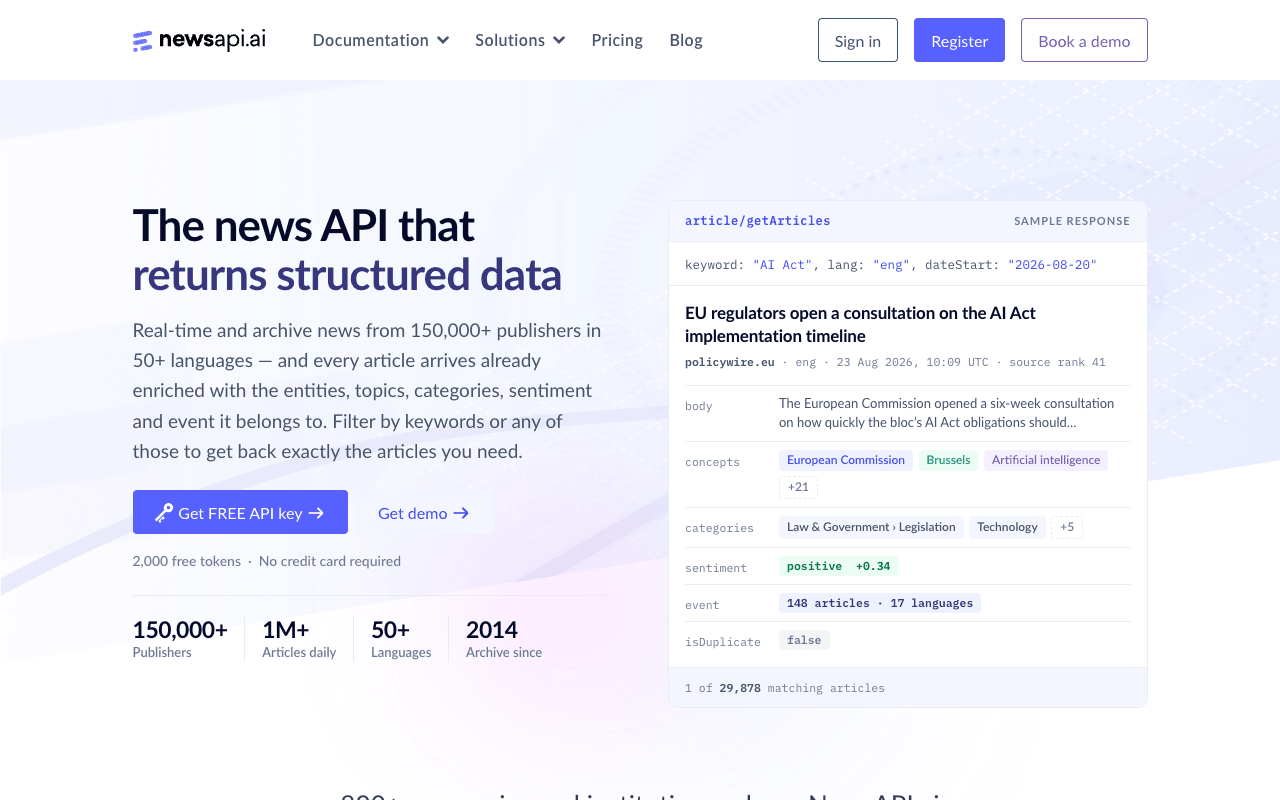
NewsAPI.ai, from Event Registry, says it covers 150,000+ publishers in 50+ languages, with an archive back to 2014. Every article arrives enriched with entities, topics, categories and sentiment, plus the full article text and extracted author names, and you can filter searches by author, source, location and source rank. The PR-relevant extra is event clustering: coverage of one story across outlets is grouped into a single event, so a client announcement counts once instead of once per reprint. An official MCP server works with Claude, Cursor and other MCP clients. Paid plans carry a commercial license; the 5K plan is $90 a month and the 20K plan $220 a month. The tradeoff is cost shape. A recent search (last 30 days) costs 1 token, but archive searches cost 5 tokens per year searched, so long coverage audits use up a plan quickly. Free tokens are for evaluation only and cover the last 30 days.
For PR teamsSave one query per client, pull full text and authors into a coverage sheet, and use events to report one story as one story.
Pros
- Full article text and author names on paid plans
- Event clustering keeps syndicated reprints from inflating reports
- Archive back to 2014 for coverage audits
- Official MCP server for Claude and Cursor
Cons
- Archive searches cost 5 tokens per year searched
- Free access is evaluation-only, last 30 days, and tokens don't renew
2
NewsData.io
Broad news API with authors, full text and up to 10 years of history
Best for: Agencies that want clear publishing rules and deep history for audits
Pricing: From $199.99/mo (Basic, monthly; save 20% yearly)
Free option: Free plan: 200 credits/day, 12-hour delay
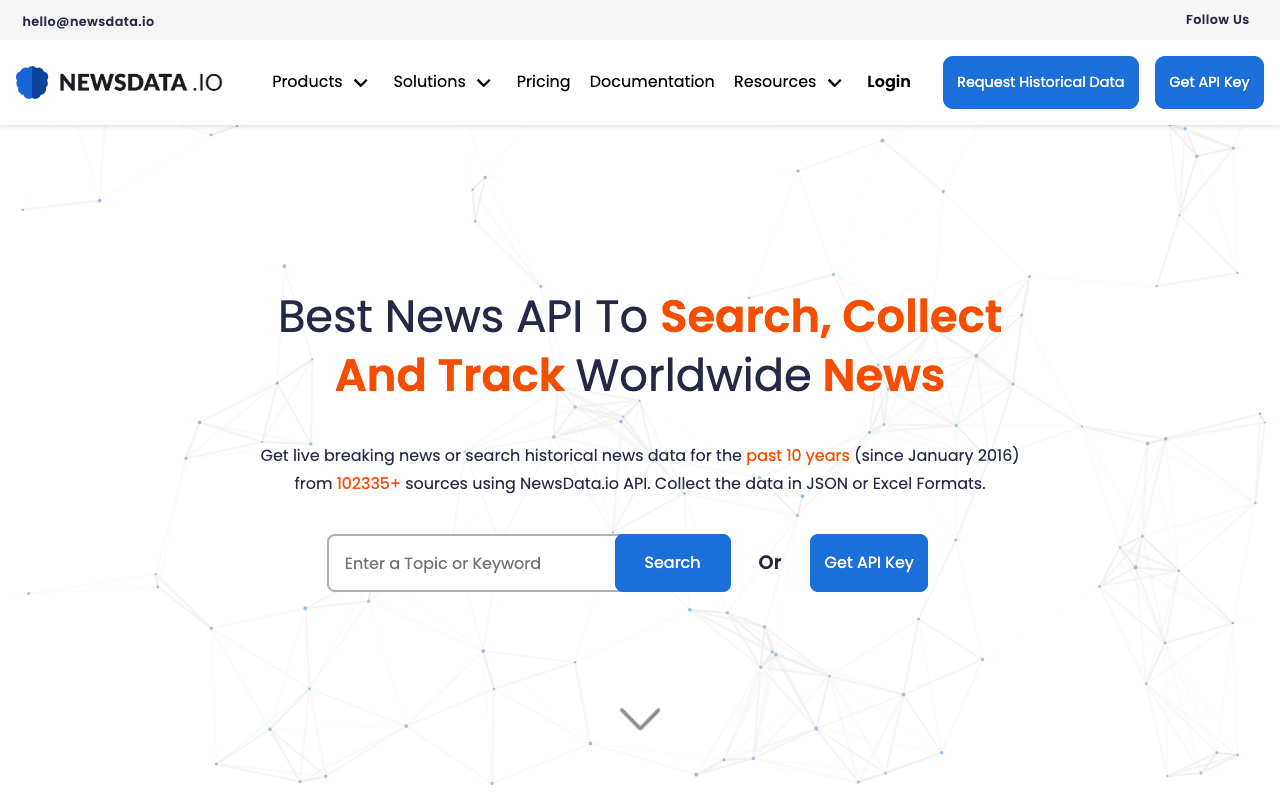
NewsData.io lists 102,335+ news sources across 206 countries and 90 languages, with up to 10 years of historical news. Each article carries a creator field for the author, a datatype that separates news from blogs and opinion, sentiment and AI tags, and full content on paid plans. Paid plans are real time: Basic ($199.99/mo) includes 20,000 credits and 6 months of history, Professional ($349.99/mo) 2 years, and Corporate ($1,299.99/mo) 10 years with a 99.95 SLA. Archive calls cost 5 credits each. Its FAQ is unusually clear on rights: data can be used for personal and commercial use, and you may publish the title, short description, publisher name, author name, date and time, but not images or full content. That fits client coverage tables that link out to the article. The free plan is 12 hours delayed with no full content or history, so it's for testing, not rapid response.
For PR teamsPull a monthly coverage table per client (headline, outlet, author, date, link) and run a two-year share-of-voice audit on Professional.
Pros
- Author field on articles, plus news vs blog vs opinion type
- Clear FAQ on which fields you may publish
- History up to 10 years on Corporate
- MCP server page and OpenAPI spec
Cons
- Free plan is 12 hours delayed with no full content or history
- Archive calls cost 5 credits each
- First paid plan is $199.99/mo
3
Perigon
News intelligence API with a journalist database and MCP on every plan
Best for: Teams that need journalist profiles alongside articles
Pricing: Commercial from $24k/yr; startup plans $250/mo and $550/mo
Free option: Free plan: 150 requests/mo, personal use only
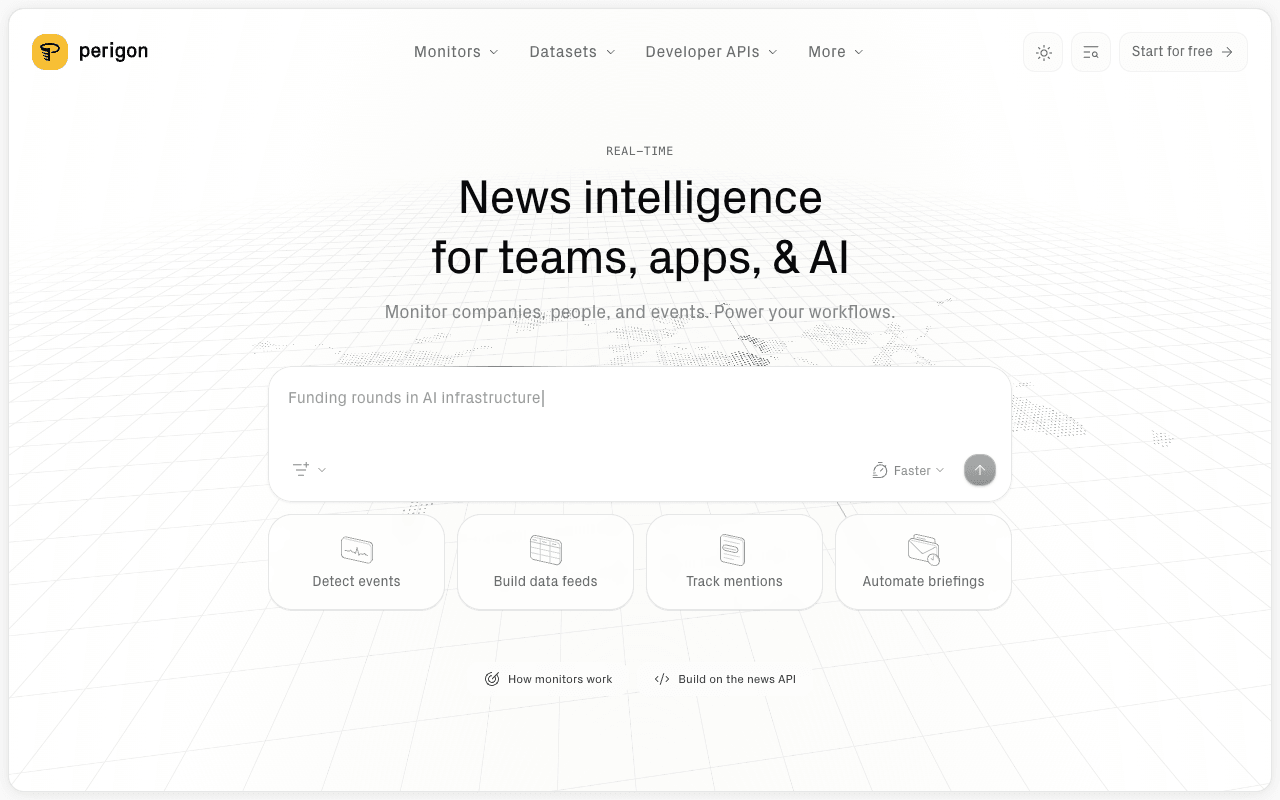
Perigon describes itself as a real-time news intelligence platform for teams, applications and AI agents, and reports an average of 6 minutes from publication to indexing. What sets it apart for PR is the Journalists endpoint: Perigon says its database holds profiles for over 230,000 journalists, which may include title, X handle, bio, LinkedIn profile and location. Articles come with sentiment, AI summaries, company and people entities and story clustering, and an MCP server is included on every plan, free included. The tradeoff is licensing. Basic ($250/mo, 1-hour delay, articles only) and Plus ($550/mo, with Journalists) are prices for eligible startups and carry a limited commercial license. A brand or agency that doesn't qualify is looking at the Commercial plan, custom priced from $24k a year, with a full commercial license and 10+ years of history. Full article text depends on use case and plan licensing.
For PR teamsSearch a client's topic, then pull profiles of the journalists covering it to shortlist who to pitch, from one API.
Pros
- Dedicated journalist profile endpoint
- 6-minute average indexing latency, per Perigon
- MCP server on every plan, including free
- Story clustering, sentiment and AI summaries
Cons
- Full commercial license starts at $24k/yr (Commercial plan)
- Basic and Plus are startup pricing with a limited license
- Free plan is strictly non-commercial
4
Medialyst news search APIWe make this
PR-first news search over REST and MCP, 0.01 credit per query
Best for: PR teams running news searches inside Claude, ChatGPT or Cursor
Pricing: 0.01 credit/query; plans from $97/mo (annual) or $149/mo (monthly)
Free option: 100 free credits, no credit card
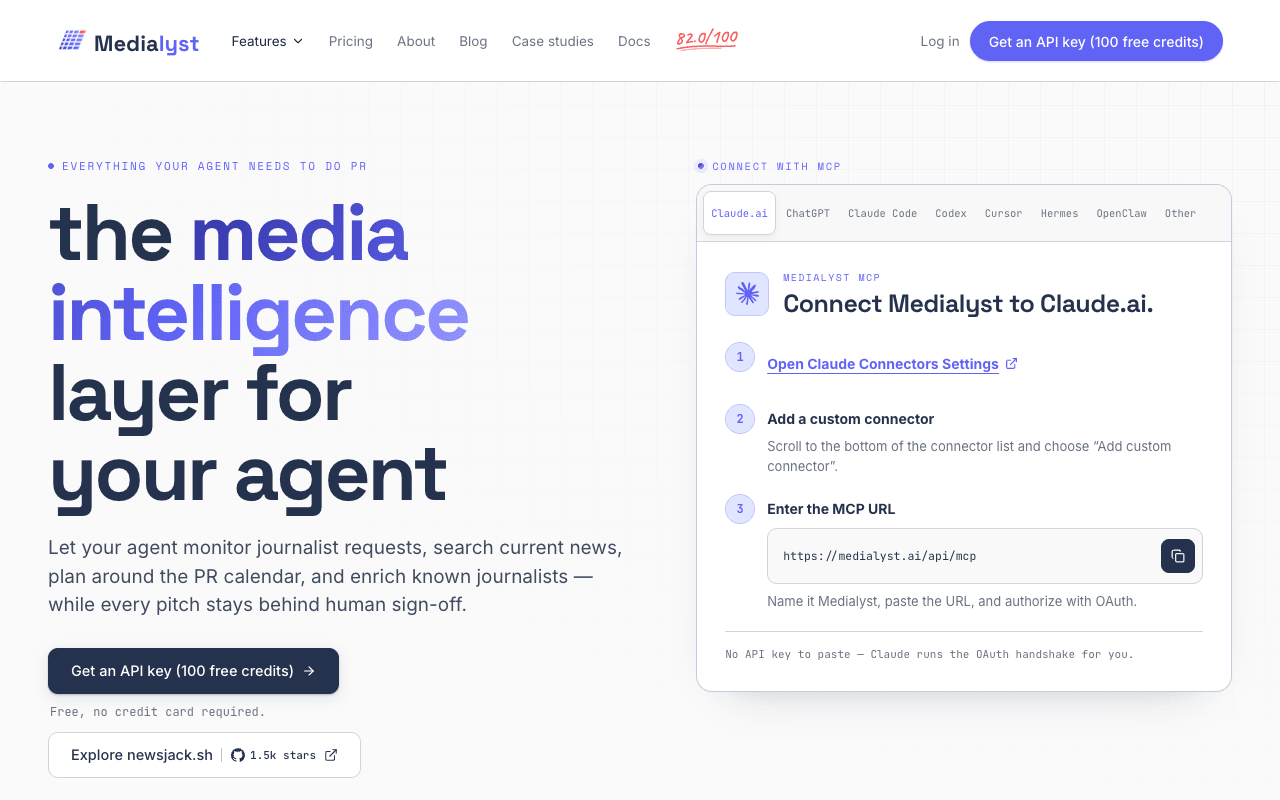
Medialyst's news search is one endpoint (POST /api/v1/news/search, MCP tool search_news) in a public API built for PR work. You search current coverage by topic and explicit publication windows, down to the last hour, and each result can carry outlet intelligence: whether the source is original editorial or a newswire, plus authority and reach. That split matters in client reports, where press release pickups shouldn't count as earned coverage. A query costs 0.01 credit, and credits are shared across the app, the REST API and the hosted MCP server, which works in Claude, ChatGPT and Cursor. The same API covers article lookup, publication lookup, journalist moves and journalist enrichment. The tradeoffs are real: search isn't advertised as returning full article text, there's no stated archive depth, and bylines come from the separate journalist lookup and enrichment features (1 credit per verified result, misses free), not from search results.
For PR teamsAsk Claude what ran about a client in the last 24 hours, keep the editorial results, then resolve the authors worth pitching with enrichment.
Pros
- 0.01 credit per query, shared with media list work
- Editorial vs newswire, authority and reach per result
- Explicit time windows down to the last hour
- Hosted MCP for Claude, ChatGPT and Cursor
Cons
- Full article text isn't advertised for search
- No stated archive depth, so not built for long audits
- Bylines need the separate enrichment step
5
GNews
Affordable news API with full text and commercial use on paid plans
Best for: Small agencies that need a commercially licensed feed on a small budget
Pricing: From €49.99/mo (or €479.99 billed annually)
Free option: Free plan: 100 requests/day, non-commercial; 10-day trial of paid plans
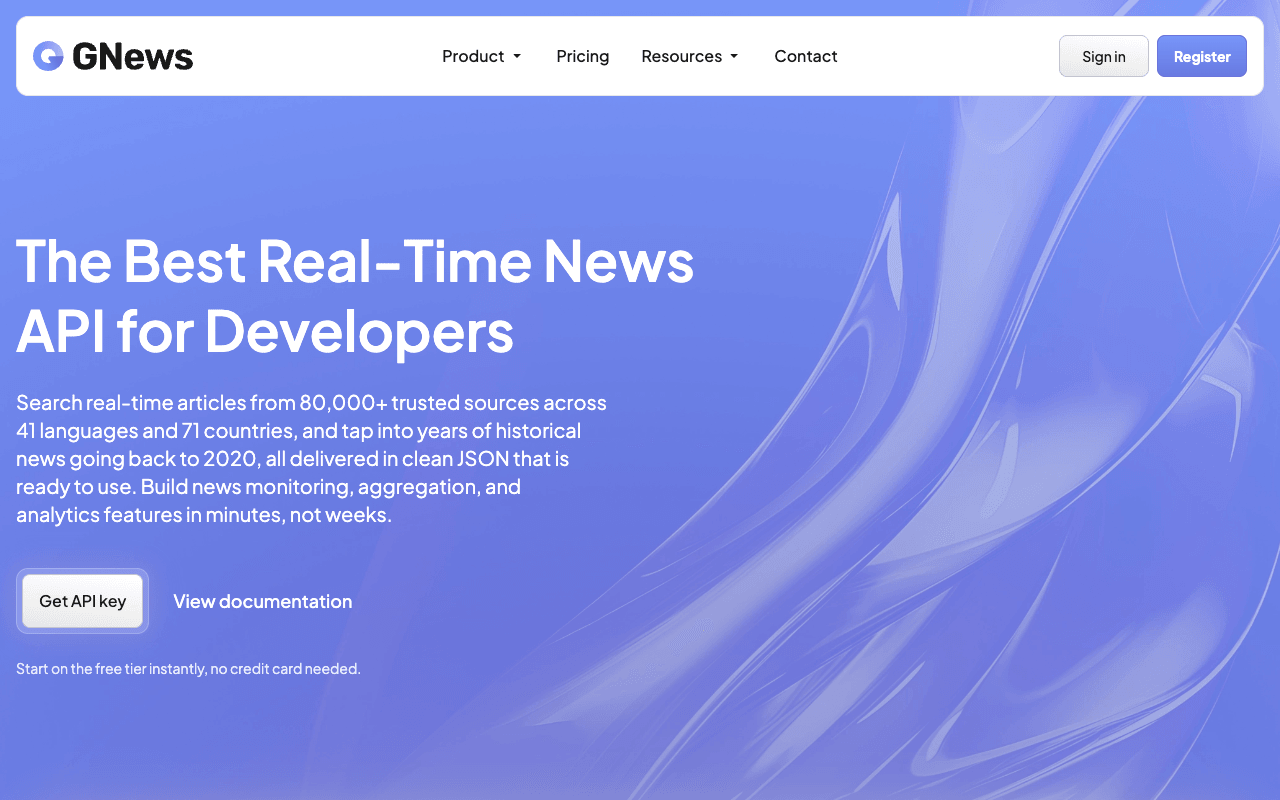
GNews says it indexes more than 100 million articles from 80,000+ sources in 41 languages across 71 countries, with history back to 2020. Its Essential plan (€49.99/mo, or €479.99 billed annually) allows commercial use and includes real-time articles, full content, 1,000 requests a day and up to 25 articles per request. Business (€99.99/mo) raises that to 5,000 requests a day, and Enterprise (€249.99/mo) to 25,000. An MCP server and SDKs are documented, and paid plans start with a 10-day free trial. Two things to know before you build client reporting on it. The free plan is non-commercial, 12 hours delayed and truncates content to a short excerpt. And commercial rights are tied to an active paid plan: if you cancel, the permission to use data commercially ends, including data you already retrieved, cached or stored. Prices are in euros.
For PR teamsRun hourly keyword checks per client on Essential and send full-text matches to the team's alert channel.
Pros
- Commercial use and full content from €49.99/mo
- Real-time articles on paid plans
- MCP server and SDKs
- Annual billing option
Cons
- Commercial rights to stored data end when you cancel
- Free plan is non-commercial, 12 hours delayed and truncated
- History goes back to 2020
6
World News API
Low-cost real-time news with authors, full text and front pages
Best for: Live alerts and agent lookups where you don't need to keep the data
Pricing: From $39/mo (Reporter, 500 points/day)
Free option: Free plan: 50 points/day, backlink required
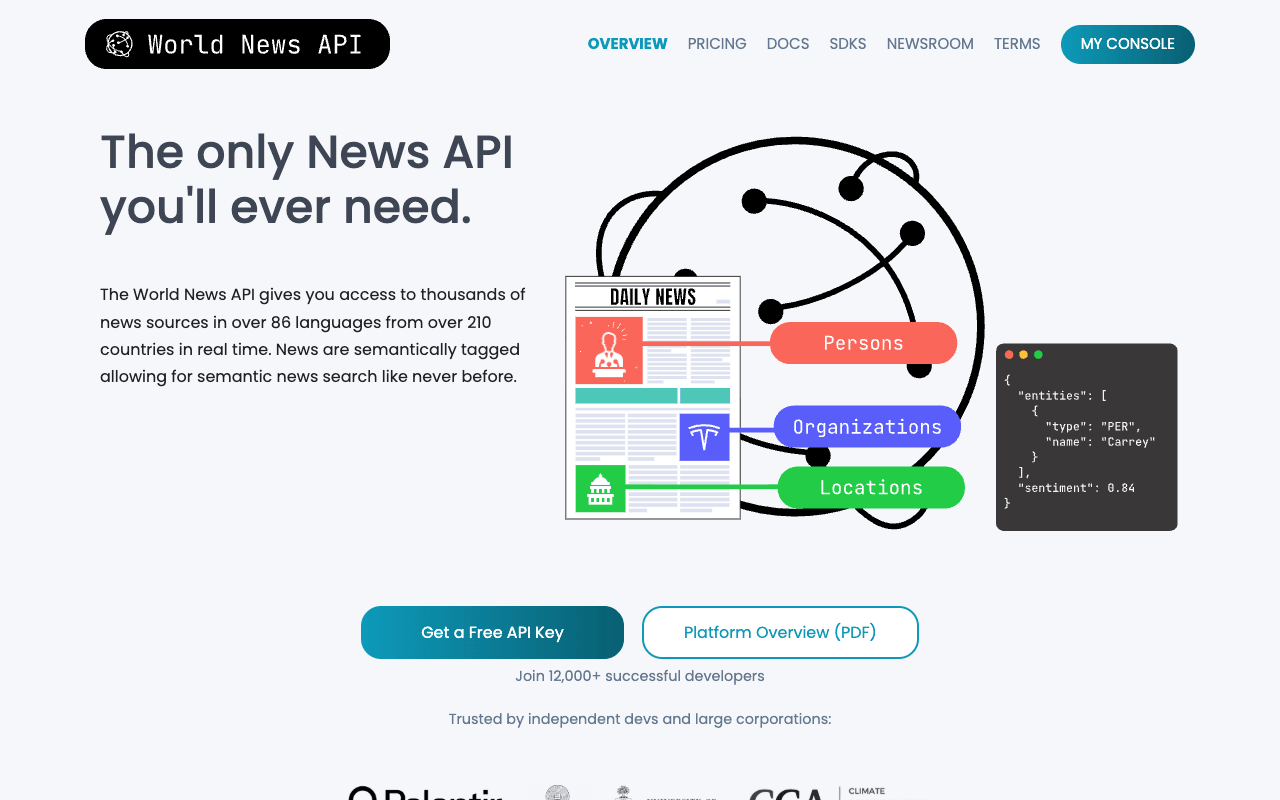
World News API covers thousands of sources in over 86 languages from over 210 countries in real time, and each article comes back with full text, a summary, authors, category, source country and sentiment (sentiment is English and German only). Paid plans add front pages from over 6,000 publications in over 125 countries, useful when a client asks whether a story made the homepage. MCP support lets you add it to Claude Desktop or ChatGPT. Pricing is points-based: Reporter is $39/mo for 500 points a day, then $0.003 per point; Journalist is $379/mo and Editor $1,779/mo. Its FAQ says paid history goes back to January 1, 2022. The big tradeoff for PR is its terms: you may not copy or store the data it provides, and caching needs written permission and lasts at most 1 hour. That rules out a coverage archive or client report database, so treat it as a live alert and lookup source.
For PR teamsUse it for live keyword alerts and on-demand lookups in Claude, and keep the coverage record in a separate tool.
Pros
- Full text, authors and sentiment in each result
- Real time from $39/mo
- Front pages of 6,000+ publications on paid plans
- MCP for Claude and ChatGPT
Cons
- Terms forbid storing results; caching max 1 hour with permission
- Free plan requires a backlink
- Sentiment limited to English and German
7
Currents API
Straightforward news API with no artificial delay on any tier
Best for: In-house teams building internal alerts and monitoring
Pricing: From $69/mo (or $690/yr)
Free option: Free Developer plan: 250 requests/day, 30 days of history
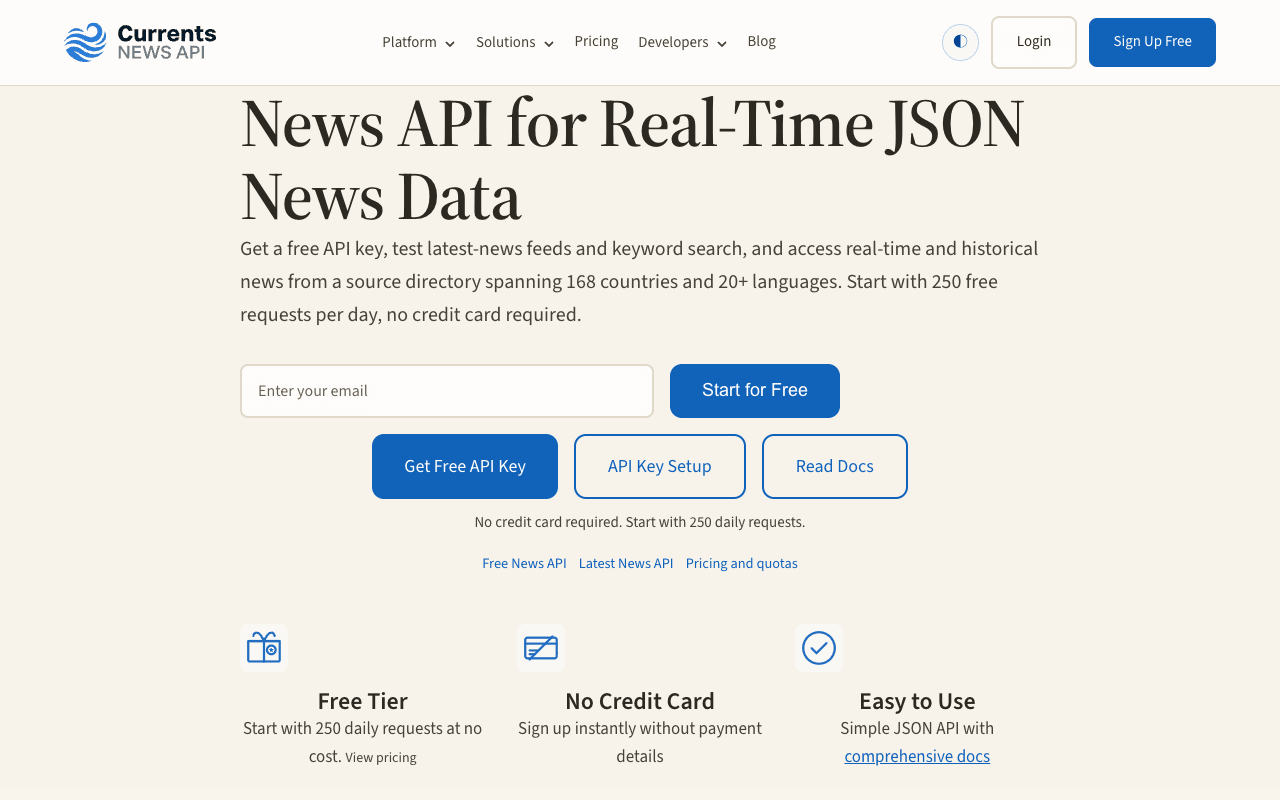
Currents API lists a source directory spanning 168 countries and 20+ languages, with 26M+ archived articles. Two things make it an easy yes for an in-house comms team. First, it says newly indexed stories reach every tier without an artificial plan delay, so even the free Developer plan (250 requests a day, 30 days of history, up to 20 results per request) works for testing rapid-response alerts. Second, its usage rights are written in plain English: internal analysis, monitoring, alerts and internal RAG workflows are allowed when results stay internal and link back to sources, while customer-facing AI summaries, derivative content and long-term archives aren't included by default. Paid plans are Builder at $69/mo (2,500 requests a day, 6 months of history), Professional at $150/mo (1 year) and Scale at $300/mo, with no overage billing. Author is returned only when the publisher provides it.
For PR teamsPower an internal alert for brand, executive and competitor names, with every hit linking back to the source.
Pros
- No artificial delay, even on the free plan
- Plain-English rules for internal monitoring use
- No overage billing
- Annual pricing available
Cons
- Client-facing summaries and long-term archives not included by default
- Self-service history tops out at 1 year
- Author only when the publisher provides it
8
Webz.io
Pay-as-you-go news data with authors, full text and entity sentiment
Best for: Technical teams that want usage-based pricing and enrichment
Pricing: Pay as you go: Search API $0.001/call + $0.0005/result; data feeds $0.01/call + $0.005/result
Free option: Free plan: $5 in credits every month, no card
Webz.io's News API returns full-text articles and summaries with metadata (author, title, URL, language, country, publication date), sentiment, entity extraction for companies, people, organizations and locations, entity-level sentiment where supported, and fake and satirical news indicators. It says it receives original content directly from corporate and government newsrooms, and it has a dedicated Media Monitoring & PR solution page. Pricing is the most granular on this list: the Scale plan is pay as you go with no commitment or minimum spend. Its Search API costs $0.001 per call plus $0.0005 per result, and its news, blog, discussion and review data feeds cost $0.01 per call plus $0.005 per result. The free plan includes $5 in credits every month with no credit card. The tradeoff is history. The free plan has limited historical access, and archive data (up to 10 years) isn't included in pay as you go, so coverage audits move you to custom high-volume pricing.
For PR teamsPay per query for client and competitor tracking, and use entity-level sentiment to flag negative coverage early.
Pros
- Usage-based pricing with no minimum spend
- $5 in free credits every month
- Author, full text and entity-level sentiment
- Fake and satirical news indicators
Cons
- Archive data not included in pay as you go
- High-volume plans are custom priced
9
NewsCatcher
Enterprise news API with author search and history back to 2019
Best for: Larger agencies and in-house teams buying an enterprise data feed
Pricing: Quote only (production on Enterprise)
Free option: 7-day trial
NewsCatcher positions its News API for AI pipelines and production systems, with 140,000+ sources and an archive of 2 billion+ articles back to January 2019. For PR, the useful piece is the /authors endpoint, which searches for articles written by a specified author or set of authors: a quick way to review a reporter's recent work before a pitch or an interview. Responses include full article text, NLP enrichment, entities, sentiment and clustering, and the docs cover an MCP integration. Enterprise lists a 99.95% uptime SLA, SOC 2 Type 2 certification and flat pricing rather than per-article metering, which suits procurement teams that need a predictable line item. The tradeoff: there's a 7-day trial on every plan, but production use of the News API is on Enterprise, and that price isn't published.
For PR teamsPull everything a target reporter has written on a beat before pitching, and feed client coverage into an internal BI dashboard.
Pros
- /authors endpoint for reporter research
- History back to January 2019
- SOC 2 Type 2 and a 99.95% SLA on Enterprise
- Flat pricing, not per-article metering
Cons
- Production use requires an Enterprise quote
- News API pricing isn't published
10
NewsAPI.org
The best-known news API: simple to start, priced for production apps
Best for: Prototyping a coverage tool before choosing a production feed
Pricing: From $449/mo (Business, billed monthly)
Free option: Developer plan: 100 requests/day, development only
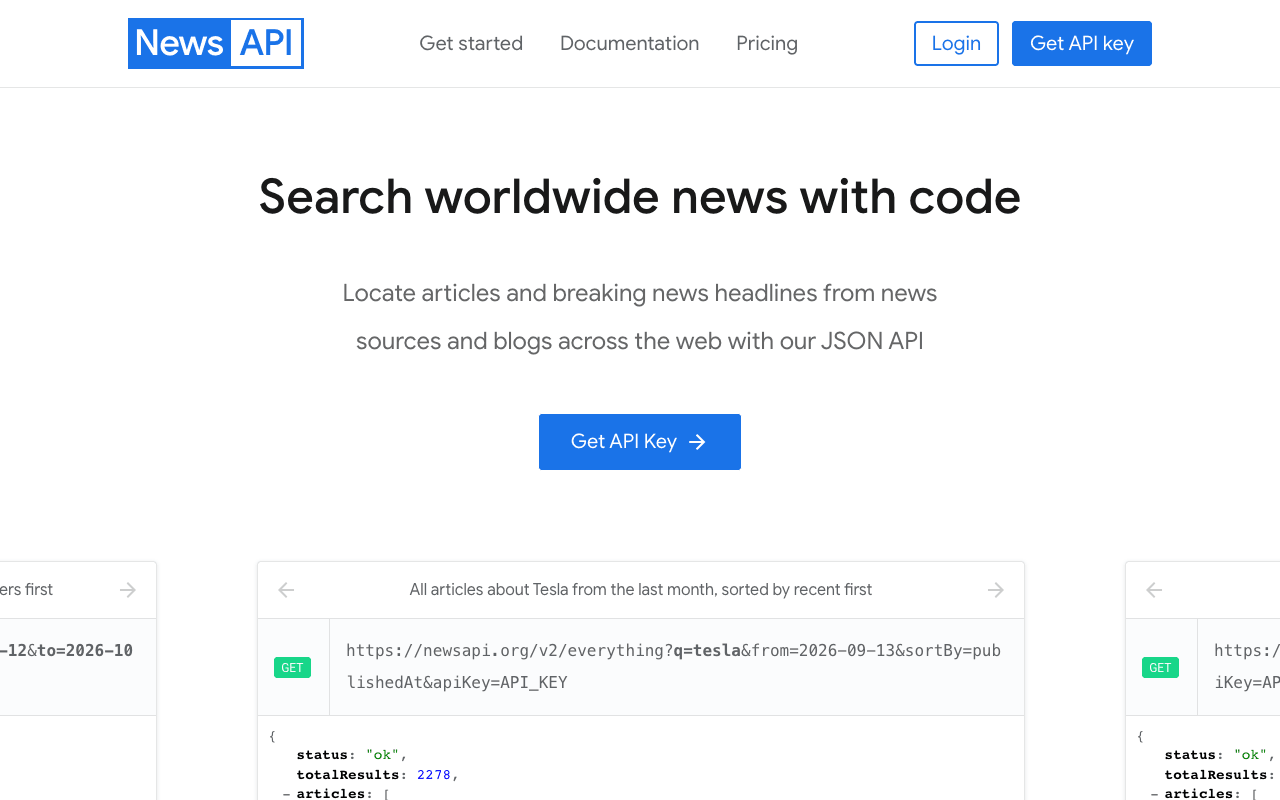
NewsAPI.org is the name most news API searches lead to, and its docs are simple. It says it searches over 150,000 worldwide sources and hundreds of millions of articles in 14 languages from 55 countries, and it returns an author string with each article. For PR teams, the plan structure matters more than the docs. The free Developer plan is for development and testing only and can't be used in staging or production, including internally; articles are 24 hours delayed and searches reach back a month. The first production plan, Business, is $449 a month for 250,000 requests, with real-time articles and 5 years of history. Advanced is $1,749 a month. Its docs say the content field is truncated to 200 characters, and its FAQ says full article content isn't available on any plan. Fine for prototyping a monitor, costly for an agency's production feed.
For PR teamsPrototype a client alert on the free plan locally, then decide whether Business or a cheaper commercial plan elsewhere fits production.
Pros
- Simple, widely used docs
- Author string on each article
- 5 years of history on Business
- Real-time articles on paid plans
Cons
- Free plan can't be used in production, even internally
- Content truncated to 200 characters; no full text on any plan
- First production plan is $449/mo