pr
Medialyst Database Quality: Carly Score Week 3, 33.7 → 42.2
Medialyst database quality, graded in public: the Carly Score went from 33.7 to 42.2 after we overhauled the entire media database.
View as Markdown
Hi there - Elvis here.
This week our Carly Score™ went up: 33.7 to 42.2.
We did it by finding 2 more correct emails.
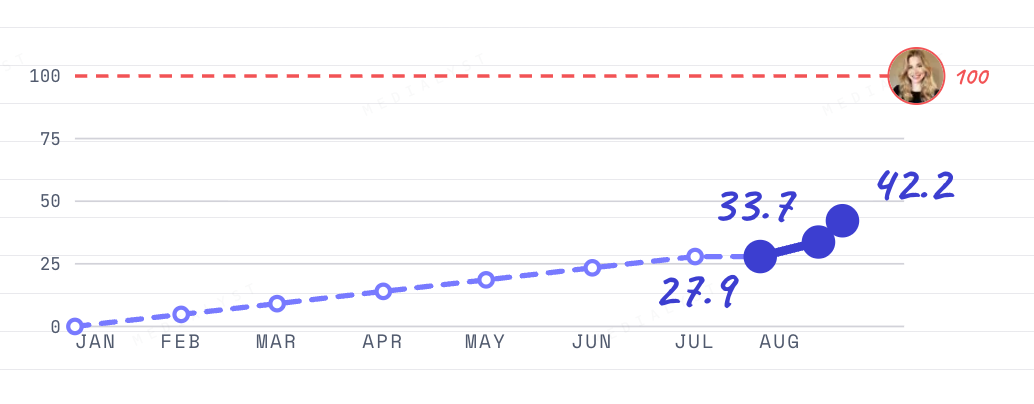
So Carly is on vacation this week. As far as we can tell she is on a beach right now with no internet.
But before she left she did two things:
- She spilled two secrets on making our media database better.
- She agreed we could re-run the same brief this week and just work on our email quality since she's away, but there's a catch.
One condition: we were not allowed to just fix the emails on her list.
That sounds like a small rule. It turned out to be the whole week. Her condition meant the only way to move the number honestly was to fix the entire media database underneath it. That is a much bigger job, and frankly the only one worth doing - because the database is what you actually get.
So we overhauled the entire media database - here's what you should see now:
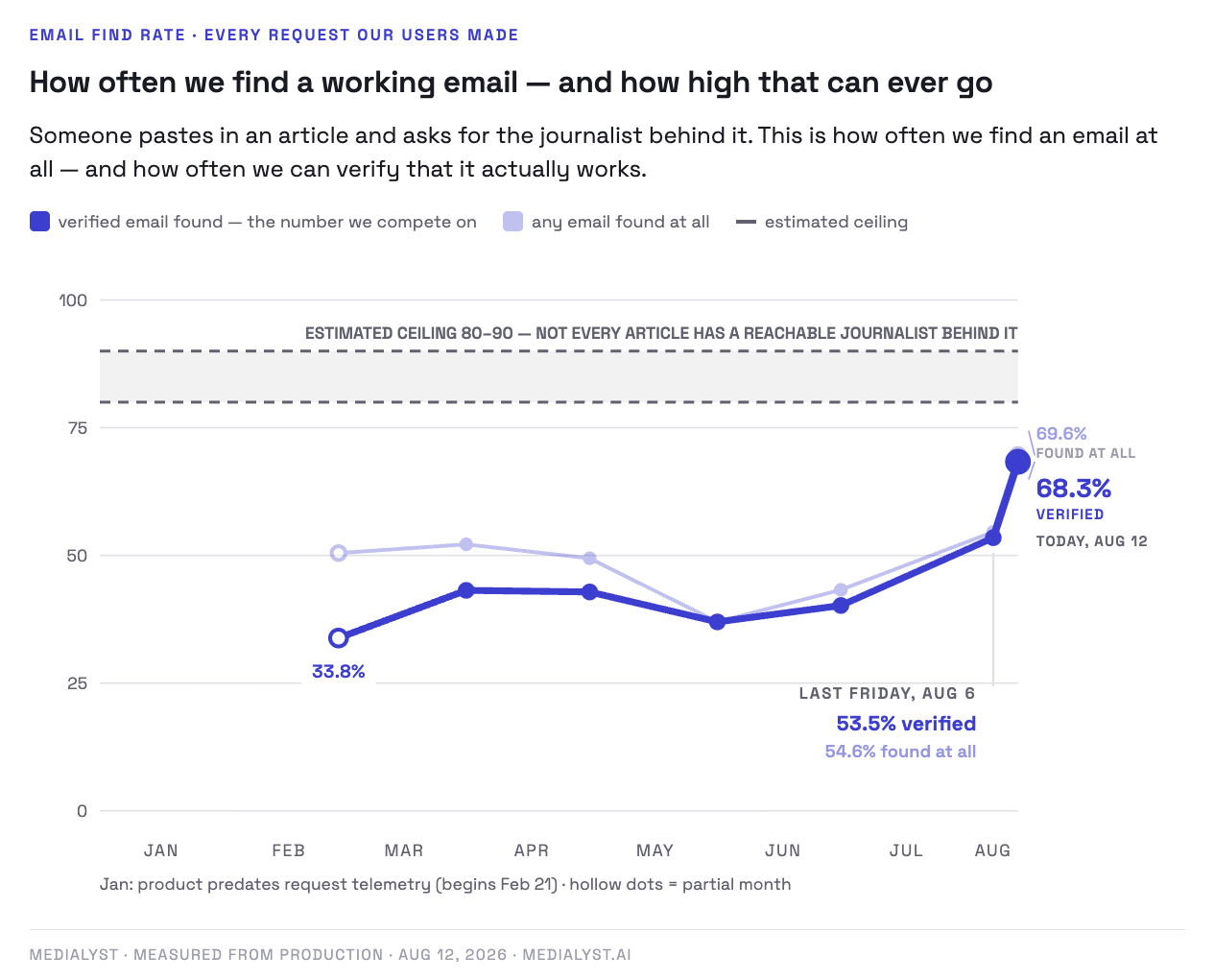
1. More of your lists should come back with an email
Last Friday, 53.5% of requests came back with a verified, deliverable address. Today it is 68.3%. (+14.9 points from last Friday) We think the theoretical ceiling is somewhere between 80% and 90%, because not every news article published has a journalist with an email you can reach.
2. Freelancers stopped being the worst group on the list
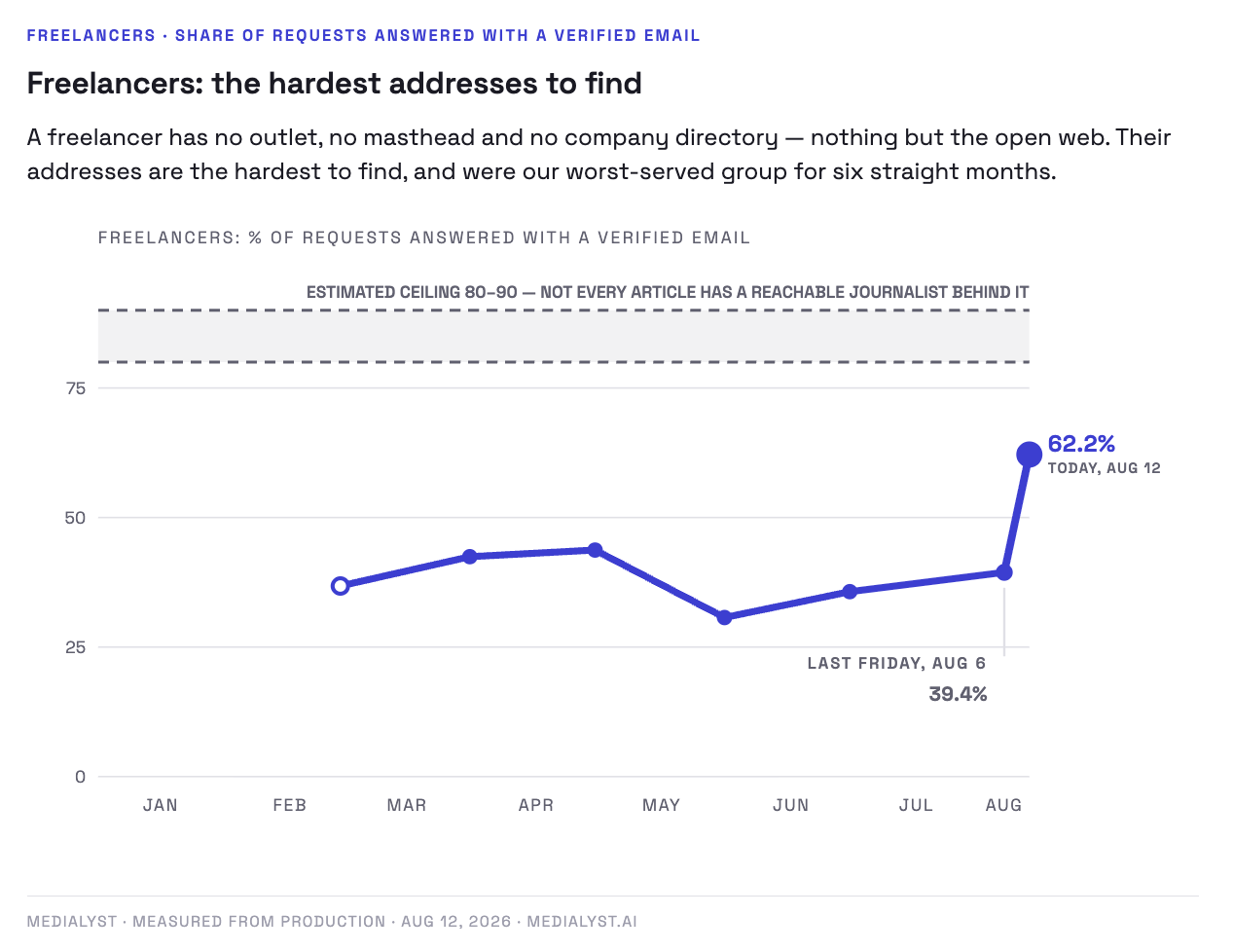
Freelancer emails are notoriously hard to get right, which we learned the hard way. They were our worst-served group for months. Last Friday we could reach 39.4% of the freelancers our users asked for. (About 1 in 8 of the journalists our users ask about is a freelancer)
This week we put a special deep research agent on them - it reads the open web, bylines and social profiles to find the address.
Freelancers are now at 62.2%. (+22.8 points from last Friday)
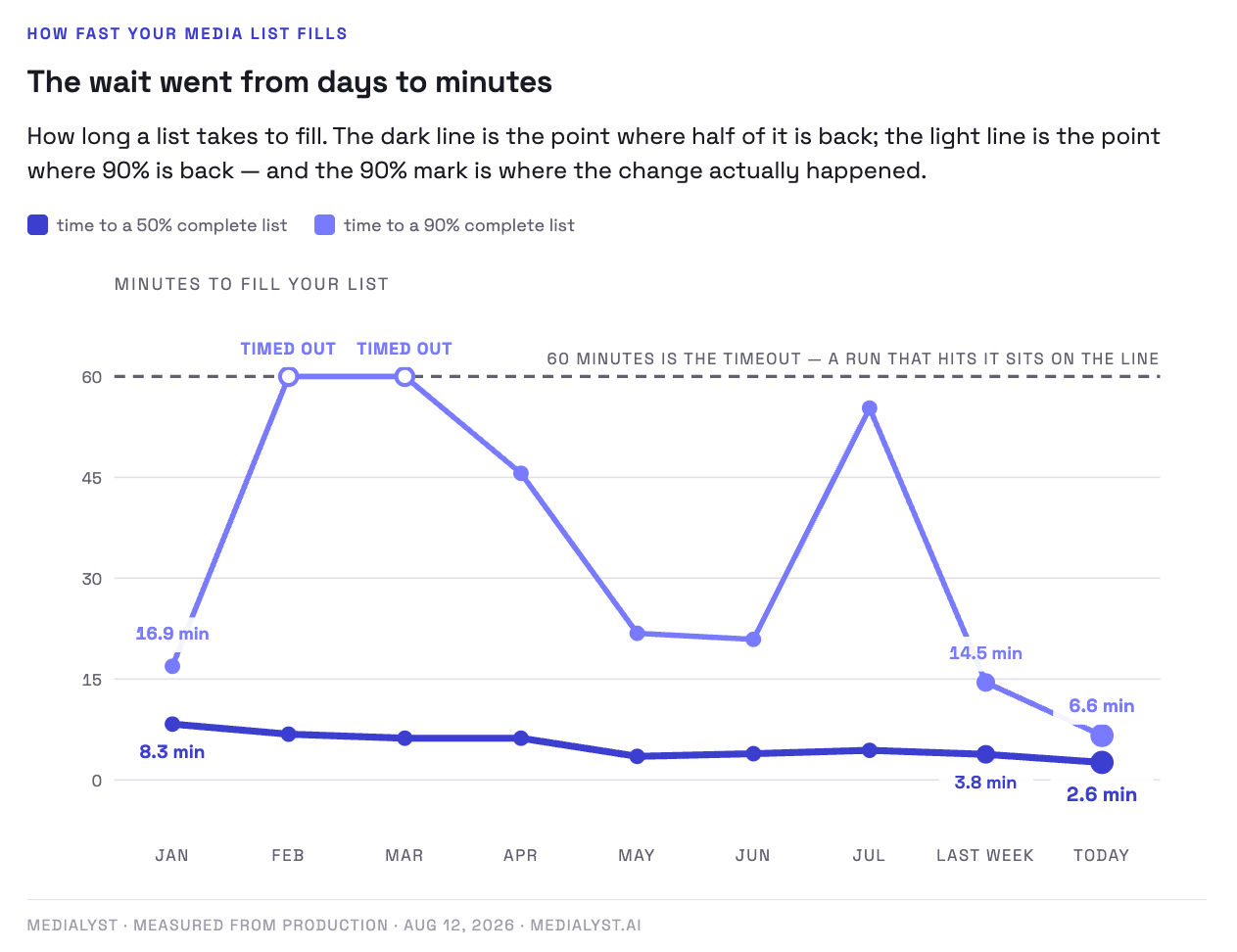
3. Lists build faster - a usable list in 2.6 minutes
Half your list comes back in about 2.6 minutes on a typical build. In January that was 8.3 minutes.
The slowest lists used to run into the 60-minute timeout. Today the slowest lists finishes in 6.6 minutes.
4. The reason it got faster: the database learned
This one needs a bit of explaining, because "it came out of our media database" sounds like the least impressive sentence in this email.
A traditional media database is a phonebook. Researchers type in rows and revisit them on a schedule, so every record starts going stale the day it's written, and you find out which ones went stale when your pitch bounces.
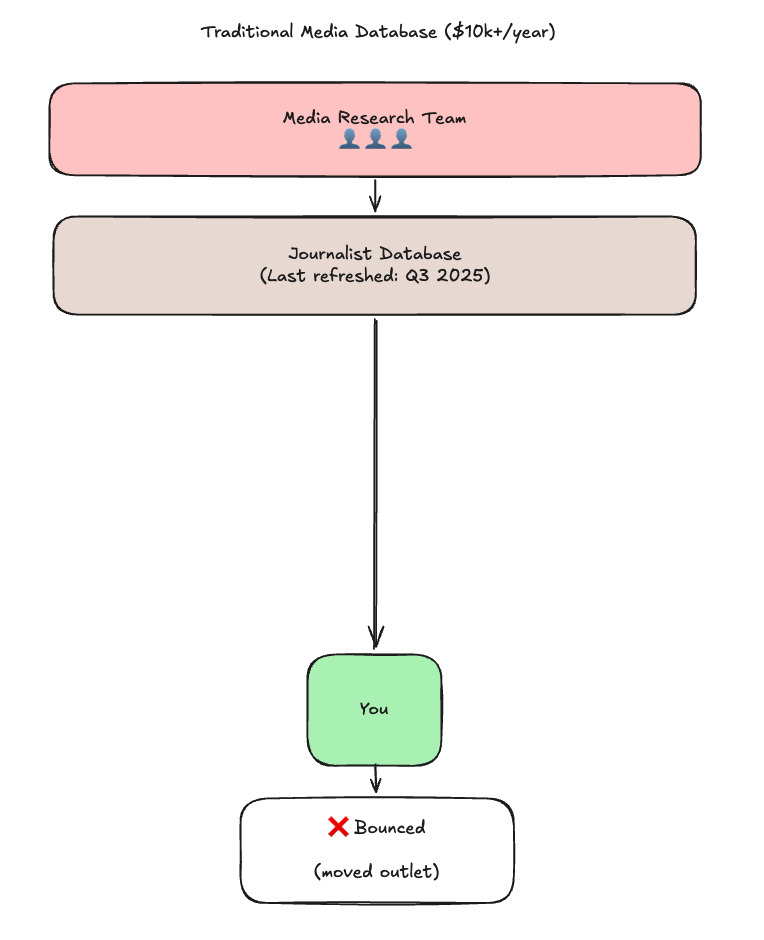
Ours works the other way round. There are no researchers. When you ask for a journalist in Medialyst, an agent goes and does the research right then - reads their recent work, finds the current address, checks it's verified and checks it's actually theirs - and gives you only what it verified.
The database isn't the source - it's only one evidence we use to piece together the journalist profile you actually see.
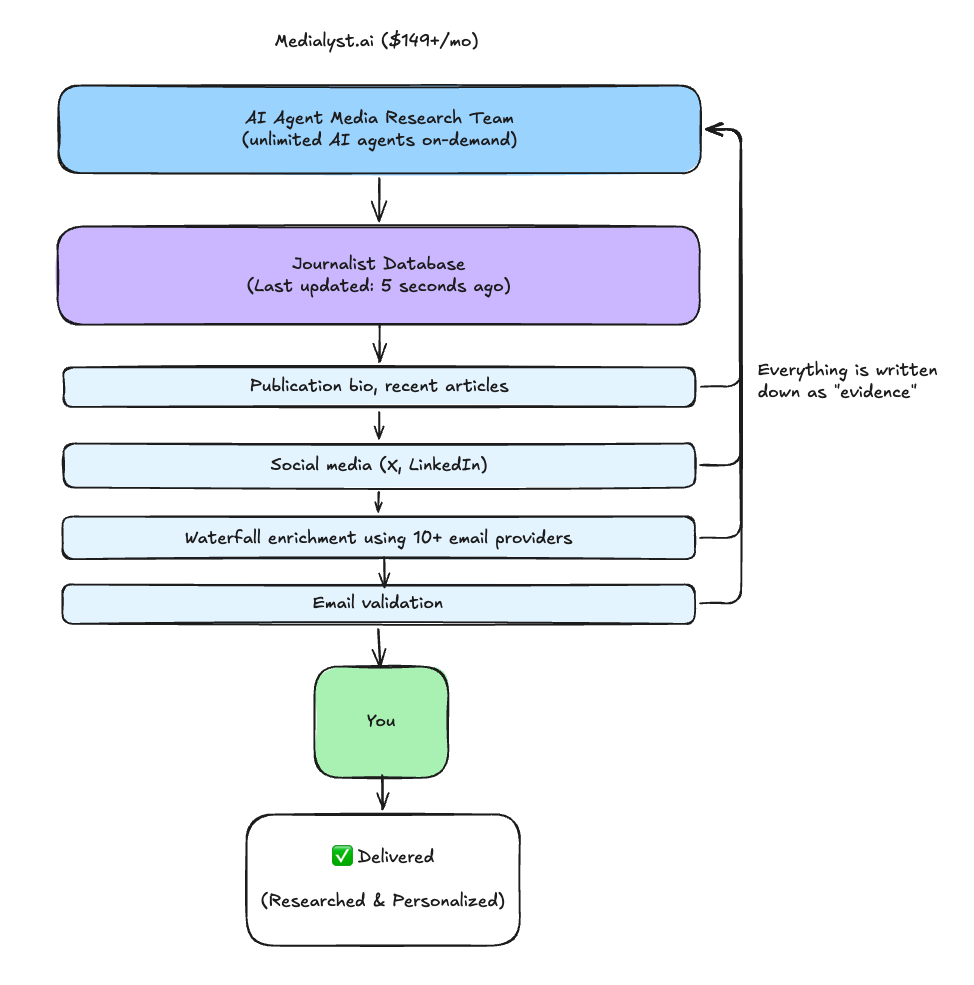
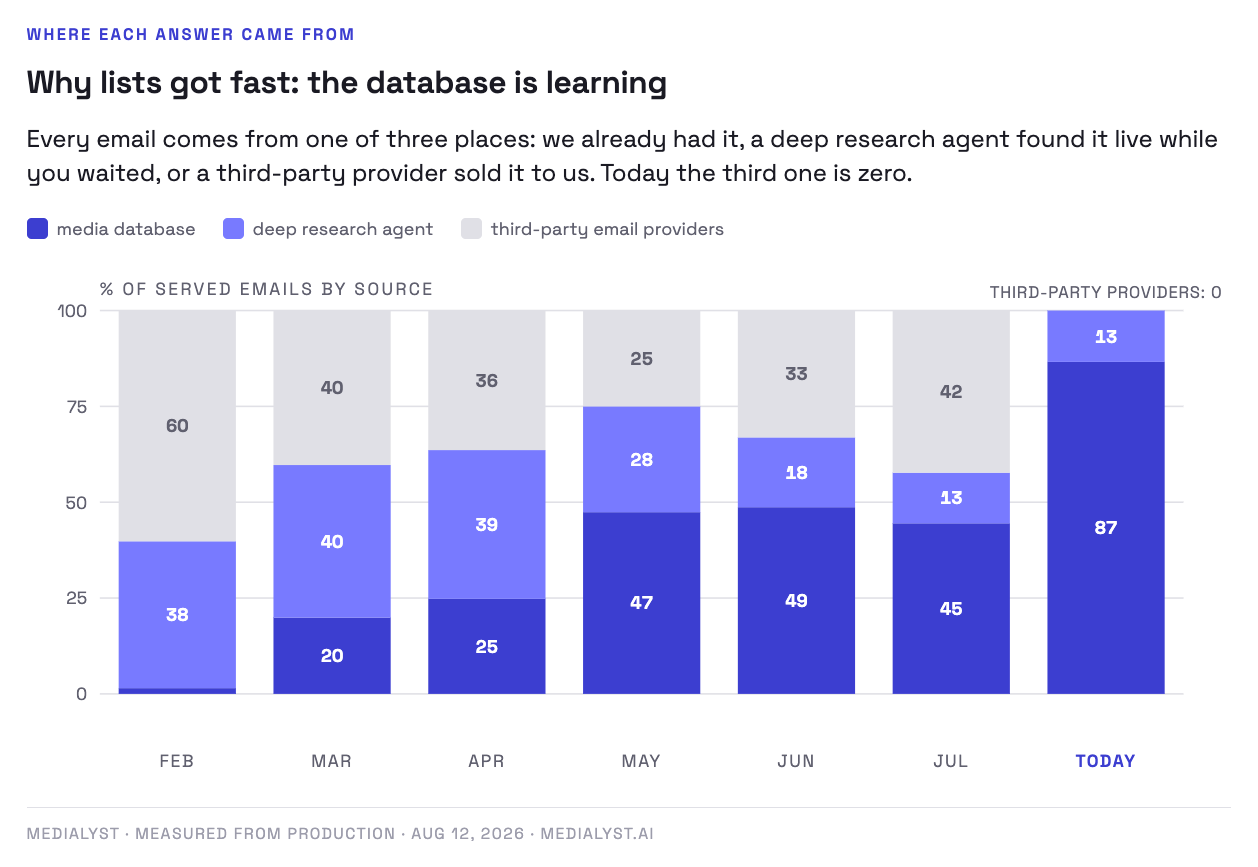
So "it came out of the database" is our best outcome: it means we already did that work for somebody else very recently.
In February almost every email had to be hunted live while you waited. In our measured re-run this week, 86.6% of the addresses we served came straight from the database, the rest were found in real-time by our deep research agents, and we did not need a single lookup from a third-party contact provider - because we already have most emails from popular journalists. (see next section)
I wrote this up back in March, when it was still mostly a theory - How we're building the world's first media database powered by AI agents . This week is the first time we can put a number on it.
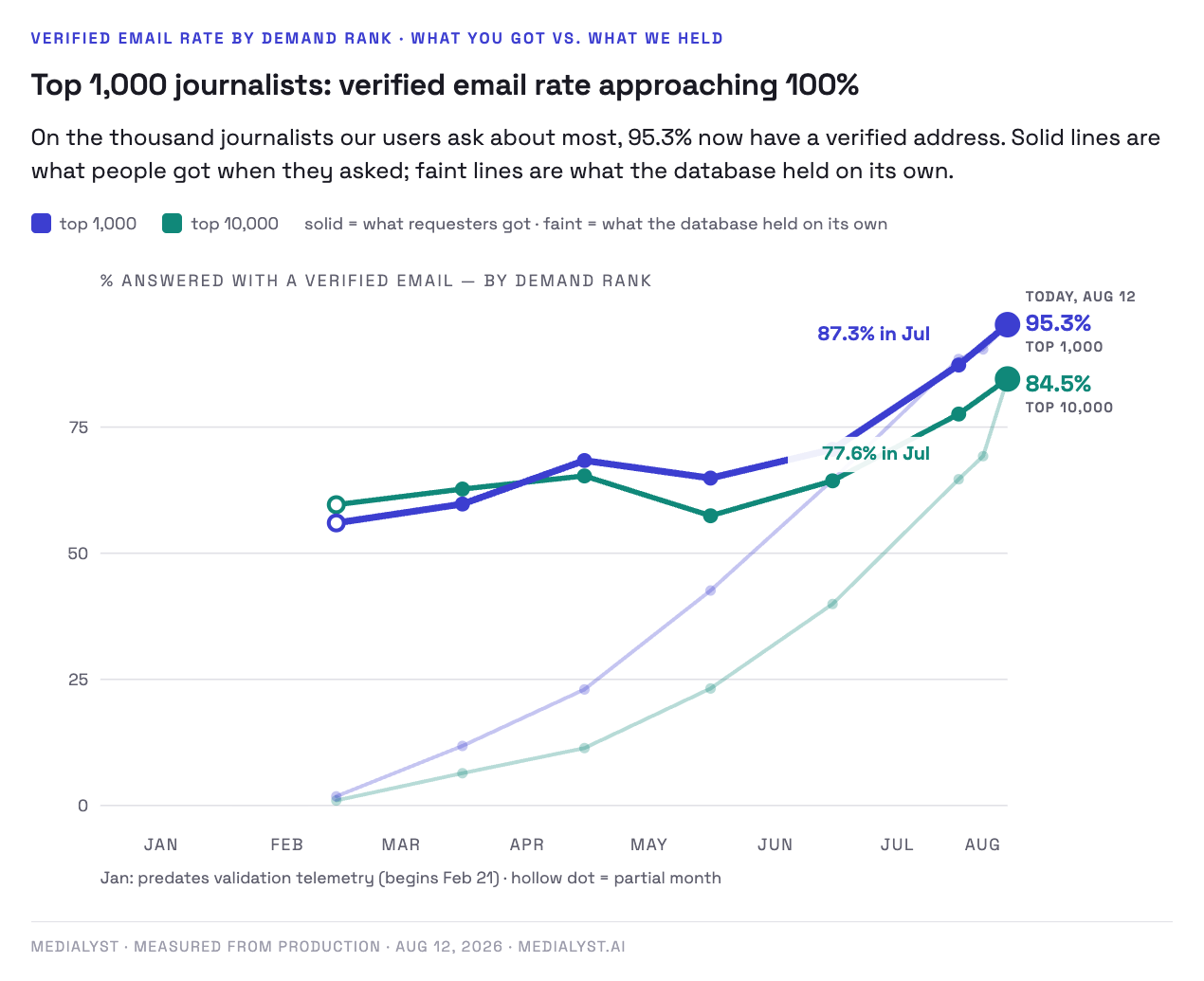
5. We worked out who the top 1,000 journalists are, and now we grade ourselves on them
We ranked every journalist by how often our users actually asked for them over the last 90 days. The top 1,000 and the top 10,000 of that ranking are now a fixed cohort we test ourselves against, and where we put the work to first.
Of the top 1,000 most-requested journalists, 95.3% now have a verified email. Of the top 10,000, 84.5% do.
Everything else we changed to get here
Those five numbers are the outcome. Here's the work behind them that you might notice:
- Journalists can now hold multiple addresses, not just our best guess. Plenty of journalists have more than one working inbox. We used to pick one and hide the rest, which meant our guess was your only option. Now you see the alternates too and choose for yourself.
- We now track journalist moves. We now have a dedicated agent team tracking journalists moves to help keep journalists contacts fresh. We've also opened it up as a real-time journalist-move feed over the API, plug into Claude and you can reach out to the journalists right when they move outlets. (Scale plan only for now - reply if if you want in)
- Non-US journalists work much better. Finding UK and other international journalists are now much improved.
- Every address has to prove it belongs to that person. Until this week an address could be served for being verified alone. Now we've put in some additional checks for evidence it belongs to this person at this outlet first.
- 53 other changes I won't bore you with. This has easily been our most productive week since January.
→ Build a list and see the difference yourself.
The future
The bet behind all of this is that a media database maintained by agents beats one maintained by a team of people. This week is the best evidence we've had that the direction holds. Every miss we dug into turned out to be a software defect.
Software defects get fixed.
And they get fixed for everyone, at once, with the whole class of records like it. That is the part that compounds, and it is why we expect this number to keep moving.
The other half of the bet is the economics. Media databases are still sold the way enterprise software was sold in 2005: book a demo, get a quote, negotiate for four weeks, sign for a year. And a lot of what you pay for is that apparatus itself - the offshore research team, the sales rep, the negotiation, the account manager - not the data. Cut it out and the same product costs less. So our pricing is on the website. Nobody should have to sit through a sales call to find out whether this works.
That is also why we publish the score, the numbers, even when it's ugly. If we are asking you to trust a database without a sales call, you should get to see exactly how good it is.
42 out of 100 today. We'll keep going.
— Elvis Sun, Founder at Medialyst.ai
P.S. Next week we'll work on finding more journalists that Carly found. So far we found 7 of her 43. Finding the rest is the problem we solve next week when Carly's back.
(Her POV right now)

Score, methodology, and history: medialyst.ai/carly-score