PR intern → 25 PR associate
Medialyst expanded its agent capacity, added PR-specific search craft, recent coverage reading, and richer outreach context so media lists build faster and feel closer to a PR associate.

Hey there,
Four things landed this week. Each one moves the product somewhere it couldn't go before.
⚡ Your agent team expanded. 25x.
This week we expanded our number of agents by 25x. Making a big media list used to be a coffee break (still not days though), now they're closer to refilling your water:
-
Typical media list: now ~5 minutes, down from ~16.
-
Largest media list build since the change: 750 journalists, completed in 6 minutes. A comparable run two weeks ago took 52 minutes to finish.
-
Per-journalist wait dropped from ~13 minutes to under 20 seconds. Daily average across all customer workspaces.
-
No more stuck-forever cells. The ones that used to get stuck are now gone. Tail latency collapsed by over 99% especially during peak hours.
And here's our north star again:
Find all relevant journalists in under 60 seconds.
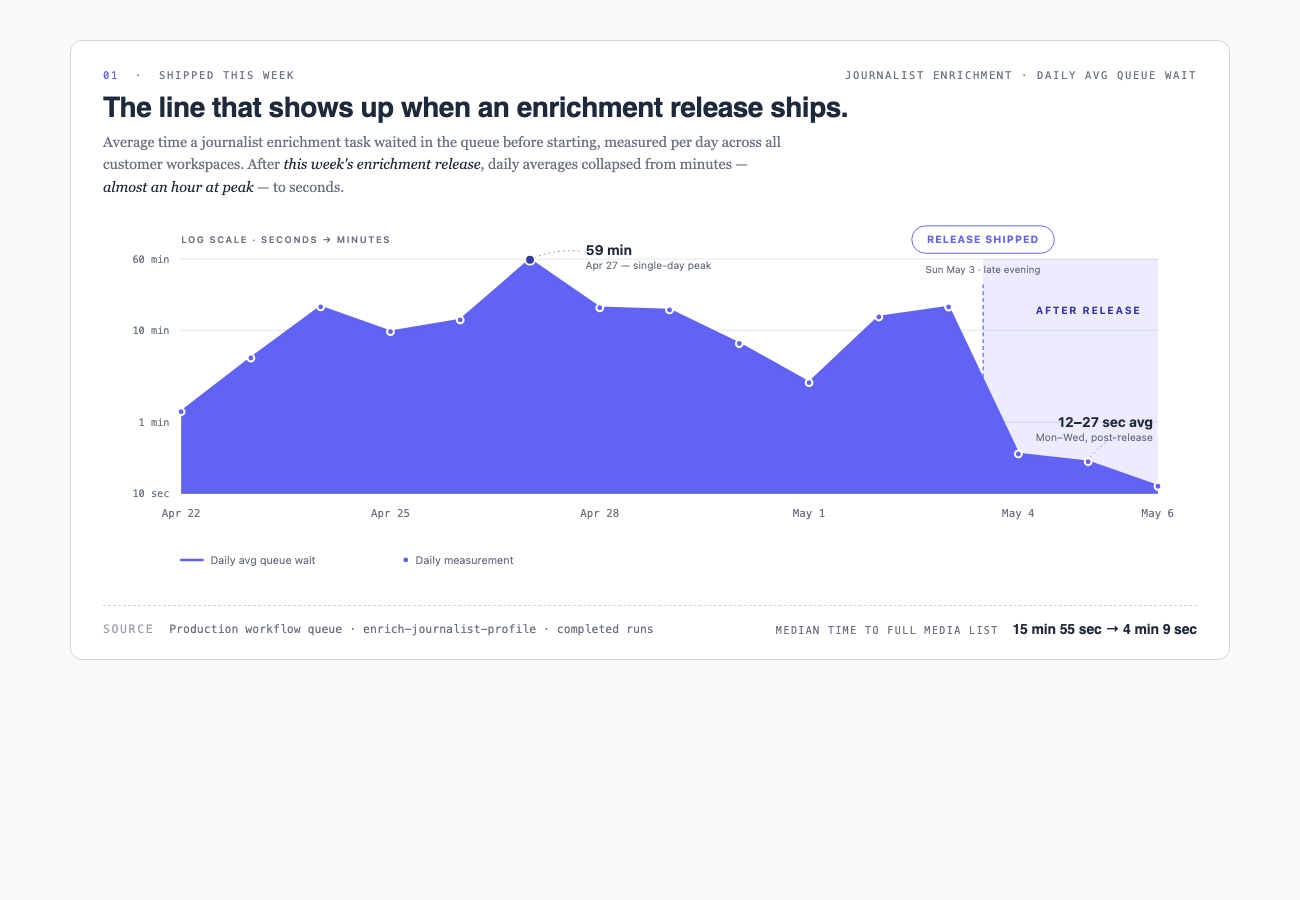
Behind the scenes: we spent the prior weeks building observability into the workflow stack - real metrics on everything the AI agents do, every page view, every retry. That visibility is what let us safely turn the dial up.
If you've been generating large lists and waiting around for enrichment to catch up - try one again today. The difference is hard to miss.
🧠 PR intern → PR associate
"My new favorite PR intern," is how Rita Liao (ex-TechCrunch) describes Medialyst.
So we asked ourselves, how do we graduate the AI to a "PR associate"? Then we taught the agent three new things to start:
- PR craft, baked in.
A few patterns we used to tell the agent in long briefs are now built into how it searches:
-
The insider tips. Agent now knows to use PR-specific keywords "expert warned" or "study reveals" to surface articles that have expert quotes or studies.
-
Tier-1 site-pinning via site:techcrunch.com. Top outlets get searched directly so they don't get drowned out by SEO chum.
-
Time-bounded recency via after:2026-04-15. When freshness matters, the agent fences the window instead of hoping fresh articles rank high.
- Read what's recent, not what's archived.
The agent now plans with article-recency control — targeting recent articles when a brief smells current (a launch, a controversy, a trending angle), and leaving the window wide open when the topic is evergreen.
- Research first. Then search.
Before firing keyword queries, the agent does a quick discovery pass to surface the key entities — the people, products, and outlets actually shaping the conversation. It was already doing this on some runs. The ones where it did beat the ones where it skipped by a wide enough margin that we made it required. Research becomes the search plan, not the other way around.
We're not stopping here. If there's a research move you do by hand that you wish the agent did automatically - hit reply we'll add it. Otherwise our research team (also AI) will keep hunting for PR knowledge and bake them into the agents.
🔬 We audited 1000s of conversations. Then rewrote the agent.
This week we (the AI agents on our engineering team mostly) also sat down with 1000s of conversations people had with Medialyst Agent over the past month - opened them up, looked at where the agent shone and where it tripped.
Then we rewrote the entire system prompt, the length of about four press releases stacked end-to-end, about what we found so the agents can perform better.
Most notably, three habits we emphasized on:
-
Act through the table, not chat. Requests for journalists, contacts, or exports route through real media list table actions instead of being invented in the chat window. This alone improves results notably.
-
Acknowledge what it doesn't know. Email-client rendering quirks, OAuth specifics, hosting providers — explicit "I'd rather not guess" zones, instead of plausible-sounding hallucinations.
-
Verify before claiming. Statements about what's in your table now trigger a fresh check first, instead of paraphrasing from memory.
The agent's task completion rate has noticeably climbed over the last few days. Give it a spin yourself and the agent should feel sharper.
🪐 New home page
For the longest time, medialyst.ai didn't look like a real home page. That was on purpose — every spare cycle went into making the product better for the people already using it, not into polishing the front door for people who weren't.
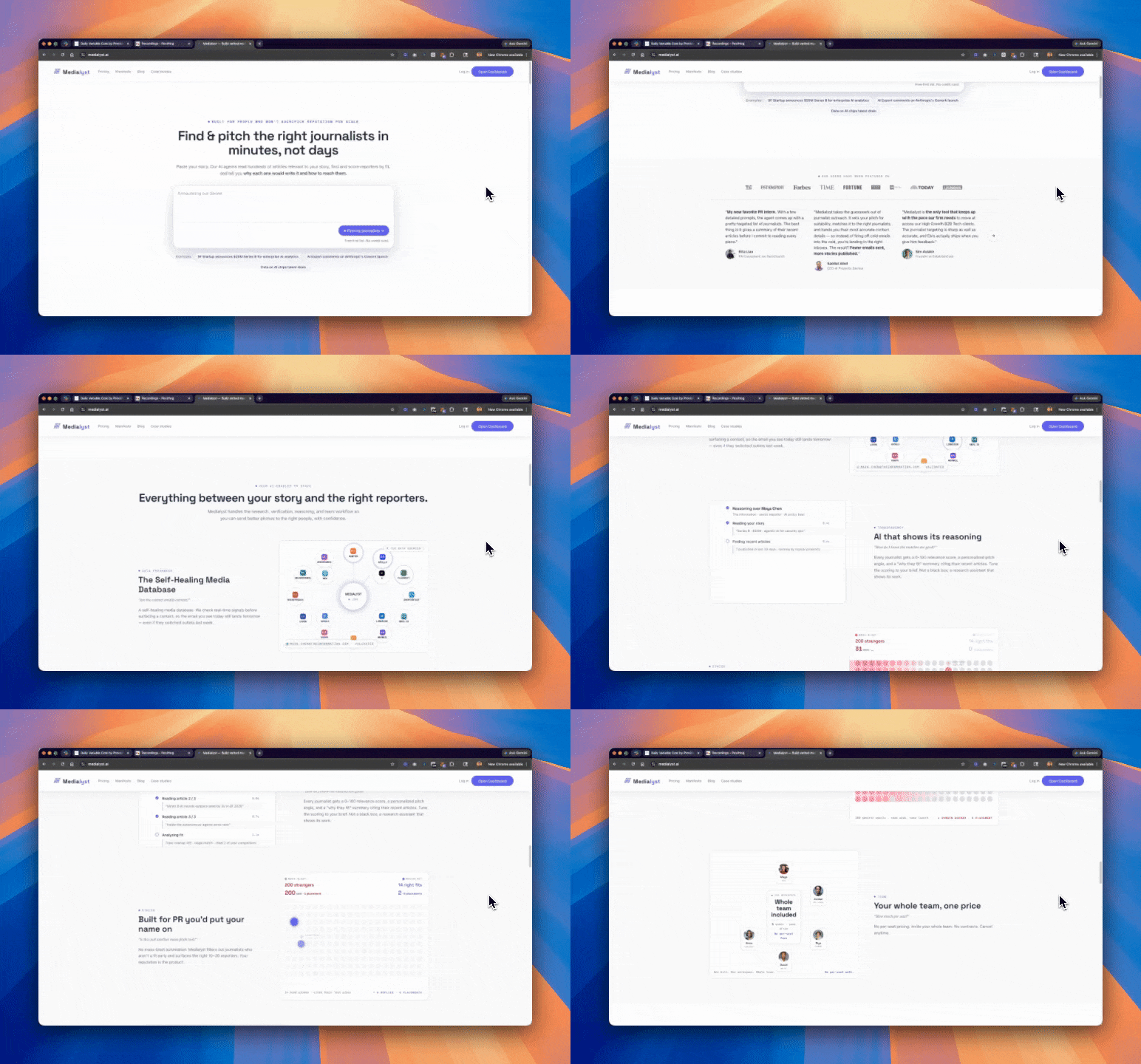
This week we finally got around to the front door and redesigned the entire thing, with real testimonials and real case studies, plus a comparison matrix that lays out where we sit vs. legacy databases, which I'm sure the Cision and Muckrack executives reading this will love :)
If you ever needed to show your boss we're a serious product — now you can.
Also shipped this week
-
More candidates per brief. The number of journalists found should now more closely match your target. Need more? Just ask the AI "Find more journalists".
-
Hardened cell retry. When an enrichment provider misses, cells retry through alternate sources instead of stranding silently.
-
Credit meter drilldown. The credit popover is rewritten for clarity and now links straight into the usage breakdown so you can see exactly where credits went (thanks Mirjam for the feedback!)
-
Free tier: planning article cap removed. Free accounts get the same planning volume as paid. Now limited by credits only.
That's the week. Thanks for reading this far and we already have some exciting stuff for you in the next one.
— Elvis Sun, Founder at Medialyst